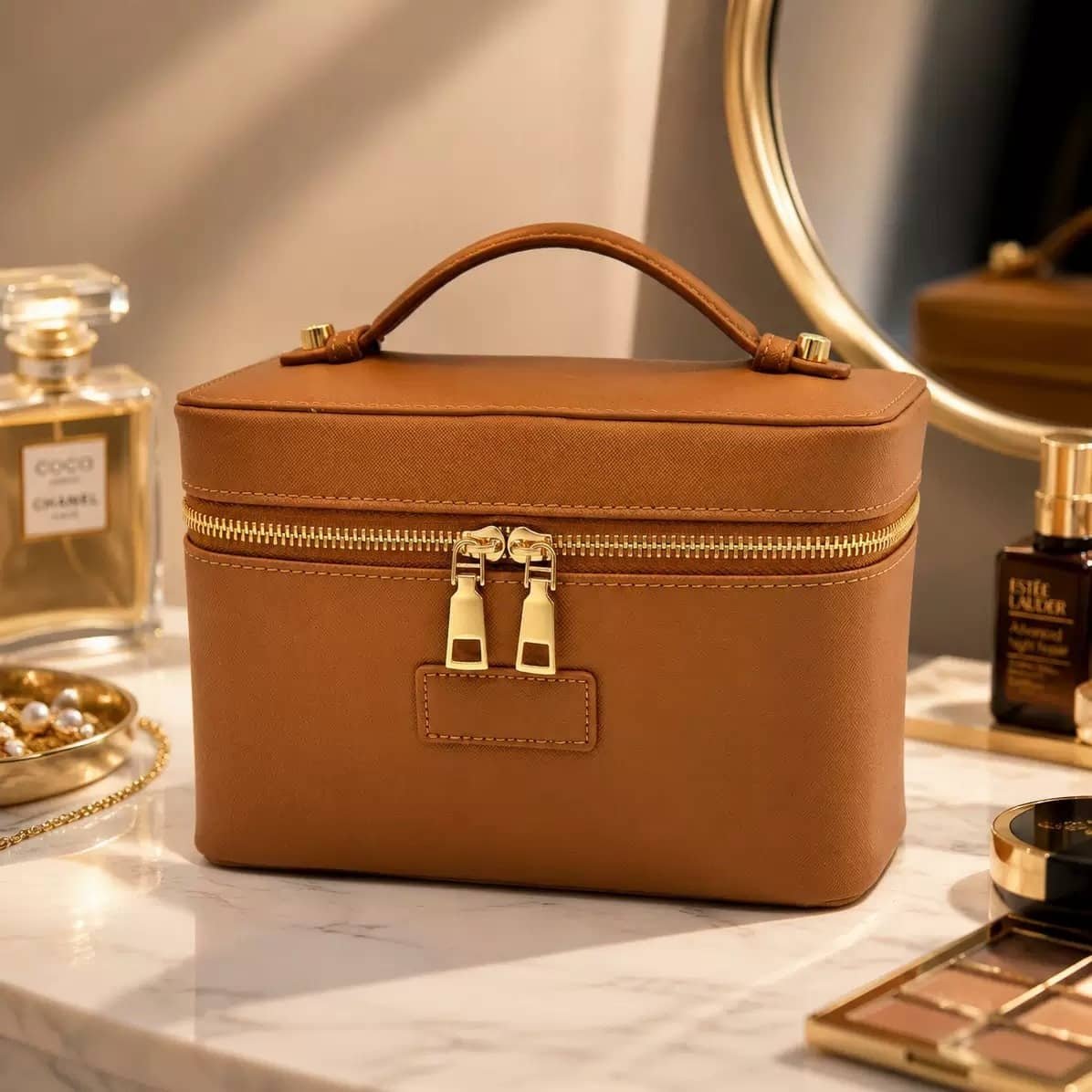
A soft cosmetic pouch only looks like a box once you fill it. Empty it out and it collapses into a flat panel of fabric on the shelf. Brands usually discover this after the photography shoot, or after the first container lands and the cases look nothing like the sample.
A premium structured vanity case has to hold its silhouette when it is empty — on a shelf, in an unboxing video, on a hotel counter after three weeks of travel. That is not solved by adding more foam at the end of the line. It is decided in the base board, the sidewall lamination, the order the lining goes in, and the tolerance held on the pattern.
This guide covers the four things that decide whether a structured vanity case works — materials, internal construction, interior layout and OEM manufacturing — for the product development manager who has to sign off a sample, not for a shopper.
1. What Is a Premium Structured Vanity Case?
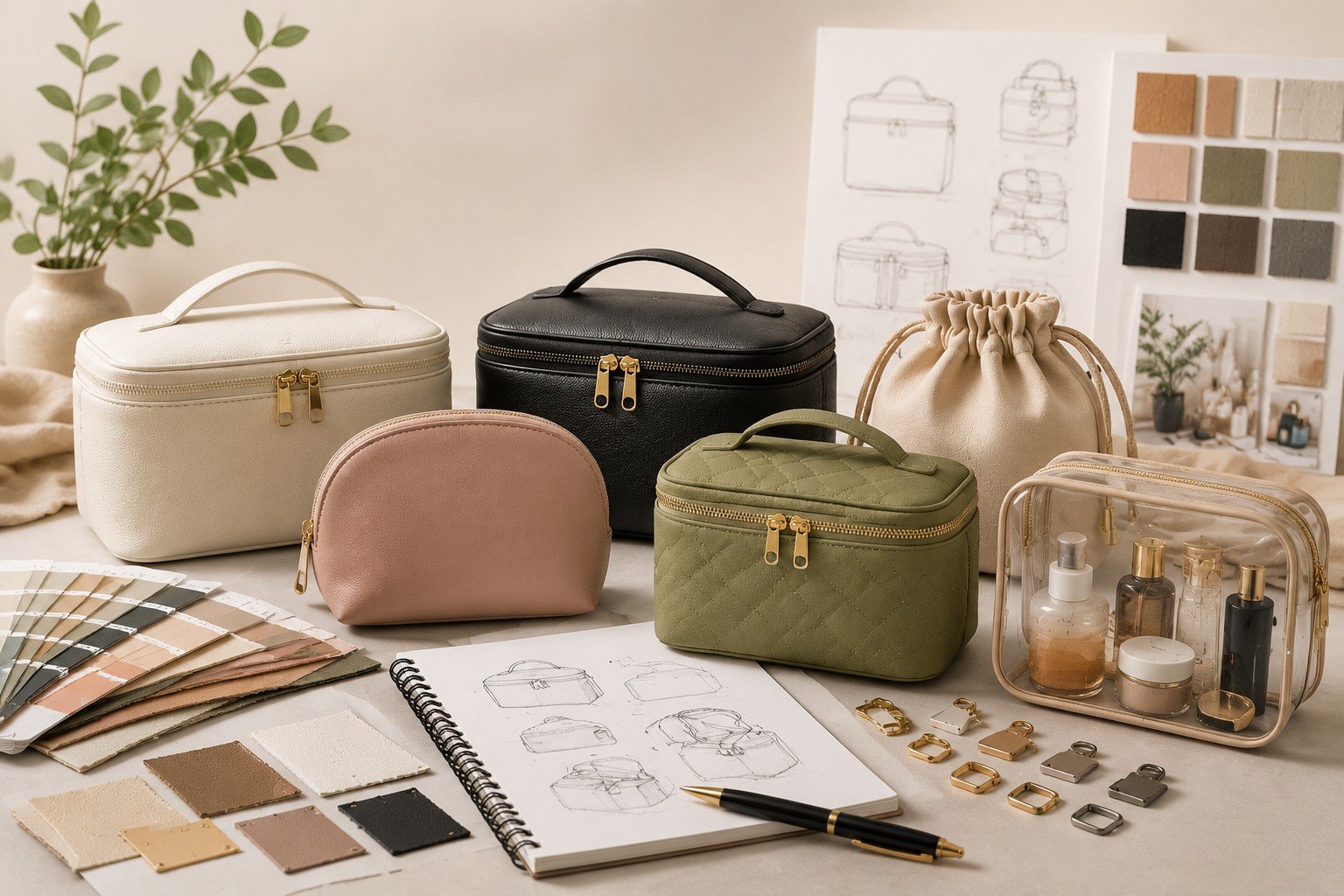
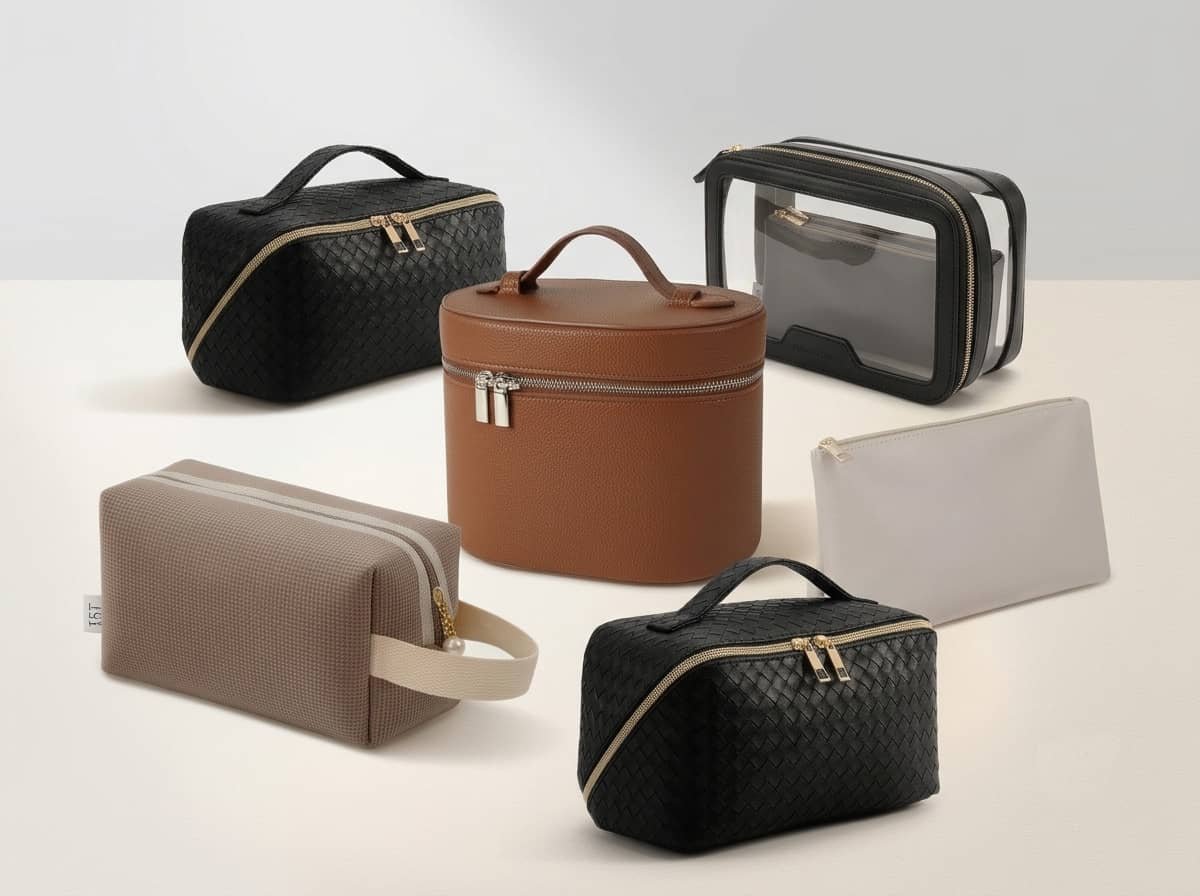
A vanity case is a box-form cosmetic carrier: a defined base, upright sidewalls, and a full-perimeter opening closed by a zip or a lid. Structured describes where the shape comes from. In a regular cosmetic bag the fabric drapes and the contents create the volume; in a structured vanity case the volume is built in — board-reinforced base, laminated sidewalls, and a lining sewn to the shell under tension.
That buys three things: dimensional stability (a 200 × 140 × 120 mm case is still that size after sea freight and six months in a warehouse), repeatable retail presentation across a listing, a lookbook and a trade show, and protection without a rigid outer carton.
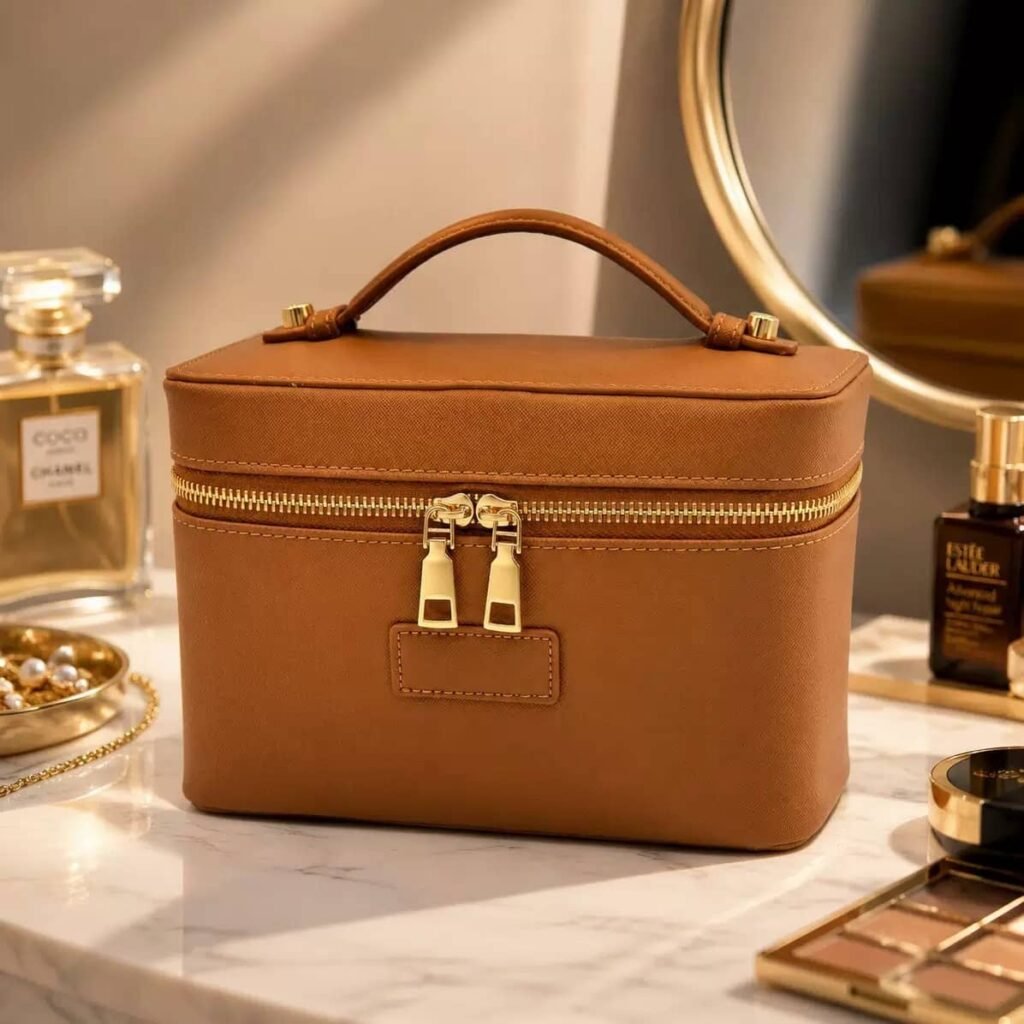
Structured Vanity Case vs. Regular Cosmetic Bag
| Specification | Regular cosmetic bag | Structured vanity case |
|---|---|---|
| Form when empty | Collapses | Holds shape |
| Source of shape | Contents and fabric drape | Board, foam and lining tension |
| Base | Single layer of fabric, sometimes a soft insert | Reinforced board, 1.5–2.5 mm, wrapped and stitched |
| Sidewall | One or two layers of textile | Laminated panel: outer + foam + reinforcement + lining |
| Interior | Open cavity, maybe one zip pocket | Configurable dividers, brush holders, elastic loops |
| Unit weight | 80–150 g | 280–650 g depending on size and board |
| Typical use | Daily carry, samples, subscription boxes | Travel storage, gift sets, professional kits, retail display |
Common Applications
- Luxury beauty collections, where the case is part of the product rather than the packaging around it.
- Travel makeup storage, for consumers who expect the case to stand on a hotel counter.
- Professional makeup organization, for artists who re-pack daily and need dividers that survive it.
- Premium gift sets and top-tier loyalty rewards built around festive and Mother’s Day programmes.
2. Materials Used in Premium Structured Vanity Cases
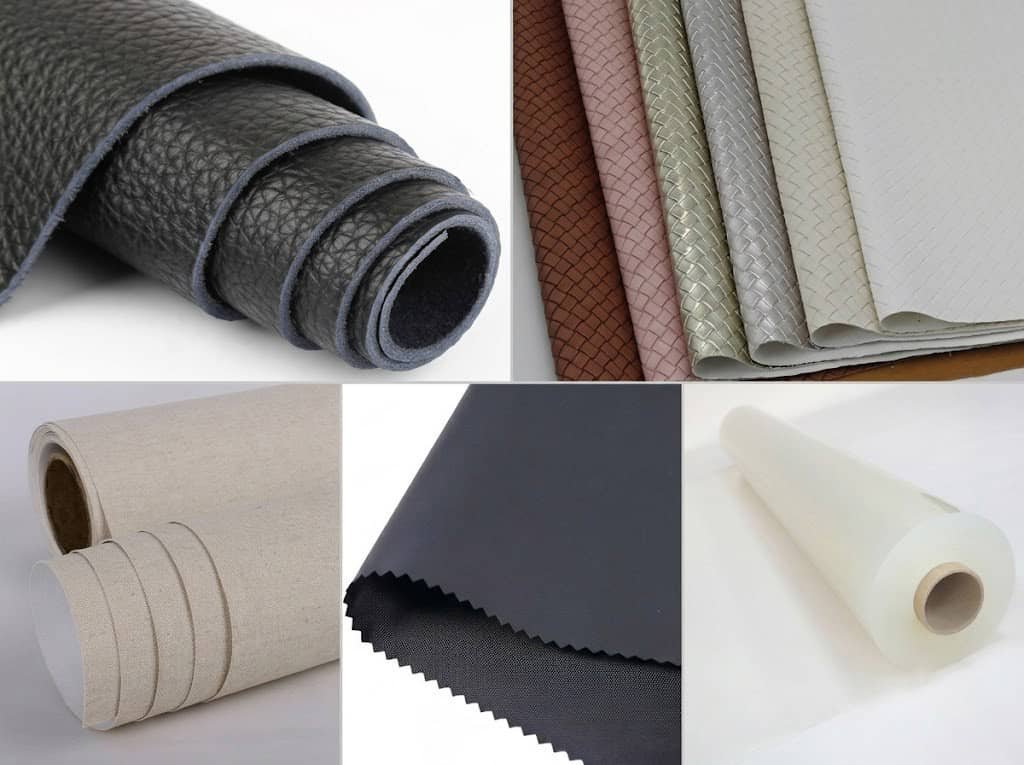
Every material decision is a three-way trade between appearance, weight and consistency. A leather that photographs beautifully may lose 20% of cutting yield because the grain must be matched across panels. A PU that sews easily may crack at the corner radius after 5,000 flex cycles.
Genuine Leather
Full-grain keeps the original grain and takes a patina; top-grain is lightly sanded and more uniform, usually better when a case has to match a printed colour reference. Outer shell thickness sits between 1.1 mm and 1.6 mm — below 1.0 mm the corner radius shows the board edge, above 1.8 mm the case gets heavy and the seam bulk is hard to close.
Grain variation is the real production issue: panels must be matched for grain size and shade before cutting, and yield drops accordingly. This is a flagship material, rarely right for a 3,000-piece promotional run— see vegan leather vs genuine leather for the cost comparison.
Premium PU Leather
PU is where most brand programmes land, because it offers the widest colour and texture range at a workable cost. Four parameters decide whether a PU is good enough for a structured case:
- Thickness, usually 0.8–1.4 mm. Under 0.7 mm it telegraphs the board through the surface within a season.
- Backing. Woven resists stretch and holds shape; non-woven is cheaper but stretches under tension — the wrong property for a panel that must stay flat.
- Abrasion resistance. 20,000 Martindale cycles is a basic fashion grade; a travel case should be specified at 50,000 and above.
- Colour consistency. Approve a lab dip against a Pantone reference and keep a retained standard at the factory, or a reorder eighteen months later will not match.
Microfiber Leather
Microfiber leather uses a non-woven microfiber base impregnated with polyurethane. At 1.0–1.4 mm it behaves closer to genuine leather than a coated PU does, with a denser hand, better flex resistance at corners, and far more batch-to-batch uniformity than a hide — the usual choice when a brand wants a leather hand with predictable colour.
Lining Materials
Lining is not a cosmetic detail. It governs cleanability, abrasion resistance and, in a structured case, a measurable share of the rigidity — a lining sewn in under tension pulls the shell square.
| Lining | Weight / type | Best for | Watch out for |
|---|---|---|---|
| Polyester | 210D woven | Workhorse for most programmes | Static; shows light marks |
| Nylon | 190T–210D | Better tear strength, softer hand | Higher cost, narrower colour range |
| Velvet | 180–220 gsm | Gift sets, jewellery-adjacent products | Sheds; traps powder |
| Microfiber | 0.6–0.8 mm | Premium touch, scratch resistance | Cost; needs sharp needles |
| Easy-clean coated | PVC or PU backed | Liquid foundation, loose powder | Stiffer; harder to turn at corners |
3. How Is a Structured Vanity Case Built?
This is where quotes diverge, and where two factories can appear to price the same drawing very differently. The drawing rarely shows the parts that cost money.
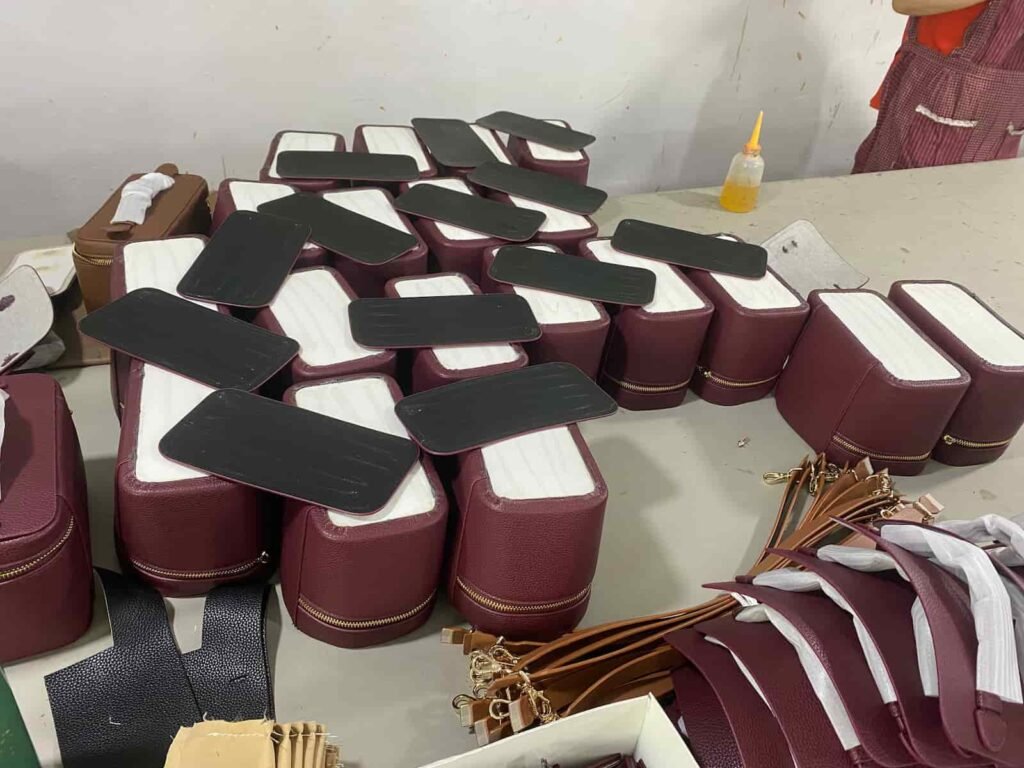
Base Board Reinforcement
The base carries the whole load and is the first thing to fail. Three materials are common: grey board at 1.5–2.5 mm, PP honeycomb for a lighter and moisture-resistant base, and high-density PE sheet where the case must survive being dropped. A workable rule is a board thickness of roughly 1% of the longest dimension, with a floor of 1.5 mm: a 200 mm case gets 2.0 mm, a 350 mm case needs 2.5 mm plus a centre rib.
How the base joins the sidewall matters as much as the board. In a base seam construction the board is wrapped in the outer material and stitched to the sidewall, leaving a visible line around the bottom — strong, but it must be reinforced at all four corners or the seam pulls. In a turned construction the base sits inside the sidewall, which hides the seam but limits board thickness.
Bottom bulge is almost always board too thin for the span, no corner support, or a base seam stitched without reinforcement tape.
Side Panel Structure
A single-wall panel is outer material plus lining. It is fine up to about 150 mm of height, and it is the most common reason a vanity case looks tired after a month of use — above 200 mm the panel bows outward under its own weight once the zip is closed.
A double-wall panel adds foam and a reinforcement insert between outer and lining, usually 0.8–1.5 mm PE sheet or 1.0 mm grey board, die-cut 2–3 mm inside the seam line so it never presses into the stitch. Buyers never see this inset and always feel it — a panel cut to the full seam line stiffens the case but leaves a hard ridge that ruins the corner. We load samples with 3 kg and reject any panel deflecting more than 4 mm.
Foam Padding and Structural Support
Foam does three jobs: it fills the panel so the case reads as solid, it absorbs impact before contents reach the shell, and it hides the board edge so the silhouette stays soft rather than boxy.
EPE at 3–8 mm and 30–40 kg/m³ covers most programmes; EVA at 5–10 mm is firmer and better where a wide panel must hold shape. Thickness and hardness must match panel size, board stiffness and outer material — this is not a “more is better” variable. Too much and the corners wrinkle because the material has nowhere to go; too little and the board telegraphs through the face. A 45° chamfer at the panel edge fixes the first case.
Lining Construction and Corner Finishing
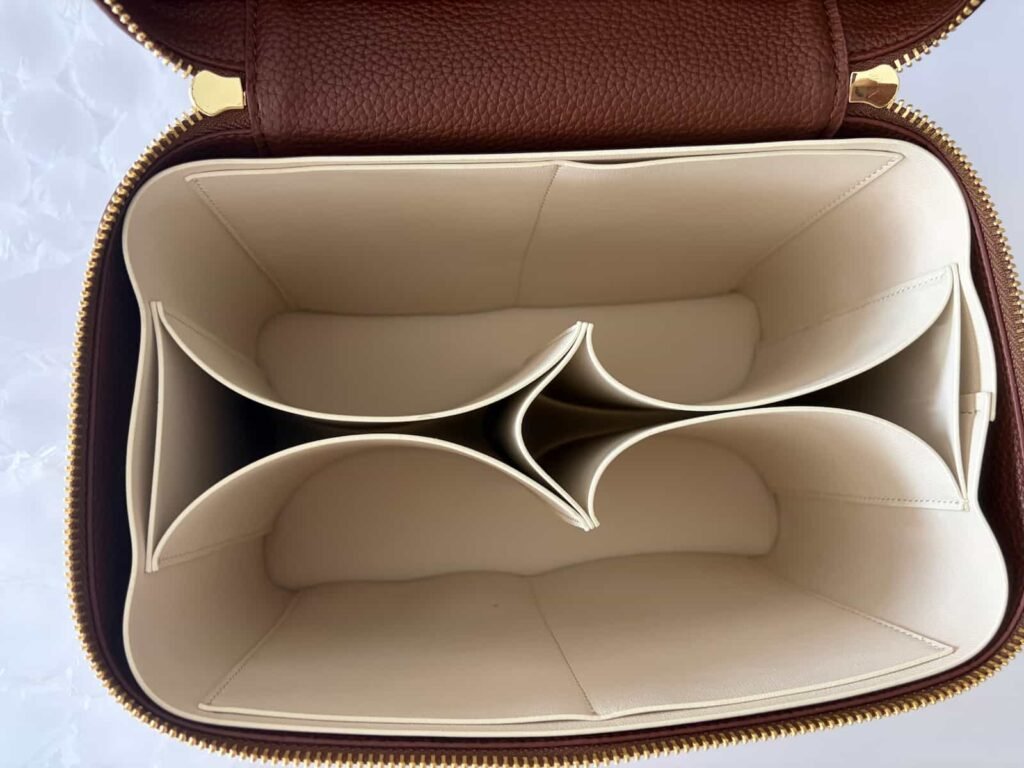
The lining is cut to its own pattern, usually 1.5–2 mm smaller per side than the shell, so it sits under tension without puckering. The reliable method is bag-in-bag: lining sewn to the zip tape first, shell assembled separately, then the lining dropped in and closed at the base. Doing it the other way round is faster and leaves a loose base lining.
Corners declare a case’s price point. Darts beat pleats on tight radii — on a 25 mm corner, two small darts work better than one large fold every time. The check belongs on every sample: run a finger along the base lining, because any bubble over about 1 mm telegraphs through the base panel within weeks.
Zipper Installation and Edge Finishing
A #5 nylon coil is standard for this product class; #8 resin is used where the opening takes load. Metal teeth look better and are the wrong choice on a curved opening.
Curved zips are the hardest single operation in a structured case. The tape has to be pre-shaped, the stitch length shortened through the radius, and the seam allowance notched so the curve does not pucker. Most problems blamed on a bad zipper are a tape that was pulled rather than eased.
Binding tape of 12–15 mm, folded and stitched at 8–10 stitches per inch, gives a clean edge — below 7 the binding drifts, above 12 the material perforates. Slider attachment should hold 8–10 kgf, because a slider that separates in the field is a return, not a repair.
4. Interior Organization and Functional Design
Interior layout is a development decision, not a decoration decision, and it is the most common cause of an extra sample round.
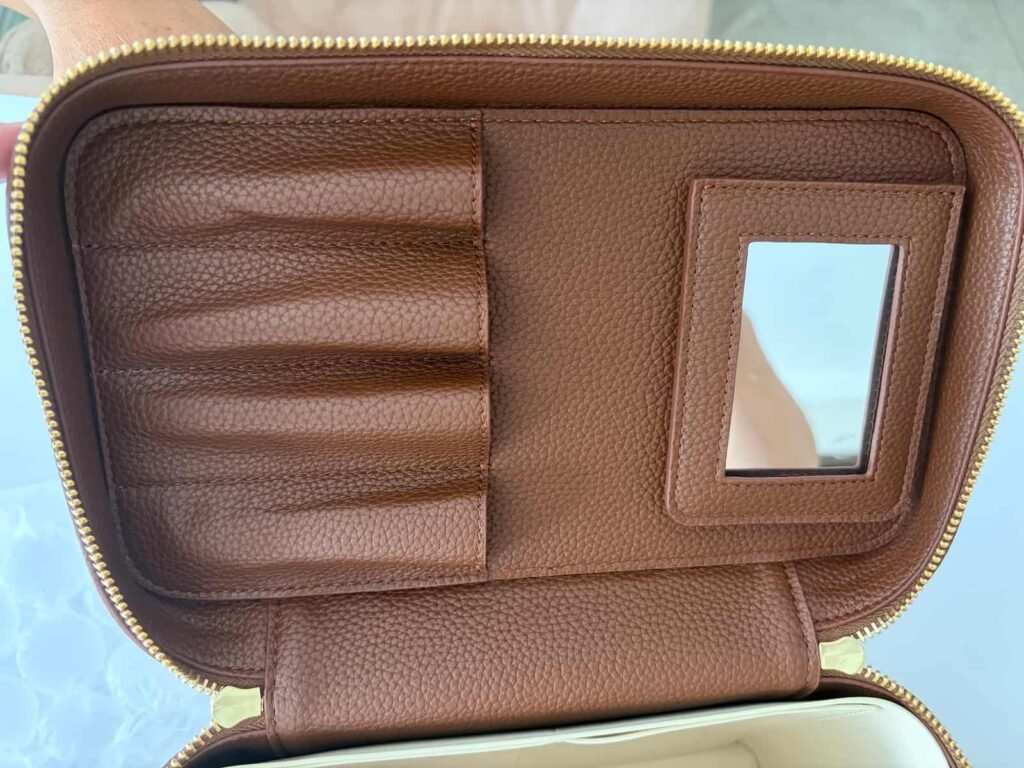
Removable Dividers
Velcro-seated or zip-in dividers let one case serve several SKUs. A removable divider needs a positive seat — a stitched channel or a full-length Velcro strip — or it migrates and the compartments collapse in transit.
Makeup Brush Holders
Usually a row of elastic loops over a padded flap, or slots in a separate roll. Loop diameter must match the brush bundle, not the shaft: a 25 mm loop holds a powder brush and nothing wider.
Elastic Straps and Mesh Pockets
Elastic is for small, light, frequently moved items — pencils, sharpeners, sachets. Mesh is for flat items and visibility. Both should sit clear of the divider channels.
Mirror and Additional Compartments
A mirror can be stitched into the lid lining or held in a card slot, and that choice sets the opening angle the case must support: a stitched mirror limits the lid to roughly 100–110°, a slotted one allows a full fold-back. Clear PVC suits bottles, a moulded EVA tray suits compacts.
Interior structure is not better when it is more complex. It is better when it matches what the user actually carries.
5. What Makes a Vanity Case Look Premium?
Six things separate a premium structured vanity case from an expensive one, and all six are inspectable on a sample table in ten minutes.
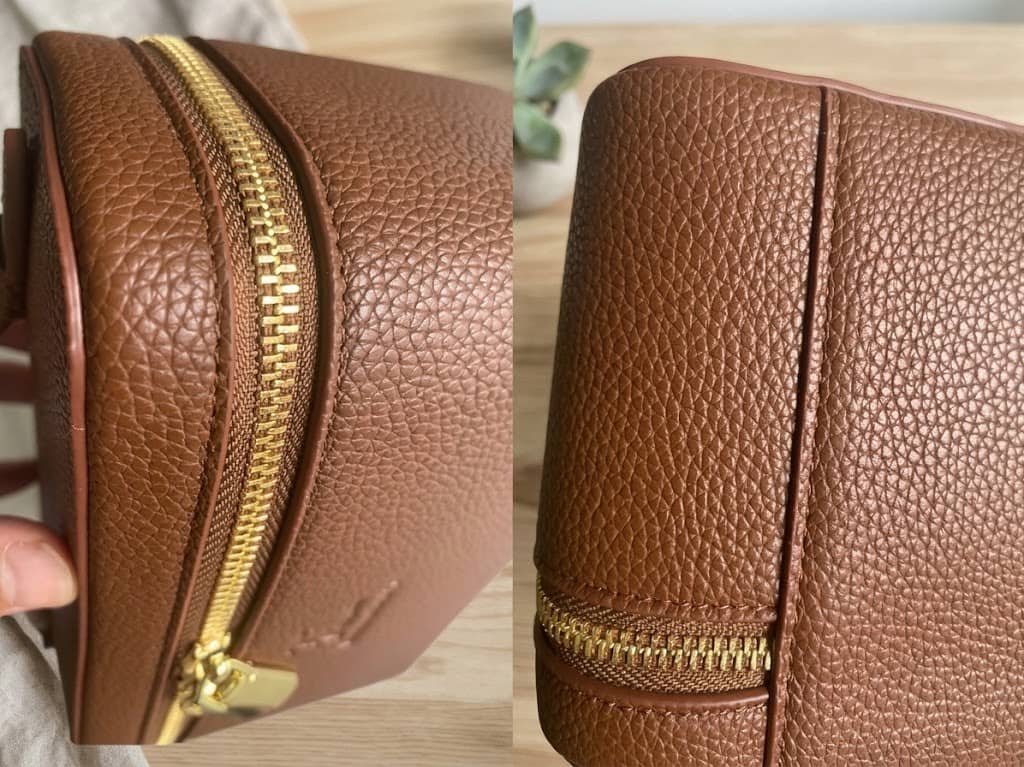
- Shape retention. Stand the empty case on a flat surface and sight along the top edge. Any visible dip means the panel is under-reinforced.
- Stitching quality. Consistent stitch length, no wandering at the ends, thread matched to the panel rather than to the trim.
- Corner finishing. Flat, without pleats, and symmetrical between the left and right sides of the same case.
- Zipper performance. Zip it round one-handed, over the corners, ten times. Any catch is a specification problem, not a break-in period.
- Hardware quality. Plating colour consistent across the batch, and a pull that does not rotate freely on its own.
- Lining fit. Flat at the base, no gap at the zip tape, no lining visible past the binding.
A premium vanity case is judged not only by how it looks when it is full, but also by how well it holds its shape when it is empty.
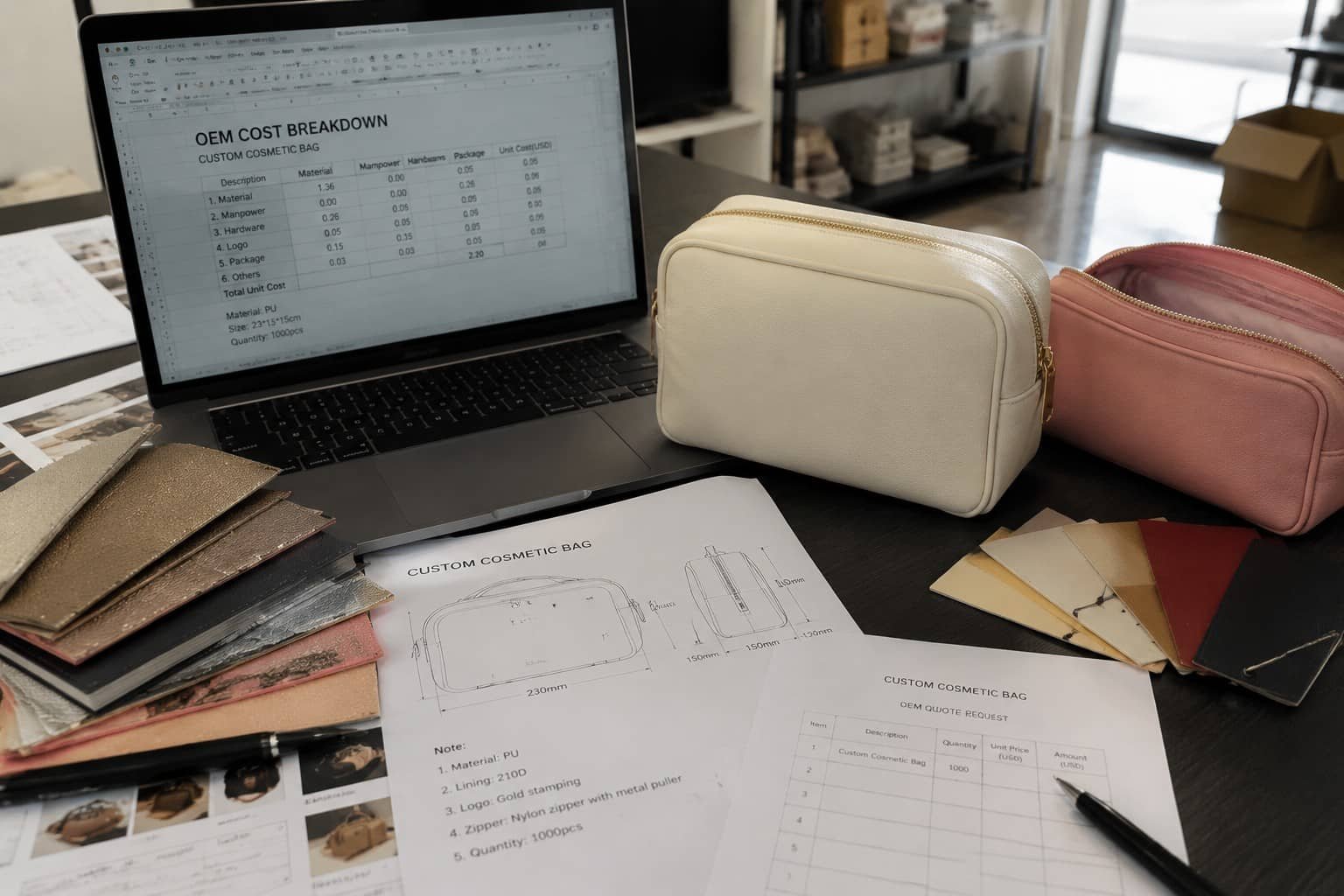
All six come at a cost. Our custom cosmetic bag cost breakdown shows where the money actually sits.
6. OEM & ODM Customization Options for Vanity Cases
Custom Size and Dimensions
Length, width and height are set by the product list, not by preference. Internal capacity is roughly the external dimension minus 4–6 mm of board and lining per side, and usable depth shrinks further with any tray or divider. Confirm the internal figures before approving the external ones.
Custom Materials and Colors
PU or genuine leather outer, Pantone-matched with a lab dip; lining colour matched or deliberately contrasted. A leather body with PU trim is a common way to hold a price point.
Custom Logo and Hardware
Embossed and debossed logos, metal plates, woven labels, custom zipper pullers. Placement matters more than method — a deboss on a curved lid panel distorts unless the die is cut for that radius.
Custom Interior Layout
Removable dividers, brush holders, elastic straps and custom pockets, driven by the product list rather than by a template.
Custom Packaging
Dust bags, gift boxes, custom labels and branded packaging. Packaging must be specified alongside the case: a rigid case in an undersized mailer arrives with crushed corners.
7. OEM Manufacturing Process: From Design to Bulk Production
| Stage | Main work | Typical duration |
|---|---|---|
| 1. Design review | Confirm drawing, dimensions, product list and target FOB | 2–4 days |
| 2. Material selection | Outer, lining, board and foam confirmed with swatches | 3–5 days |
| 3. Pattern making | Paper pattern, board die, structure trial | 3–5 days |
| 4. Sample development | First unit built to the pattern | 5–7 working days |
| 5. Sample approval | Dimensions, structure and appearance signed off in writing | Buyer dependent |
| 6. Bulk production | Cutting, sewing, assembly, hardware | 25–40 days |
| 7. Quality inspection | Structure, hardware, stitching and function checked against the approved sample | 2–3 days |
| 8. Packing and shipping | Packaging, carton drop test, documents | 2–3 days |
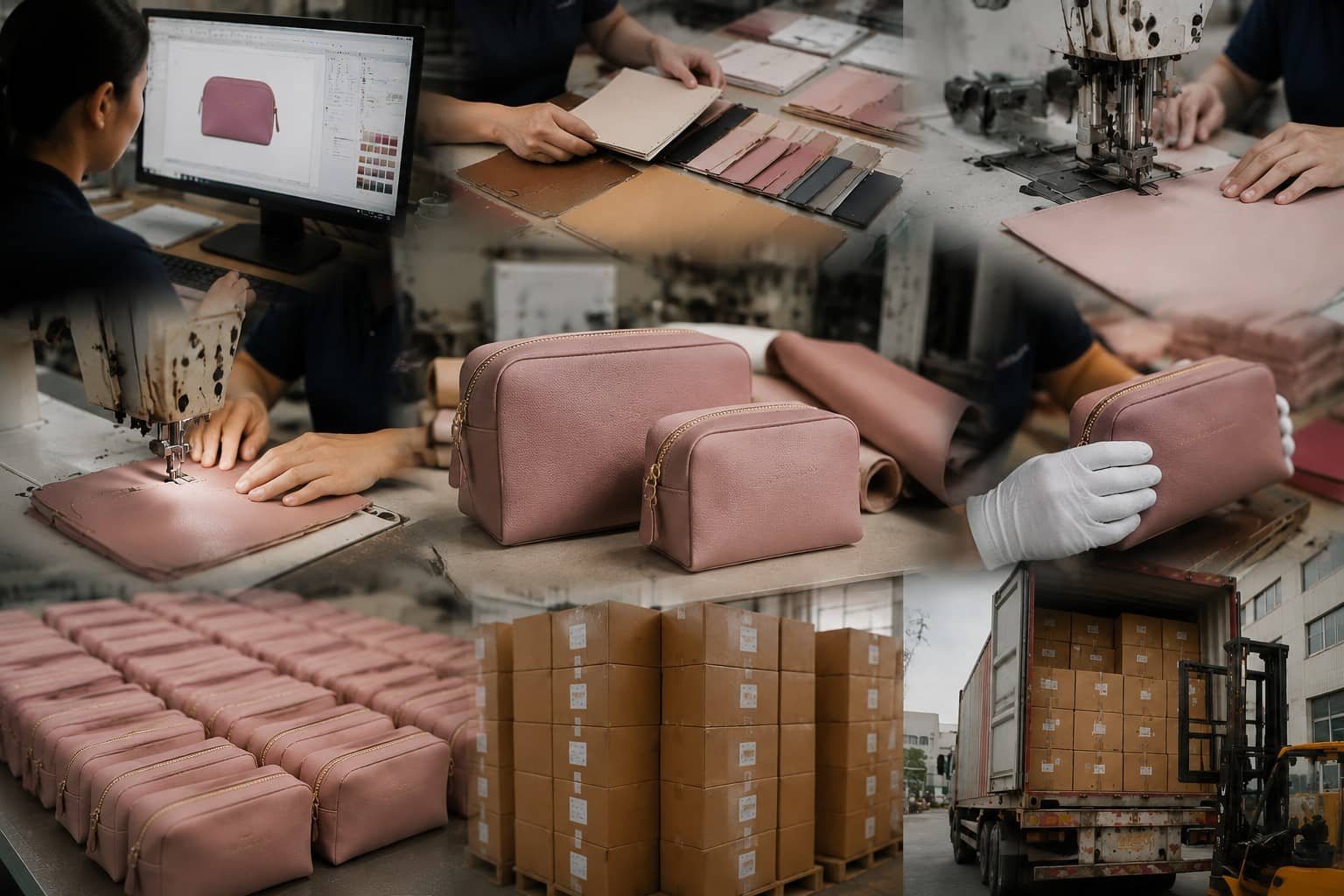
Sample approval is the hinge the project turns on. Bulk must be measured against a signed sample and a written specification, not a photograph. Keep one approved sample at the factory and one at the brand’s office, and make the inspection report cite the sample number. The eight stages are identical to any custom makeup bag production process; only stage three differs.
8. How to Choose the Right Vanity Case Manufacturer
Before comparing quotes, ask six questions. The answers tell you more than a price list.
- Does the factory understand structured construction, or does it mainly make soft pouches? Ask what board thickness it would specify for your dimensions, and why.
- Can it develop custom patterns in-house? A factory that outsources pattern making cannot control tolerance.
- Has it built reinforced cosmetic cases before? Ask for two references in this product class, not in bags generally.
- Can it show material test data, including Martindale results for the PU it proposes?
- How does it control bulk consistency? The answer should mention retained standards, an approved sample and in-line checks — not “we check every piece”.
- Can it support both OEM and ODM development? OEM if your design is fixed, ODM if you need the structure proposed for you.
Solton Leather is a Guangzhou-based manufacturer of structured cosmetic cases, makeup bags and leather accessories, with in-house pattern making and sampling. Judge us on the six questions above rather than on a brochure.If the format is already decided, start from our structured vegan leather vanity case and work back to the specification.
9. Frequently Asked Questions
What is the best material for a premium structured vanity case?
It depends on the price point and the run. Microfiber leather gives the closest leather hand with consistent colour and no grain matching; a premiun PU is the most practical choice for volume programmes; full-grain leather suits flagship SKUs where the material story is part of the value.
How do you make a vanity case keep its shape when empty?
Four things together: a base board sized to the span, a double-wall side panel with an inset reinforcement, foam specified by panel size rather than by thickness alone, and a lining sewn in under tension. Remove any one and the collapse comes back.
Can structured vanity cases be customized with genuine leather?
Yes, typically at 1.1–1.6 mm for the outer shell. Expect grain matching before cutting, a lower cutting yield than PU, and a 15–25% weight increase. Full-grain is usually reserved for flagship or limited runs.
Can the interior compartments be customized?
Yes. Removable dividers, fixed compartments, brush loops, elastic straps, mesh pockets, moulded trays and mirror options can all be specified. Send the product list with dimensions first — the layout follows the products, not the other way round.
What is the MOQ for custom structured vanity cases?
MOQ is driven by the material run and the pattern cost rather than by a single number. On an existing construction with a stock material, 100 pieces per style and colour is realistic. A new pattern with a new board die and custom hardware sits higher, typically 300–500 pieces. Confirm against your actual specification before committing to a launch date.
How long does it take to develop an OEM vanity case sample?
Sampling runs 5–7 working days once design and materials are confirmed, and bulk production 25–40 days after sample approval. A completely new structure usually needs two sample rounds, because the first unit is what reveals whether the board and foam combination behaves — plan two to three weeks of calendar time before the bulk clock starts.