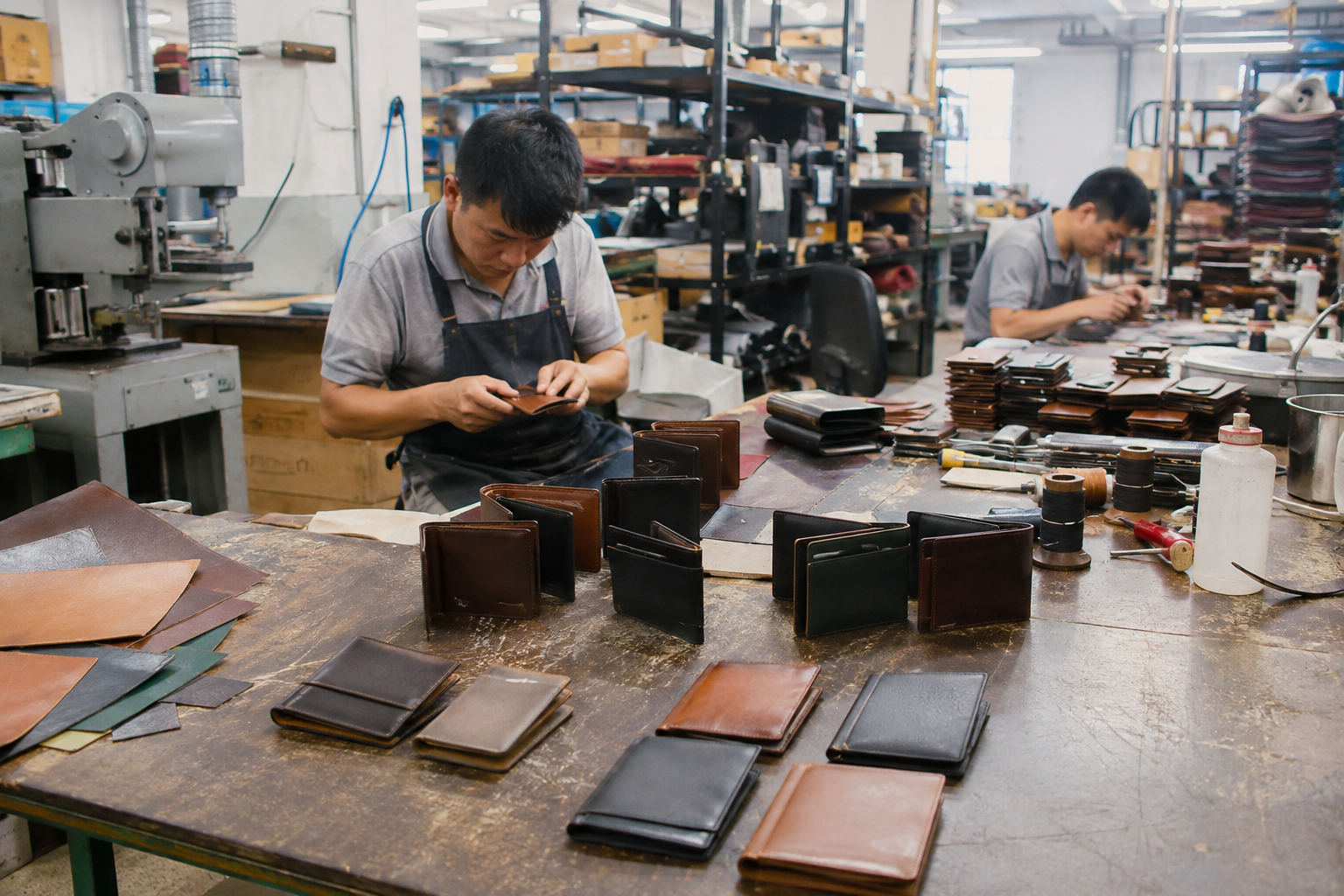
The card holder is now the most engineered item in small leather goods. A conventional wallet is judged on leather, stitching and silhouette — all visible on a table. A pop-up card holder adds a mechanism: a trigger, a spring, a stack of cards that must rise on command and stay put when it doesn’t. That is what makes the product hard to source well, and commercially interesting.
For a brand the appeal is clear: it demonstrates in a fifteen-second video and looks different from the flat wallets filling every marketplace listing. For a manufacturer the difficulty is equally clear. A pop-up wallet is not a leather good with a metal part inside; it is an assembly where the aluminum cassette, the ejector and the leather cover share a few millimeters of tolerance. When they disagree, the customer feels it — a card that jams, one that slides out in a pocket, a shell that bulges after two months.
Table of Contents
What Is a Pop-up Card Holder and How Does It Work?
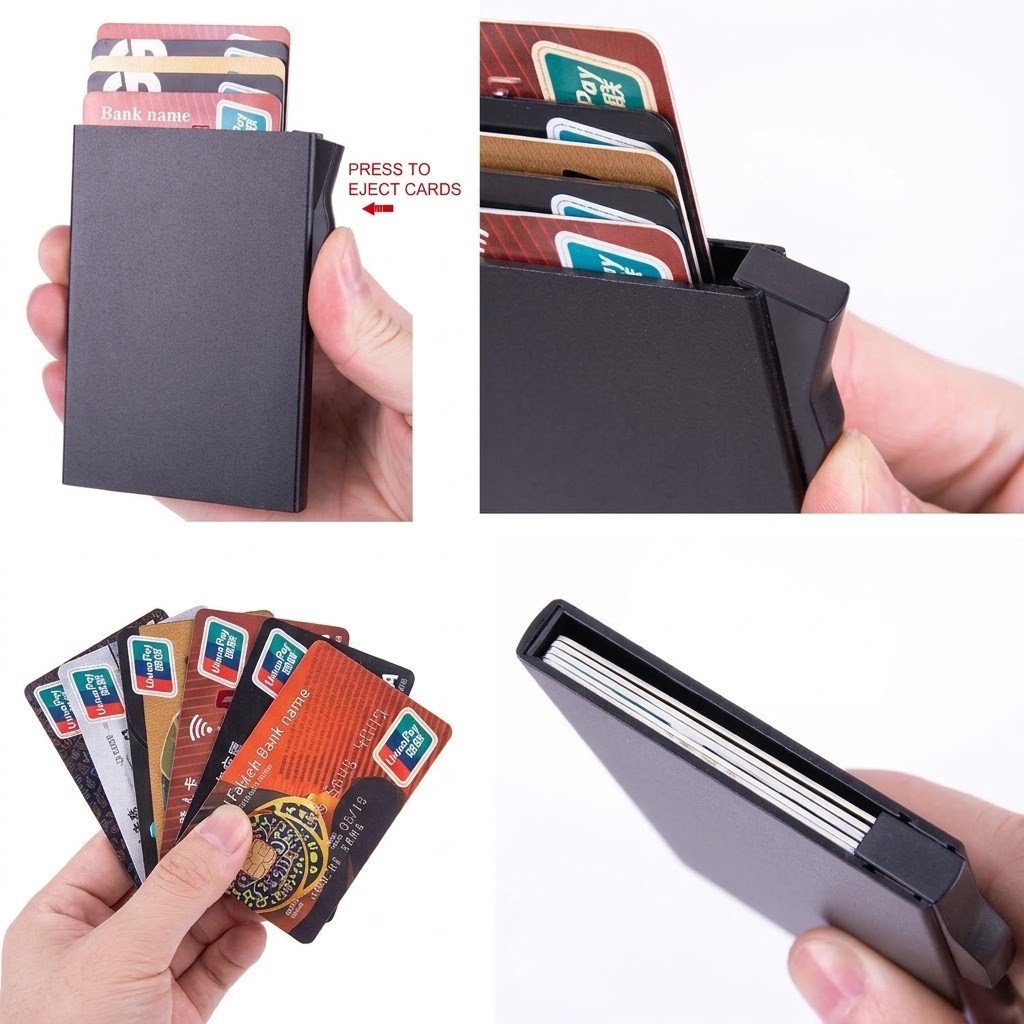
A pop-up card holder stores cards in a rigid aluminum cassette and dispenses them with a mechanical trigger. The user presses a lever or button on the spine or face; an ejector plate rises and pushes the stack upward in a staggered fan, so the top card sits proud of the case and can be gripped between two fingers. Releasing the trigger lets the plate retract and the cards settle back under spring tension.
Five components define the product:
- Aluminum card case. The structural chassis, typically 0.8–1.2 mm anodized aluminum alloy. Its cavity sets card capacity and fit tolerance.
- Ejector mechanism. An ejector plate driven by a spring, elastic band or linkage. Travel sets how far cards rise; spring rate sets trigger feel.
- Release lever. Thumb lever on the spine, push button on the face, or sliding tab — a comfort question as much as a mechanical one.
- Card slots / cavity. Sized for 5–8 cards at 0.76 mm ISO thickness, with a retention lip or friction pad.
- Leather cover. The outer skin, wrapped and stitched around the chassis. It carries the material story and most of the perceived value.
Quality is decided at the interface between these parts. A case 0.3 mm too deep holds eight cards but lets six rattle; a spring 10% too strong ejects briskly when new and feels gritty a year later. The work is holding tolerances across three material systems — metal, leather and elastic — that move differently under humidity, load and time.
Different Types of Pop-up Card Holders
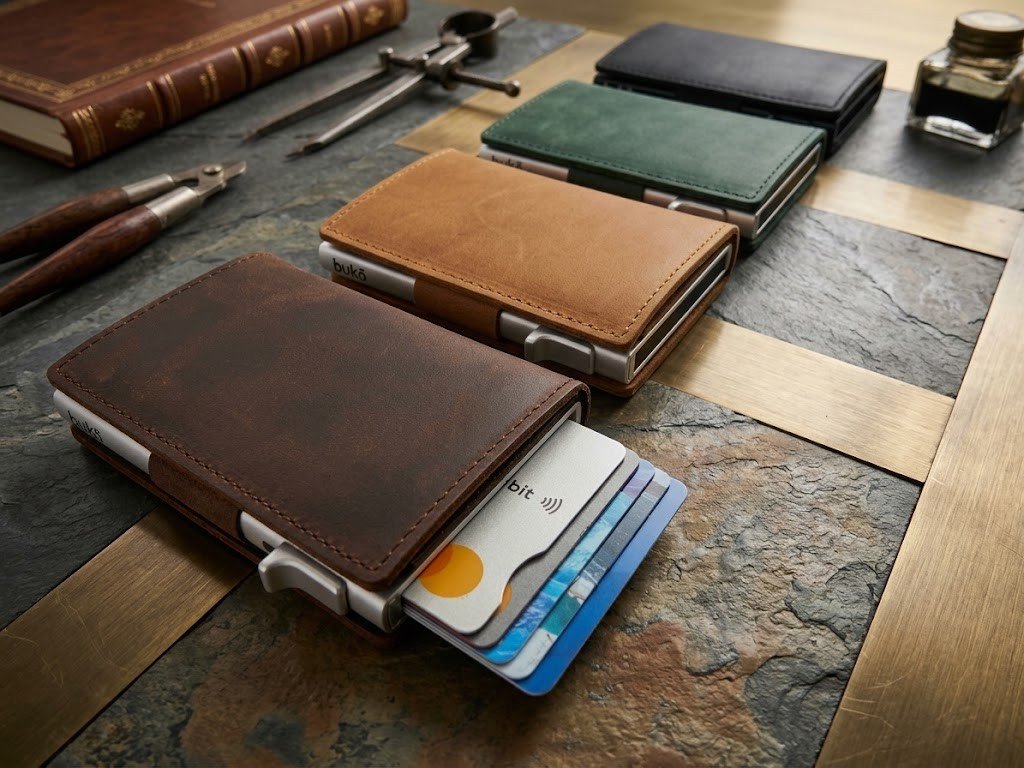
Four structural families dominate the market, differing in capacity, silhouette, cost and target customer.
1. Aluminum pop-up card holder. A bare anodized case with the mechanism exposed or semi-exposed. Lowest material cost, strongest “tech accessory” signal; suited to corporate gifts, EDC brands and entry price points. With little branding surface, anodizing quality becomes the product.
2. Leather-wrapped pop-up wallet. The cassette wrapped in leather, trigger accessible through a cut-out or leather-covered lever. Highest volume for fashion and lifestyle brands, because it pairs a mechanical story with a material story — and the most demanding, since leather thickness must match the case geometry and every wrapped corner is a failure point.
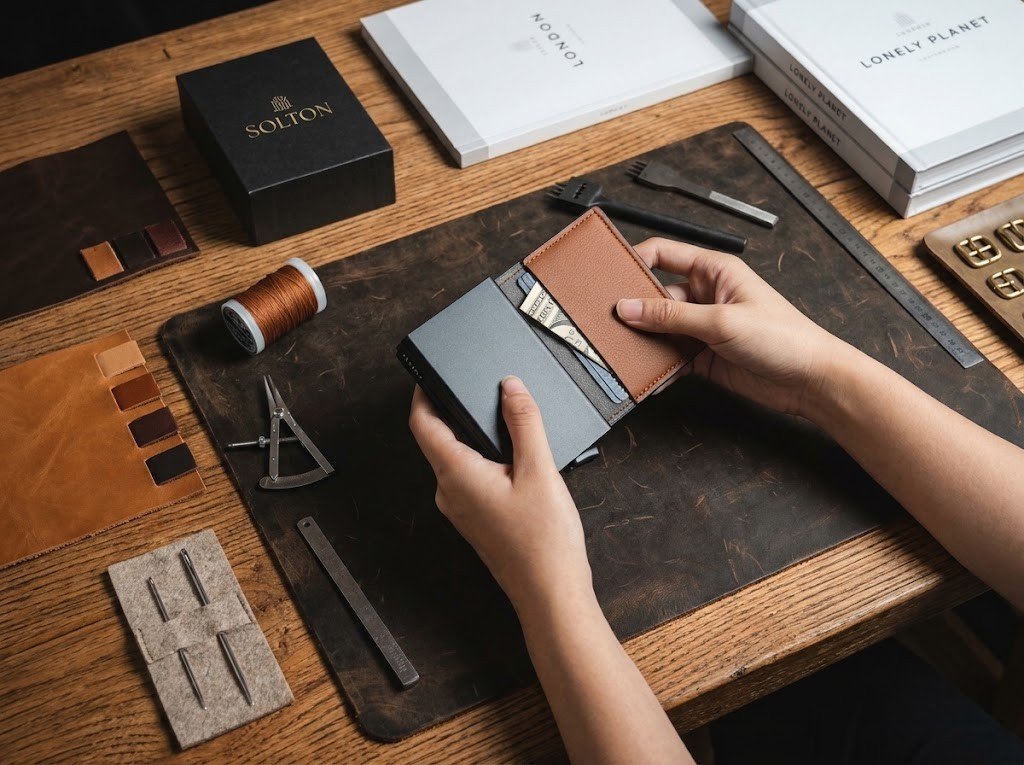
3. Pop-up bifold wallet. Cassette on one side, note compartment and extra card slots on the other. Higher capacity, conventional proportions, broader demographic. The challenge is the hinge: it must close flat without the cassette pressing on the note pocket.
4. Hybrid pop-up wallet. Cassette plus magnetic closure, coin pocket, cash clip or detachable module. Highest development cost and margin potential — and where ODM capability matters most, because the structure must be designed rather than adapted.
| TYPE | TYPICAL CAPACITY | PROFILE | RELATIVE COST | BEST SUITED TO |
|---|---|---|---|---|
| Aluminum pop-up card holder | 5–8 cards | Slim, rigid, technical | Low | Corporate gifts, EDC, entry price points |
| Leather-wrapped pop- up wallet | 5–8 cards | Slim, soft-touch, premium | Medium | Fashion and lifestyle brands |
| Pop-up bifold wallet | 8–12 cards + notes | Conventional wallet | Medium– high | Mass market, gift retail |
| Hybrid pop-up wallet | 6–12 cards + coin/cash | Bulky, feature-rich | High | Premium gifting, differentiated DTC brands |
Leather adds 1.5–2.5 mm of overall thickness to a case of identical capacity — often the difference customers read as “premium” or “bulky.”
These four cover most briefs. If you are weighing a pop-up against non-mechanical formats, our custom leather card holders range sets out capacity and construction side by side.
Materials Used in Custom Pop-up Card Holders
Material selection is a negotiation between weight, durability, appearance and cost. Leather is usually the first decision and the one with the longest lead time — our guide to genuine leather materials covers tannage, grain grades and finish options.
Genuine leather — full-grain and top-grain. Full-grain keeps the original grain and is the most durable option; top-grain is lightly corrected for better yield. Wrapping leather is usually split to 0.7–1.0 mm. Thicker hides look richer but do not bend cleanly around a 90-degree aluminum corner, producing the puckered edges that surface in reviews six months after launch.
PU leather. Consistent thickness, unlimited colors, roughly a third of the cost. Its thickness tolerance is tighter than a natural hide’s — a real advantage when the build-up allowance is only ±0.1 mm.
Aluminum alloy. 6063 or 5052: light, corrosion-resistant, suited to anodizing. Wall thickness sets rigidity; surface treatment decides how it ages. Anodizing resists scratching but wears at the trigger contact point, which is often masked or reinforced.
Microfiber lining. Used inside the cover and sometimes the cavity. Protects cards from abrasion and adds a soft-touch impression — low cost, meaningful perceived value.
Spring and ejector components. Stainless spring steel with POM or nylon guides. The least visible and most consequential choice in the product: a spring losing 15% of its rate over 5,000 cycles changes trigger feel, and no final inspection catches it.
Edge paint. Polyurethane, two to three coats with sanding between. The edge is where leather, adhesive and aluminum meet — the first place a poor build shows.
| MATERIAL | WEIGHT IMPACT | DURABILITY | APPEARANCE | COST | MANUFACTURING NOTE |
|---|---|---|---|---|---|
| Full-grain leather | Moderate | Excellent | Premium, ages well | High | Requires 0.7–0.9 mm splitting; low yield |
| Top-grain leather | Moderate | Very good | Uniform, premium | Medium– high | Better yield, more consistent wrapping |
| PU leather | Low | Good | Uniform, unlimited colors | Low | Tight thickness tolerance aids assembly |
| Aluminum 6063/5052 | Dominant | Excellent | Technical, finish-driven | Medium | Anodizing quality defines perceived value |
| Microfiber lining | Negligible | Good | Soft-touch interior | Low | Prevents card abrasion |
| Spring steel / POM | Low | Critical | Invisible | Low | Determines trigger feel and service life |
Pop-up Card Holder Manufacturing Process
A pop-up wallet passes through eight stages, each with a characteristic failure mode.
1. Design and structural development. 3D model of cassette, ejector travel and wrap allowance, then a functional prototype — usually CNC-machined aluminum, not the final stamped part. Typical risk: designing around nominal case dimensions instead of post-anodizing ones, shifting every wrap allowance.
2. Aluminum mechanism selection. Cassette size, wall thickness, trigger type and spring rate against target capacity. Typical risk: specifying capacity by card count rather than cavity volume, so it works in the sample room and fails in the field.
3. Leather cutting and preparation. Hides inspected, split to specification, die-cut for volume. Typical risk: thickness variation within one hide — 0.8 mm at the center, 1.0 mm at the belly — which wraps unevenly and shows only after assembly.
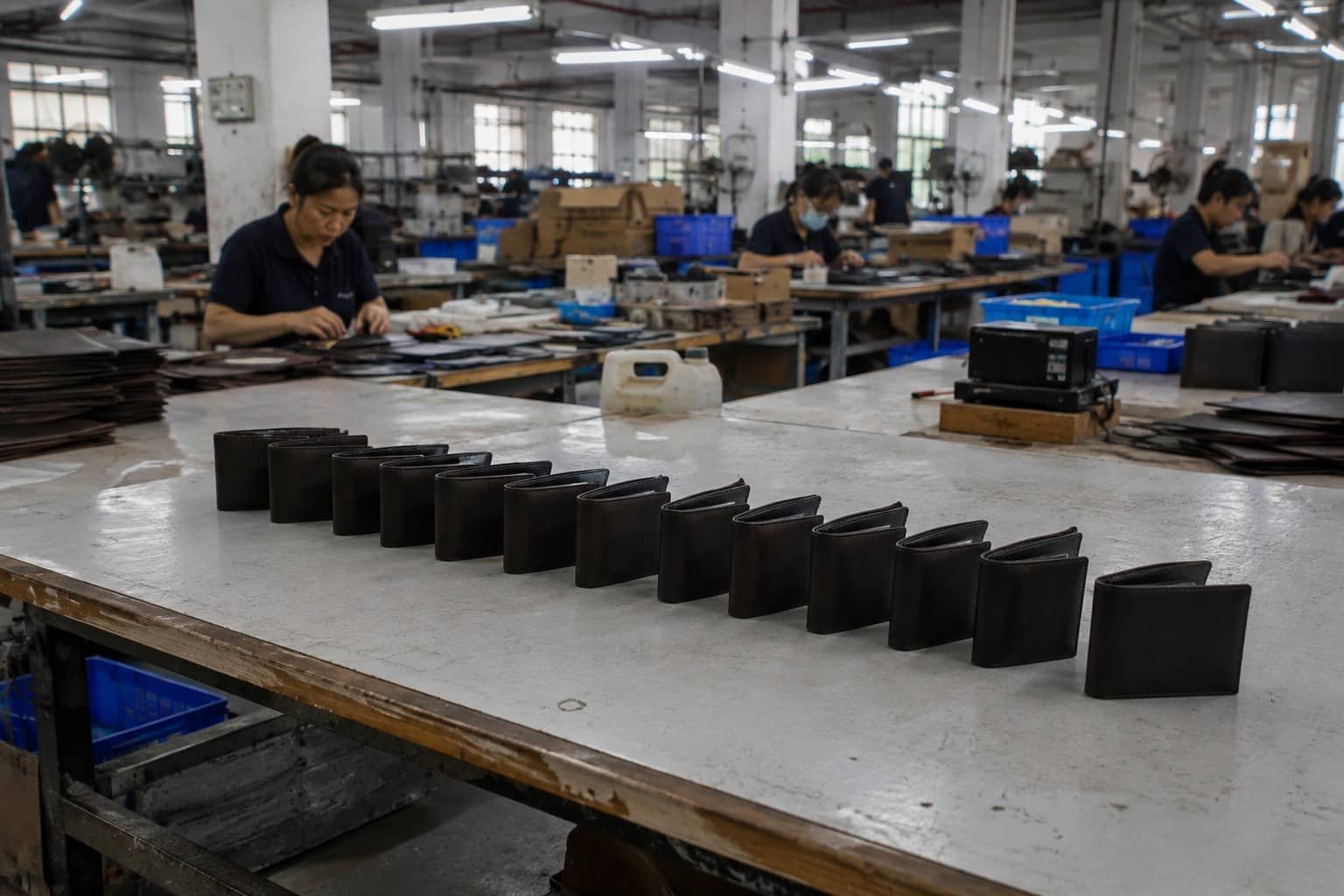
4. Leather wrapping and assembly. Edges skived, panel glued and wrapped, trigger cut-out aligned. Typical risk: uneven adhesive and insufficient corner tension, producing lifting or a bulge within weeks.
5. Stitching and edge finishing. Typical risk: stitch length drifting as the needle crosses the aluminum edge underneath, and edge paint laid too thick in one coat, which cracks instead of flexing.
6. Mechanism installation. Typical risk: a trigger visibly off-center against the leather cut-out — functional, but a retail rejection.
7. Functional testing. Every unit, or a defined AQL sample, cycled for ejection, retention and reset. Typical risk: testing only with new cards on a clean bench, which hides behavior with worn cards or a bent stack.
8. Final inspection and packaging. Typical risk: lighting that hides edge-paint defects and scratches, so problems surface in the customer’s hands.
Quality Control: What Should Buyers Check?
QC should be built around five checks that predict field performance rather than pass a bench test.
Card ejection smoothness. Cycle the trigger through full travel and watch whether the stack rises evenly or stutters. A correct unit ejects in one continuous motion with no lateral wobble. Test at maximum capacity and again with a single card — a full stack masks alignment problems that a single card exposes.
Card retention. Close the case, invert and shake firmly. Cards should not migrate or protrude. Repeat after the retention lip has seen use, since a friction fit relying on a new, stiff lip will loosen.
Mechanism durability. Cycle testing is the most informative test available, and standards vary by product — agree them in writing before mass production. A common approach is a set number of eject/reset cycles on a pneumatic rig, with ejection height and trigger force measured at intervals. What matters is not the headline number but whether measurements are recorded before and after: spring fatigue, not breakage, is the usual failure.
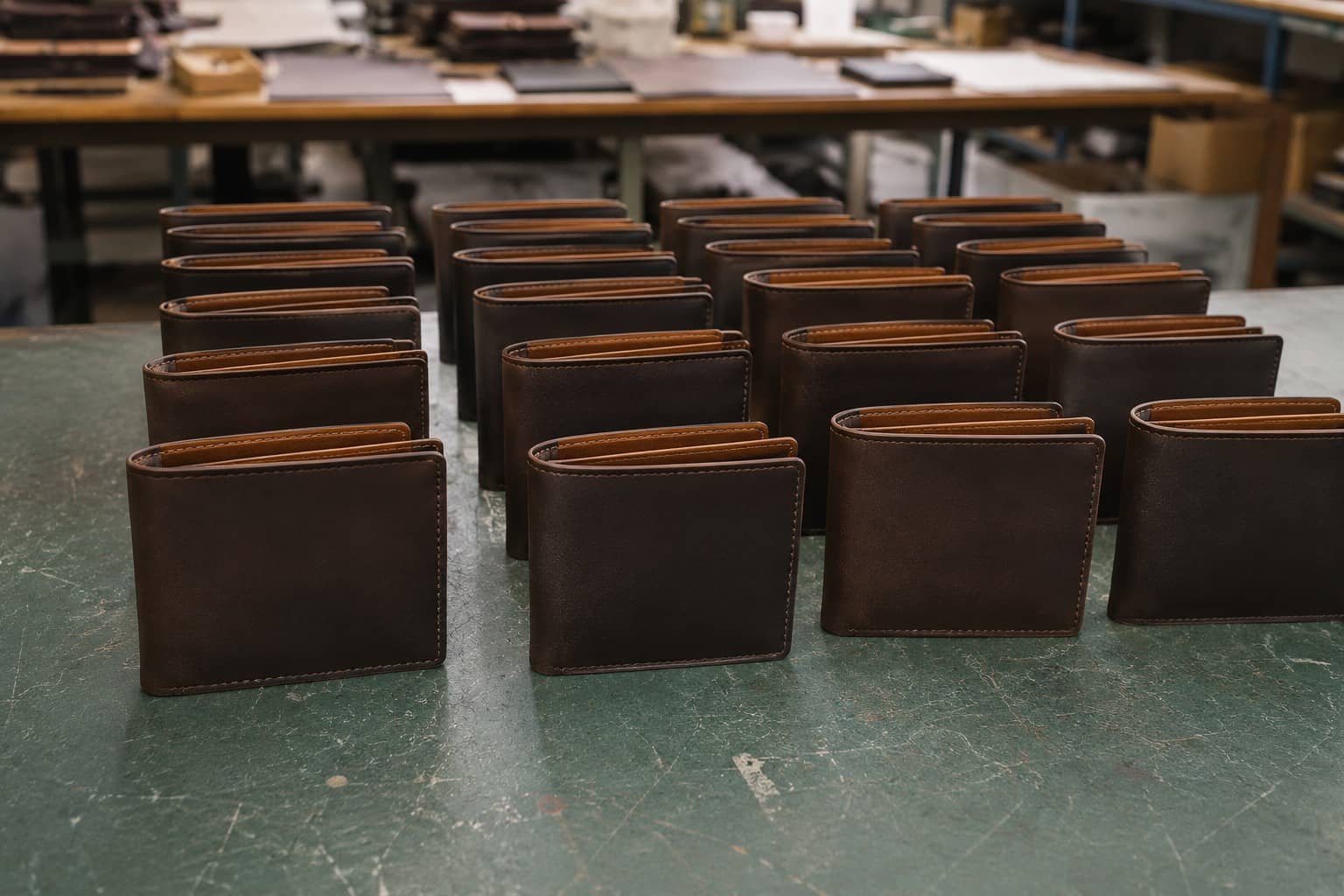
Leather wrapping quality. Inspect all four corners and the spine under raking light for lifting, visible adhesive, puckering and thickness steps where leather meets the case edge. Run a thumb along each edge; any discontinuity becomes a wear point.
Stitching and edge finishing. Check stitch density around the perimeter, especially where the seam crosses the aluminum edge. Confirm thread tension and that no stitch has broken the leather surface. Edge paint should be smooth, even in width, and crack-free when the panel is flexed.
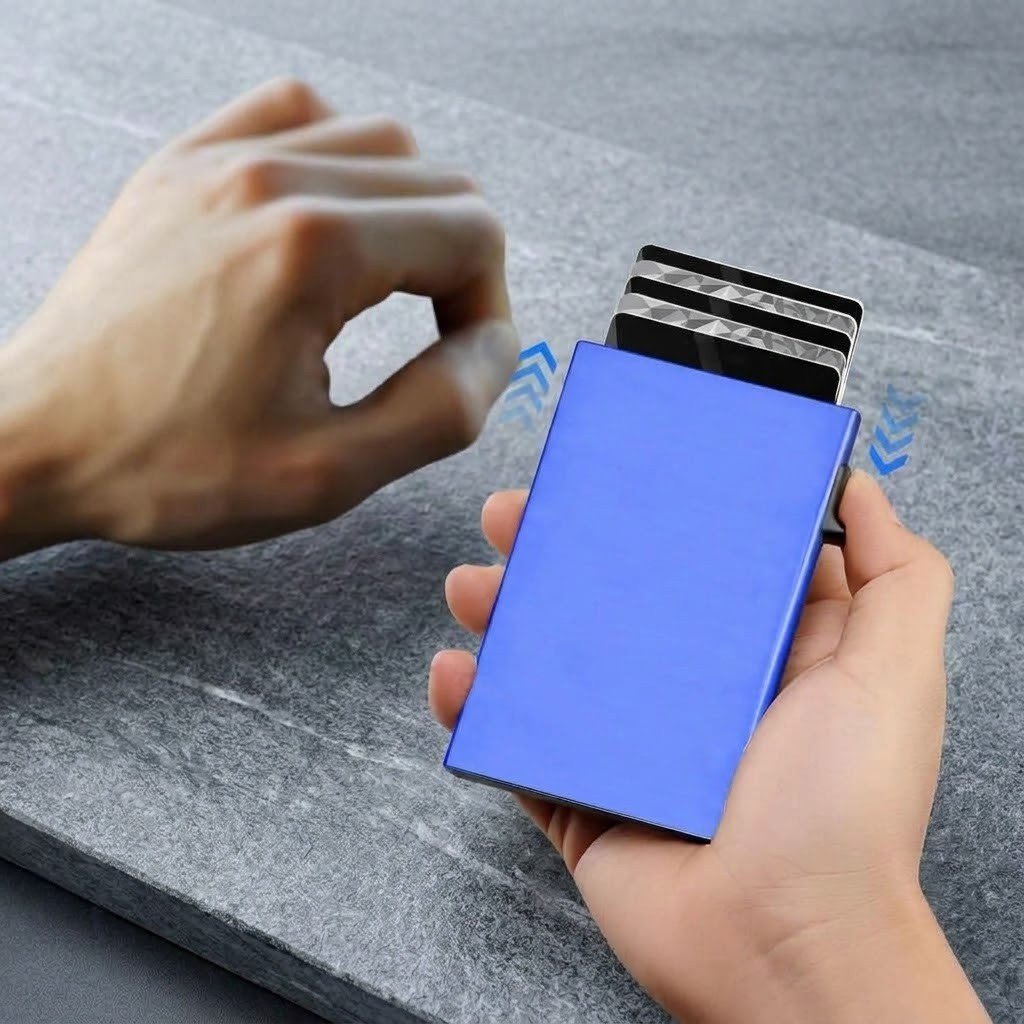
Why Do Some Pop-up Wallets Have Card Ejection Problems?
Ejection complaints are the most common after-sales issue in this category, and they trace back to three causes.
1. Cards eject unevenly or jam. Usually a stack-thickness problem: a cavity sized for 0.76 mm cards binds on a stack containing an embossed or metal card. The second cause is cassette tolerance — if internal width sits at the top of its range while the ejector plate sits at the bottom, the plate tilts under load and the stack rises at an angle. The fix is dimensional: tighten cavity tolerance and specify plate-to-wall clearance.
2. Cards work loose in the pocket. Insufficient retention, either because the cavity is oversized for the intended card count or because the retention lip has relaxed. This is usually a specification error rather than a production defect — the product was designed for a full stack and is used half-full. Good designs hold retention across the full stated range with a sprung pressure plate or tapered cavity, not a fixed lip.
3. The leather shell deforms. Three factors: leather too thick for the wrap radius, insufficient or uneven wrapping tension, and a chassis without the structure to resist leather’s tendency to return to flat. A case bulging at the spine after a few months is showing adhesive creep under sustained tension — a process and material issue, not a design flaw.
These three failure modes separate a supplier who can quote a card holder from a manufacturer who can keep a program in market for multiple seasons.
Custom Pop-up Card Holder OEM/ODM Services
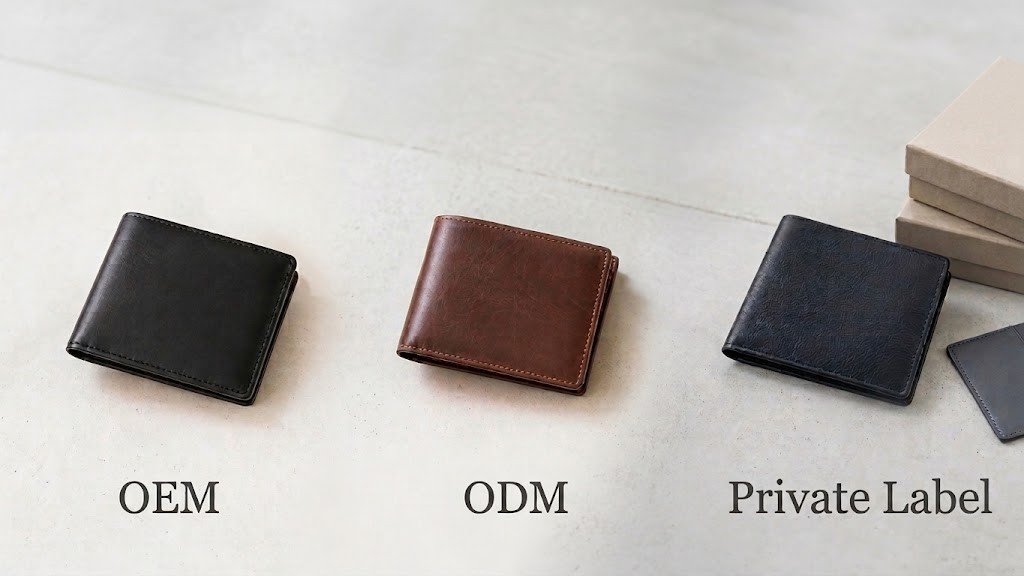
The line between OEM and ODM matters more in a mechanical product than in a flat wallet. OEM means building to your tech pack; ODM means the structure comes from the factory, including the cassette, trigger and spring rate. If that distinction is new to your team, start with our breakdown of OEM vs ODM wallet manufacturing.
Customization falls into seven areas; most programs combine four or five.
| CUSTOMIZATION | AVAILABLE OPTIONS |
|---|---|
| Leather | Genuine leather (full-grain / top-grain) or PU |
| Color | Pantone matching or custom color development |
| Logo | Debossed, embossed, foil stamp, metal plate, laser |
| Mechanism | Different aluminum structures, trigger types and spring rates |
| Capacity | Different card capacities and cavity configurations |
| Packaging | Custom gift boxes, inserts, sleeves, unboxing sets |
| Design | OEM to your tech pack, or ODM from concept |
Cooperation runs in five stages: design review and feasibility feedback on your tech pack; structural prototyping, often with a machined case to validate the mechanism before tooling; material confirmation with swatches and thickness records; sample testing against the agreed standard with buyer sign-off; and mass production with in-line QC and pre-shipment inspection.
Two points matter early. Whether the cassette is existing or new — reusing a proven structure cuts development time and tooling cost sharply, at the price of less differentiation. And the wrap method: single-piece is cleaner but less forgiving of thickness variation, while multi-panel gives better corner control at the cost of extra seams.
How to Choose a Reliable Pop-up Card Holder Manufacturer?
The question is not whether a factory makes card holders, but whether it can hold a mechanical tolerance inside a leather assembly. The six criteria below are specific to pop-up construction; for the wider checklist — supplier audit, capacity planning, payment terms — see choosing a reliable wallet manufacturer.
- Leather card holder experience. An existing small leather goods line, not a metal business adding leather accessories. Edge finishing is learned over years.
- Metal-and-leather assembly capability. Can they handle the aluminum chassis in-house or through a controlled partner, and document the dimensional handoff between the two?
- Mechanism testing. Ask to see the cycle rig, the recorded data and the acceptance criteria. A supplier who tests without recording is not really testing.
- Customization depth. Logo, color and packaging are table stakes; the differentiator is whether they can modify mechanism, capacity or structure for your program.
- A stable QC process. Documented in-line checks at wrapping, assembly and final inspection — not one end-of-line look.
- Sampling discipline. A supplier who insists on a signed functional standard before mass production is usually worth keeping.
Send your drawing or tech pack for a feasibility review. As a custom leather wallet manufacturer, Solton Leather works with brand customers from structural concept through mass production: leather selection, aluminum mechanism development, wrapping and stitching, functional testing and custom packaging.
Frequently Asked Questions
How does a pop-up card holder work?
Cards sit in a rigid aluminum cassette with an ejector plate beneath the stack. Pressing a lever or button releases a spring that drives the plate up, pushing cards out in a staggered fan so the top one can be gripped. Releasing the trigger lets the plate retract and the rest settle back.
How many cards can a pop-up wallet hold?
Most designs hold 5–8 standard 0.76 mm cards; bifold and hybrid structures reach 10–12. Real capacity depends on thickness — embossed, metal or heavily laminated cards reduce the usable count. Confirm it with the cards the end customer will carry, not test blanks.
Are pop-up card holders RFID protected?
They can be. The aluminum cassette shields five sides and blocks most 13.56 MHz reading, but the open card slot remains a path unless the design includes an RFID-blocking liner. If RFID is a marketing claim, specify it as a tested requirement rather than assuming the aluminum body is enough.
Can pop-up card holders be made with genuine leather?
Yes — full-grain and top-grain are both standard, usually split to 0.7–1.0 mm for wrapping. Thicker leather improves hand feel but makes clean corner wrapping harder, so thickness should be specified with the wrap method.
Can I customize the logo and aluminum mechanism?
Both. Logos can be debossed, embossed, foil stamped, laser marked or applied as a metal plate. Mechanism customization covers trigger type and position, spring rate, ejector travel, capacity and case finish. Mechanism changes usually need a prototype before tooling.
What is the MOQ for custom pop-up card holders?
MOQ depends on whether the aluminum structure is existing or newly developed, and on the leather and packaging specification. Reusing a proven cassette with custom leather and logo starts far lower than new tooling. Confirm MOQ against a specific specification, not a general figure.