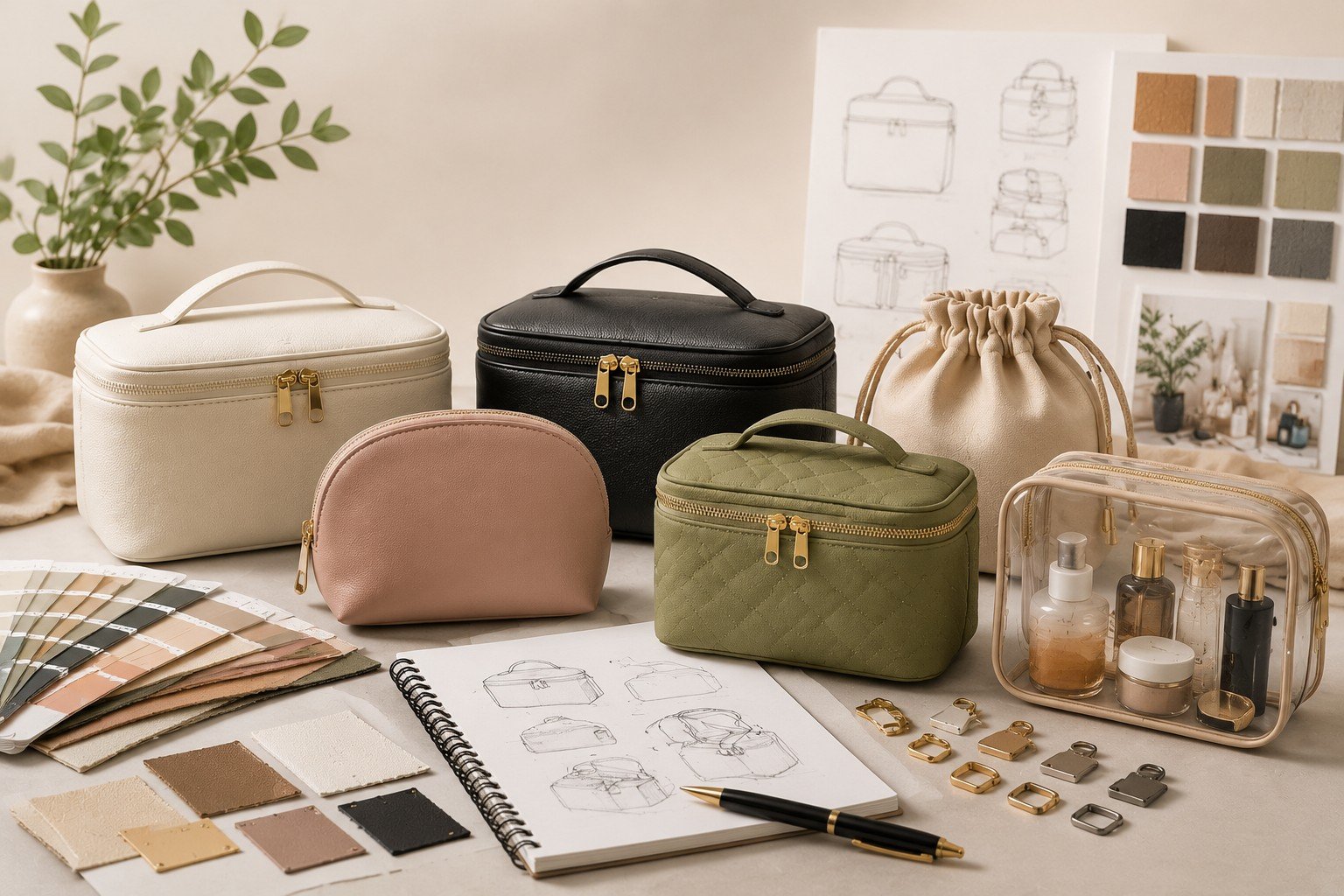
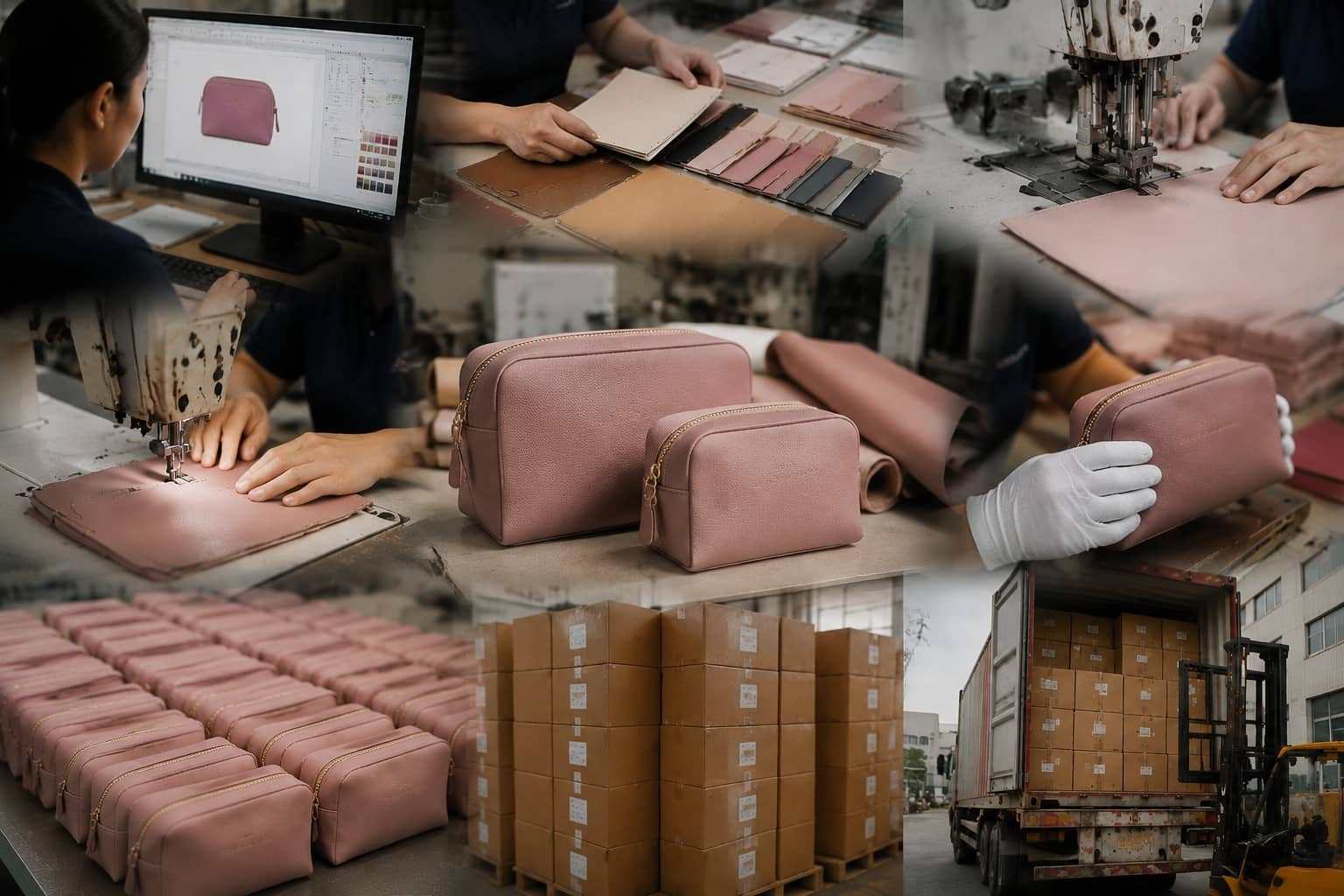
Quick Summary: The makeup bag production process moves through nine stages — concept design, material selection, pattern making, prototype sampling, precision cutting, sewing and assembly, logo customization, quality control, and final packing and delivery. A typical custom order takes 5–7 working days for sample development, plus 30–45 days for bulk production.
Introduction: From a Product Idea to a Finished Makeup Bag
Every cosmetic bag on a retail shelf has passed through a structured makeup bag production process — each stage shaping how the final product looks, feels, and holds up over time. Understanding the custom makeup bag production process helps brands estimate realistic timelines, control development costs, and communicate more effectively with manufacturers.
This guide walks through each stage of how custom makeup bags are made, covering leather cosmetic bags, PU pouches, and fabric styles. Whether you are developing your first private label collection or switching to a new OEM partner, the makeup bag manufacturing steps below apply across most common materials and structures. By the end, you will know exactly what happens inside the factory and how to manage a custom makeup bag production project from start to finish.
Table of Contents
1. Product Concept & Design Development
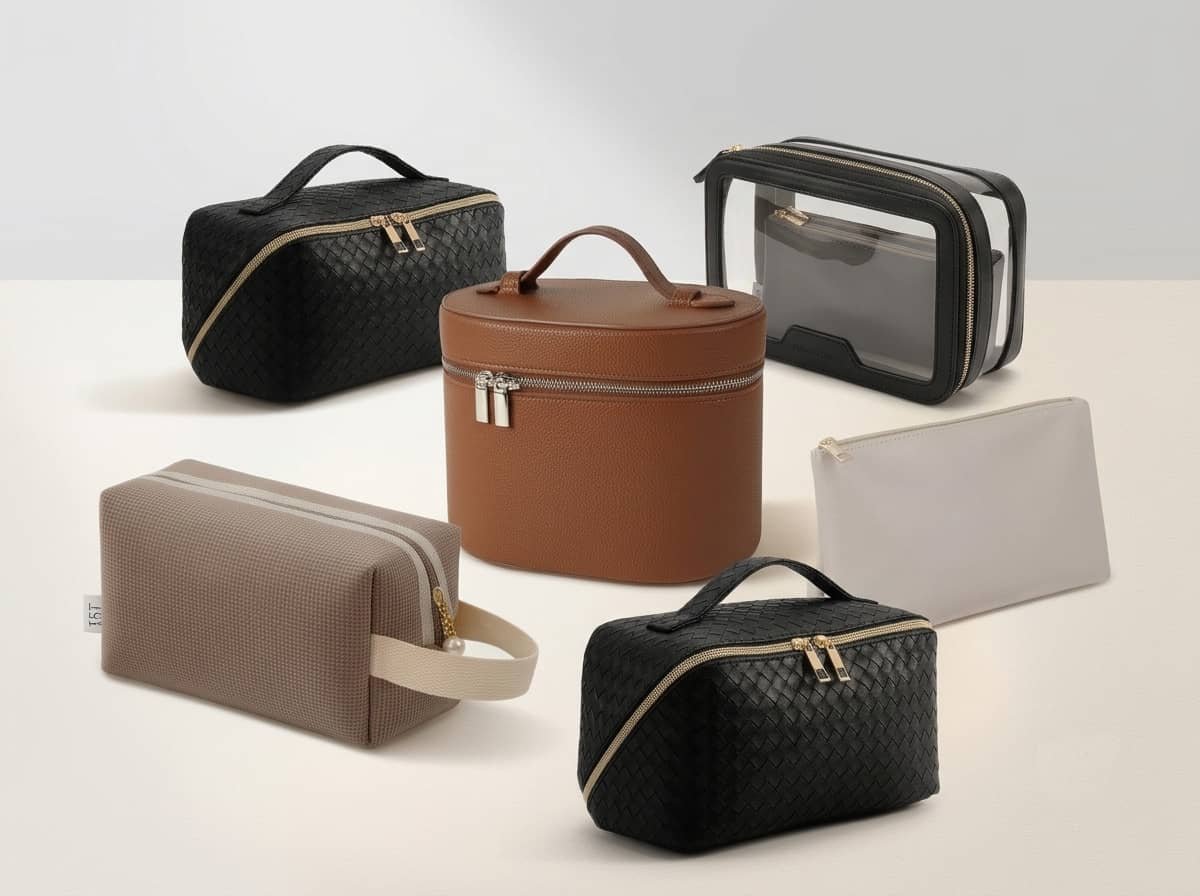
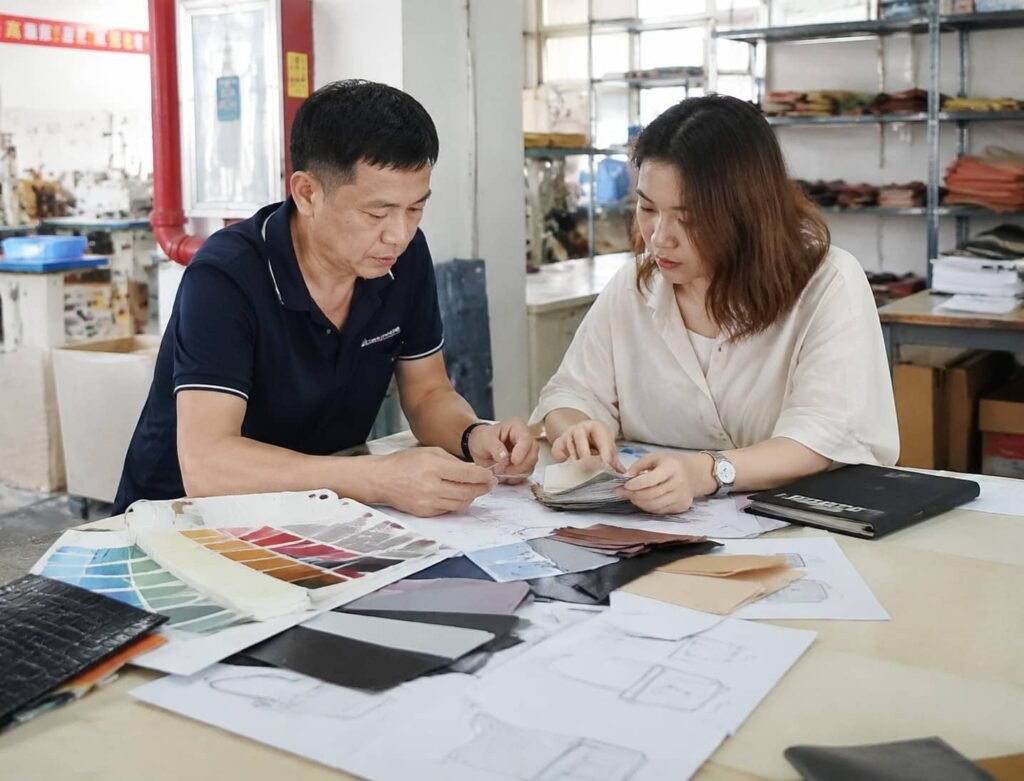
Every custom makeup bag starts with a product brief. Before a manufacturer can quote a price or cut material, they need to understand what you are building and who it is for. The most productive design conversations cover five areas: target customer profile, bag style and structure (pouch, train case, hanging toiletry bag, or multi-layer organizer), dimensions and capacity, functional features such as zipper type and waterproof lining, and design references.
Most brands provide sketches, inspiration images, or a competitor sample. Even a rough drawing with dimensions carries more weight than pages of written description. The factory team then evaluates construction feasibility — checking whether the proposed seams work with the chosen material thickness and whether the structure can be produced efficiently at scale. This back-and-forth is normal: custom makeup bag design is a collaboration, not a one-way handoff.
If you’re still refining your concept, start with our custom makeup bag design guide — it covers brand positioning, material selection, and how to prepare a design brief
that gets faster quotes from factories.
2. Material Selection for Custom Makeup Bags
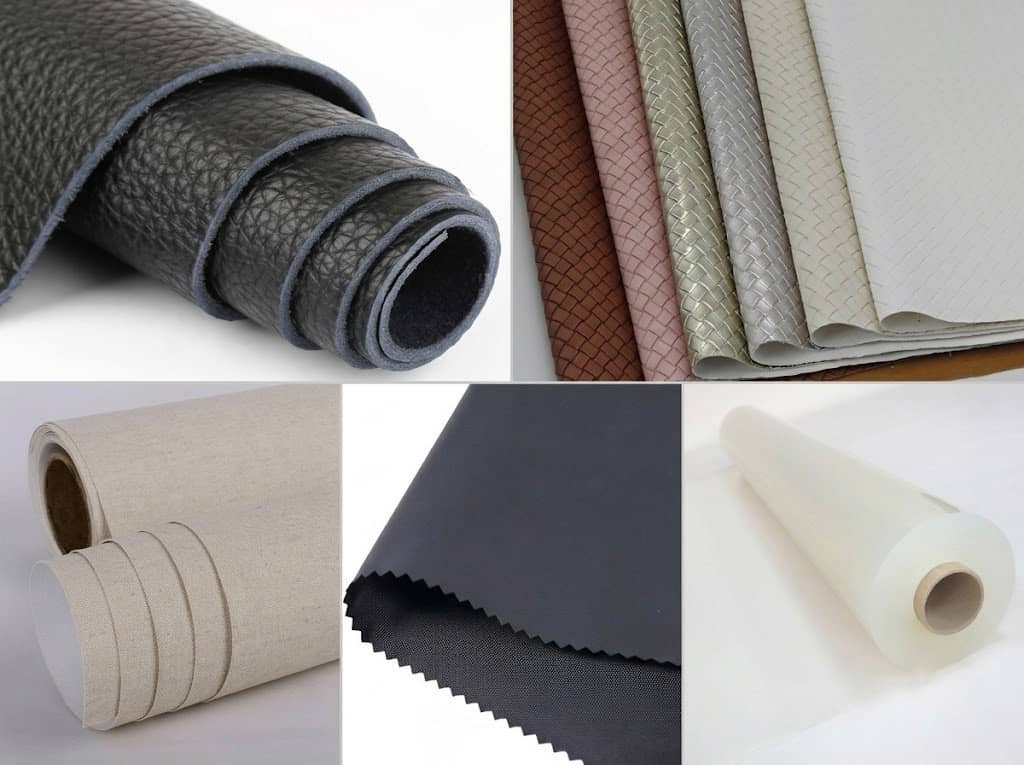
Material choice is one of the most consequential decisions in the entire makeup bag production process. It determines cost, lead time, minimum order quantity, and how the bag performs after months of daily use. Getting material selection right at the outset prevents expensive changes once production has begun.
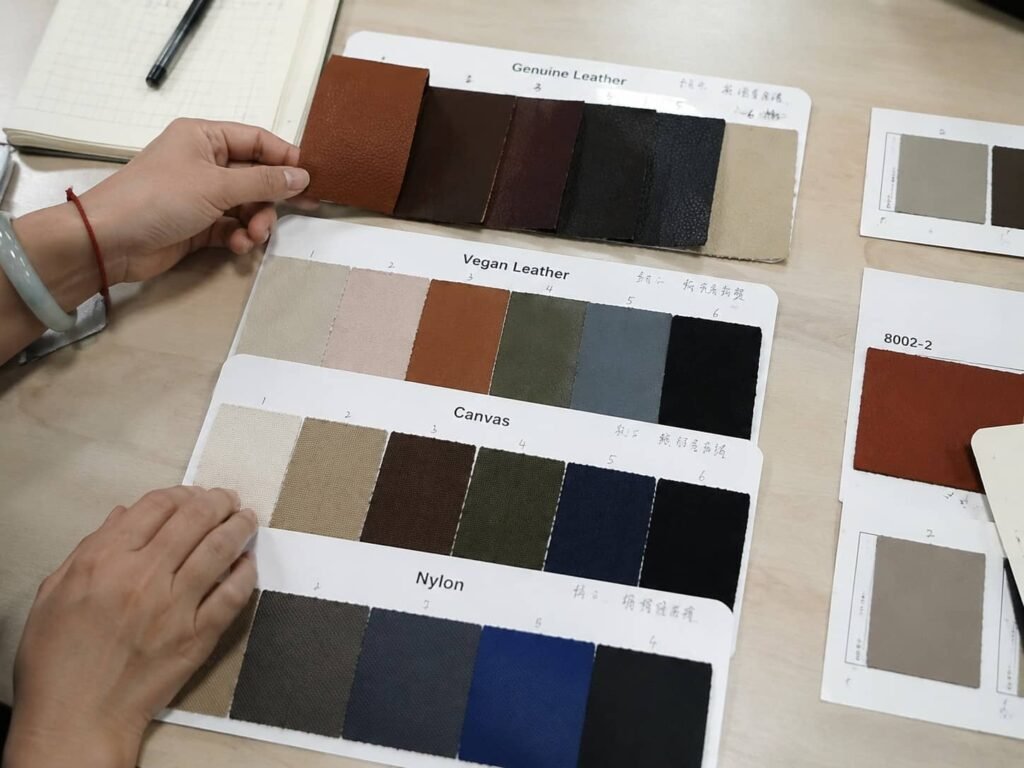
Exterior Materials at a Glance
The table below compares the main materials available for custom makeup bag production, matched to brand positioning rather than raw specifications — because what matters most is which material aligns with your target customer.
| Material | Positioning | Key Advantage | Best For |
|---|---|---|---|
|
Genuine Leather (Cowhide / Sheepskin) | Premium luxury | Ages beautifully — develops natural patina; unmatched hand feel | High-end beauty brands, boutique collections, luxury gift sets |
|
Vegan Leather (PU / Microfiber) | Accessible premium | Wide colour range; consistent cutting; peel-resistant options available | Mid-range beauty brands, vegan-positioned lines, subscription box products |
|
Canvas (12–16 oz cotton) | Natural / Casual | Washable; takes screen printing well; eco-friendly perception | Clean beauty brands, organic skincare lines, casual everyday bags |
| Nylon & TPU | Functional / Travel | Lightweight; waterproof; TSA-compliant transparent options | Travel accessory brands, promotional kits, utility-focused products |
Choosing between genuine leather, PU, vegan leather, or fabric? Each material affects
production cost, lead time, and available customization methods. Compare all five options in our cosmetic bag materials comparison guide.
Interior Materials
The lining is what the customer touches every time they open the bag. Polyester lining (150D–210D) is lightweight and affordable for everyday cosmetic bags. Microfiber suede offers a premium soft-touch feel and resists staining — ideal for higher-end vanity cases. Waterproof nylon lining is essential for toiletry bags and bags used near sinks.
For a deeper comparison including detailed cost and durability trade-offs, see our best cosmetic bag materials guide.
Need help selecting the right material for your makeup bag collection?
3. Pattern Making & Prototype Development
Once materials are confirmed, the makeup bag prototype stage begins — the point in the custom makeup bag production process where a design on paper becomes a physical product you can hold. For a typical structured cosmetic pouch, the pattern maker drafts several individual pattern pieces, each with seam allowances and grain line markings.
| Stage | Duration | Key Activities | Deliverable |
|---|---|---|---|
| Design Confirmation | 1–2 days | Review all specs: dimensions, materials, hardware, logo method, packaging | Confirmed production brief |
| Pattern Making | 2–3 days | Draft patterns; calculate seam allowances; mark grain lines; plan construction sequence | Complete pattern set (8–15+ pieces) |
| First Prototype | 2–3 days | Cut and sew sample using actual selected materials; test zipper, shape, and filled capacity | Physical prototype + measurement photos |
| Revision Round | 3–7 days | Adjust pocket depth, zipper length, or material stiffness per buyer feedback | Revised sample for re-approval |
| Pre-Production Approval | 1–2 days | Final sample signed off; becomes the quality reference for the entire batch | Approved PP sample |
Most first samples need adjustments — a pocket too shallow, a zipper catching at the corner, a material feeling stiffer than expected. One or two revision rounds is completely normal. Brands that rush through prototyping almost always encounter problems in bulk production. A zipper that snags on the sample becomes fifty bags with the same issue.
An experienced OEM partner can help avoid costly mistakes before mass production.
4. Why Manufacturing Experience Matters During Product
Development
The design and sampling stages are where a manufacturer’s experience — or lack of it — becomes visible. This directly impacts how smoothly the makeup bag production process unfolds once you move into bulk manufacturing. A partner who understands the full custom makeup bag production workflow from day one saves you from repeating expensive mistakes that less experienced factories routinely make.
An experienced pattern maker looks at your sketch and flags construction issues immediately: a seam that will pucker with that material thickness, a zipper placement that will strain when the bag is full, a gusset width that will not give enough interior volume. These insights during development prevent costly sampling rounds later.
Material knowledge matters just as much. A custom makeup bag manufacturer who works with leather, vegan leather, canvas, and TPU regularly can recommend which material and lining combinations perform well together — and which ones will delaminate or wear poorly after six months of use. Their sample room should turn around a prototype in a week because they have done it thousands of times before.
When evaluating a partner, ask about sample development timelines, whether they have in-house pattern makers (not outsourced), and how many revision rounds they typically need. The answers reveal more about their capability than any factory tour photo.
For a detailed guide on selecting the right production partner, see our article on choosing a custom makeup bag manufacturer.
CASE EXAMPLE: Developing a Vegan Leather Makeup Pouch for a Premium Beauty Startup
A European beauty brand approached the factory with a clear brief: a minimalist vegan leather makeup pouch sized 20 × 12 × 6 cm, with a gold foil logo and waterproof lining. The brand’s target customer was a 25–35 year-old professional willing to pay a mid-premium retail price.
During material selection, the factory recommended microfiber leather over standard PU for its softer hand feel and better peel resistance — a detail the brand had not considered but which aligned perfectly with their premium positioning. The first prototype revealed that the originally requested zipper length caused the opening to gap at the corners; the pattern maker adjusted the gusset angle and the second sample was approved in one week.
Logo testing compared gold foil stamping against blind debossing on the chosen microfiber surface. Foil stamping won — the metallic finish popped against the matte material. After pre-production approval, the bulk order of 500 units was completed in 35 working days with AQL 2.5 inspection before shipment.
Key takeaway: The brand’s initial design was 80% right. The manufacturer’s input during sampling closed the remaining 20% — the material recommendation, the zipper adjustment, and the logo method comparison. That is the value of an experienced OEM partner during the makeup bag production process.
Budget planning goes hand in hand with production planning. Understand how material,
MOQ, design complexity, and packaging each affect your quote in our custom cosmetic bag cost breakdown.
5. Material Preparation & Precision Cutting
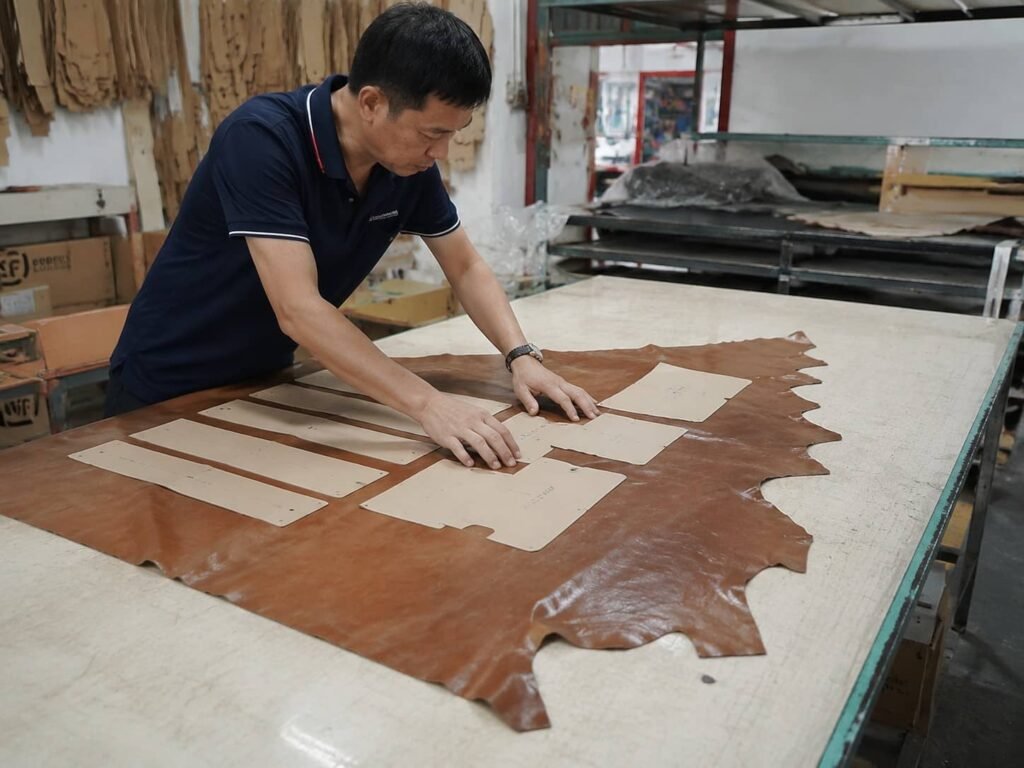
Before cutting begins, incoming materials go through inspection: colour consistency across the batch, surface quality, and thickness uniformity. At this stage of the makeup bag production process, any substandard material is rejected before it reaches the cutting table.
For leather makeup bags, cutting is a skilled manual process — the cutter positions pattern pieces on each hide to work around natural imperfections and follow grain direction for consistent appearance across the finished bag. A machine cannot make the judgment calls an experienced cutter makes daily, which is why genuine leather bags carry higher labour cost. Skilled cutting reduces material waste while maintaining consistent product quality across the entire production batch.
For PU and fabric bags, multiple layers can be cut simultaneously using hydraulic presses, improving speed and consistency. Key supporting processes include skiving (edge thinning for leather panels to reduce seam bulk — a hallmark of quality craftsmanship) and lining cutting (slightly smaller than exterior panels to prevent internal bunching).
6. Sewing & Assembly: Building the Makeup Bag Structure
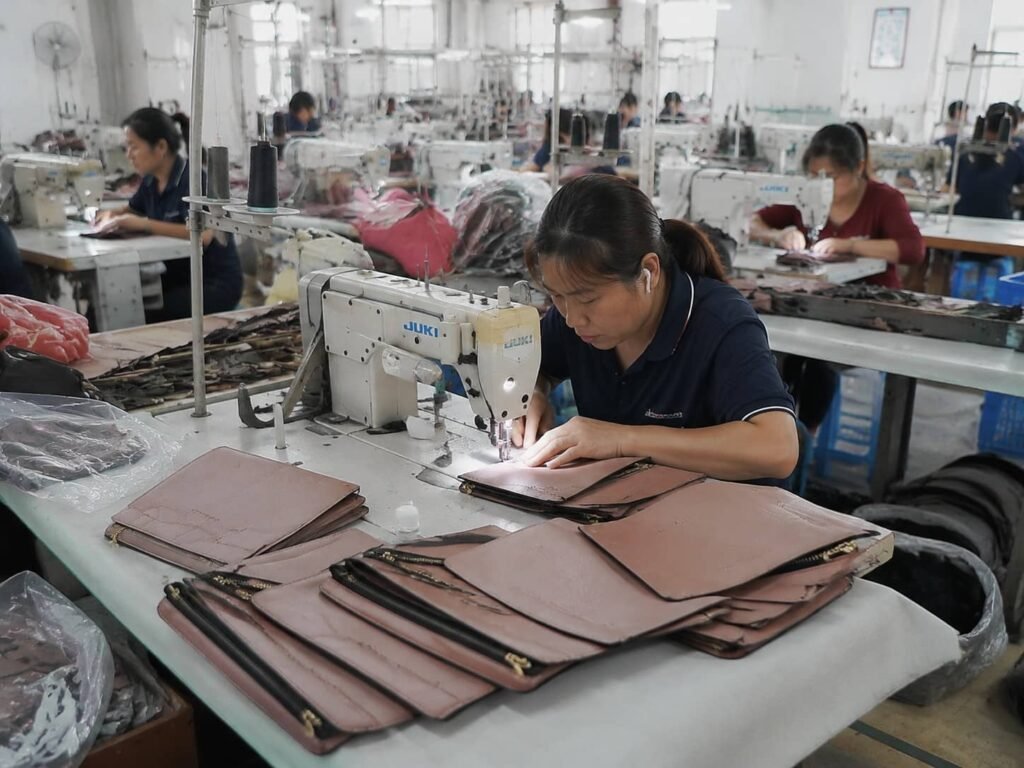
The sewing and assembly stage is the heart of how makeup bags are made. Cut pieces move through an ordered sequence: panel preparation (pockets and reinforcements stitched first), main body assembly (exterior panels joined with stiffener inserted for structure), zipper installation (the most technique-sensitive step in the entire cosmetic bag manufacturing process), lining insertion, hardware attachment, and edge finishing.
Zipper installation alone reveals the sewer’s skill level. A poorly set zipper pulls unevenly, catches fabric, or separates after repeated use. Experienced sewers run the zipper back and forth several times after installation to confirm smooth operation before the bag moves to the next station.
For leather bags, raw edges are painted with edge coat — applied in 2 to 3 thin layers, dried between applications — to create a smooth, sealed finish. This detail immediately distinguishes a well-made bag from a cheap one. The industry standard for mid-to-premium cosmetic bags is 7 to 8 stitches per inch.
Fewer compromises seam strength; more increases production time without proportional quality gain for most bag styles.
7. Logo Customization & Private Label Options
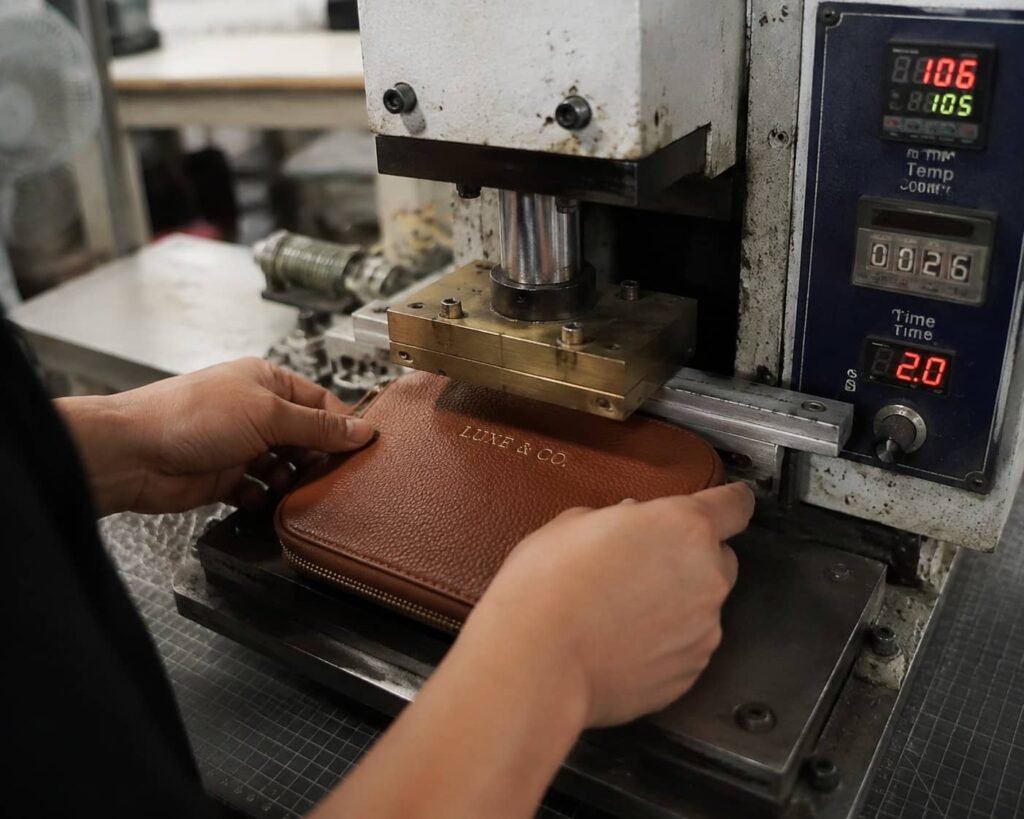
For brands ordering custom logo makeup bags, branding is a distinct stage within the makeup bag production process. Each method suits different materials and brand aesthetics — and the choice directly affects both the production timeline and the final per-unit cost.
| Logo Method | Best Material | Durability | Cost Level | Best For |
|---|---|---|---|---|
|
Debossing (Blind Stamp) | Genuine leather, thick vegan leather | Permanent — recessed into material | $$ | Minimalist luxury branding, subtle brand marks |
| Foil Stamping | Leather, vegan leather, coated fabric | Very good — foil may wear over years of use | $$ | Gold / silver / metallic brand marks |
|
Embossing (Raised) | Genuine leather, rigid cases | Permanent — raised surface relief | $$$ | Premium leather goods, vanity cases |
| Screen Printing | Canvas, nylon, flat PU panels | Good — may fade with heavy abrasion | $ | Casual / eco bags, bright multi-colour logos |
| Metal Logo Plate | All bag types | Permanent — hardware riveted or screwed | $$$ | Luxury collections, structured bags |
| Custom Zipper Puller | All bag types | Permanent — engraved or debossed metal/leather | $-$$ | Subtle branding on every bag style |
Beyond the logo, consider branded touchpoints: custom-printed lining fabric, woven satin inner labels, and custom packaging including dust bags, gift boxes, and hang tags. Each layer adds perceived value. For a complete overview of OEM makeup bag production capabilities including private label makeup bags services, visit our manufacturing page.
8. Quality Control During Makeup Bag Production
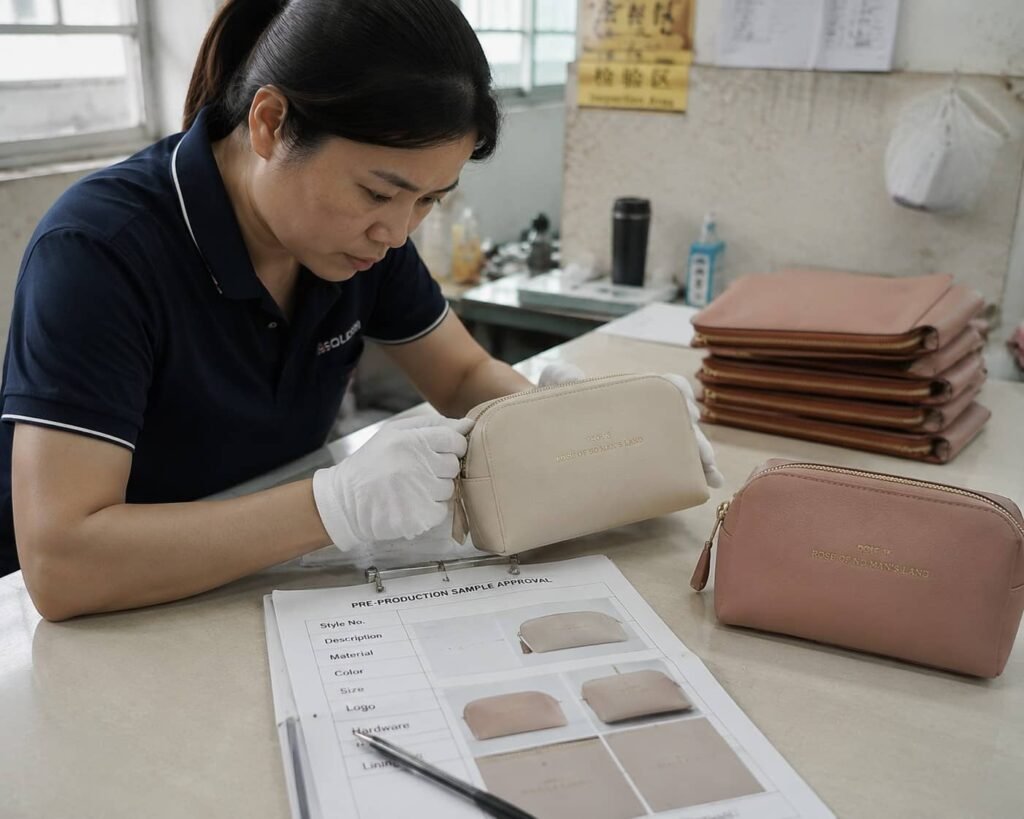
Makeup bag quality control is not a single checkpoint at the end — it runs through every stage of the makeup bag production process. A well-run custom makeup bag production line has QC gates at each major handoff: after cutting, after sewing, after branding, and before packing. For B2B buyers, understanding what this looks like on the production floor is more useful than generic quality claims.
Appearance inspection covers surface scratches, stains, glue residue, colour consistency across panels, and logo placement alignment under standardized lighting. Construction inspection checks stitch tension and spacing, seam alignment at corners, zipper straightness, and edge painting quality — no bubbles, no cracks, no uneven colour.
Functional testing includes running each zipper fully open and closed at least 20 times, load-testing the bag to its intended capacity to verify seam integrity, and pull-testing attached handles and hardware. Many manufacturers follow AQL-based inspection standards according to buyer requirements, with samples randomly drawn from the production batch for independent inspection before packing approval.
9. Mass Production & Delivery Timeline
Once the pre-production sample is approved and QC standards are agreed, the makeup bag production process moves into bulk manufacturing. A single production line with 8 to 12 workers can produce 150 to 300 cosmetic bags per day depending on complexity — a simple pouch moves faster than a multi-layer organizer. Bulk makeup bags are manufactured against a confirmed schedule with in-line QC checks performed by the supervisor at regular intervals.
After passing final QC, bags are individually packed with acid-free tissue to hold shape, placed in poly bags or dust bags, and packed into export-grade cartons. Cartons are labelled, palletized, and prepared for shipment.
Here are the realistic timeframes for each stage:
| Stage | Duration | What Affects Timing |
|---|---|---|
| Design consultation & material selection | 2–5 working days | Completeness of your design brief |
| Pattern making & first sample | 5–7 working days | Bag complexity — more pieces = more time |
| Sample revision (if needed) | 3–7 days per round | Number and scope of changes requested |
| Material procurement | 5–15 working days | Material type — custom colours take longer |
| Bulk production | 30–40 working days | Order volume, bag complexity, factory capacity |
| QC inspection & packing | 2–3 working days | Order size and inspection standard |
| Sea freight | 15–35 days | Destination port distance from China |
| Air freight | 5–10 days | Flight availability; significantly higher cost per kg |
Total estimated timeline from design confirmation to delivery: roughly 60 to 90 days for a first-time custom order including sampling and sea freight. Repeat orders with established designs can be completed in 40 to 50 days.
hese are factory-side timeframes. Brand-side delays — taking a week to review sample photos, waiting for internal budget approval, finalizing packaging design — extend the total. A two-week buffer in your launch calendar is prudent.
Ready to develop your own custom makeup bag collection?
Related Production Resources
Frequently Asked Questions
What is the production process of a makeup bag?
The makeup bag production process moves through nine stages: concept design and product specification, material selection, pattern making and prototype sampling, material inspection and precision cutting, sewing and assembly, logo customization and private label branding, quality control inspection at multiple checkpoints, and final packing and shipment. Each stage builds on the previous one — rushing through sampling almost always creates problems that multiply during bulk production.
How long does it take to manufacture custom makeup bags?
For a first-time custom order, the entire custom makeup bag production process from design consultation through sample development, bulk production, and sea freight delivery typically takes 60 to 90 days. Sample development alone takes 5 to 7 working days for the first prototype, plus 3 to 7 days per revision round. Bulk production runs 30 to 45 working days. Repeat orders with existing designs usually complete within 40 to 50 days.
Can I customize makeup bags with my own logo?
Yes. Most OEM and private label manufacturers offer six main logo methods: debossing (blind stamp), foil stamping (gold, silver, and colour foils), embossing (raised), screen printing, metal logo plates, and custom zipper pullers. The best method depends on your bag material and brand aesthetic. Logo setup involves a one-time die or screen fee, after which the per-unit branding cost is modest.
What materials can be used for custom makeup bags?
The four main categories are genuine leather (cowhide or sheepskin), vegan leather (PU and microfiber), canvas (12–16 oz cotton), and functional materials (nylon and TPU). Interior lining options include polyester, microfiber suede, and waterproof nylon. Material selection affects cost, minimum order quantity, lead time, durability, and the overall look and feel of the finished bag.
What information should I provide before starting a custom makeup bag project?
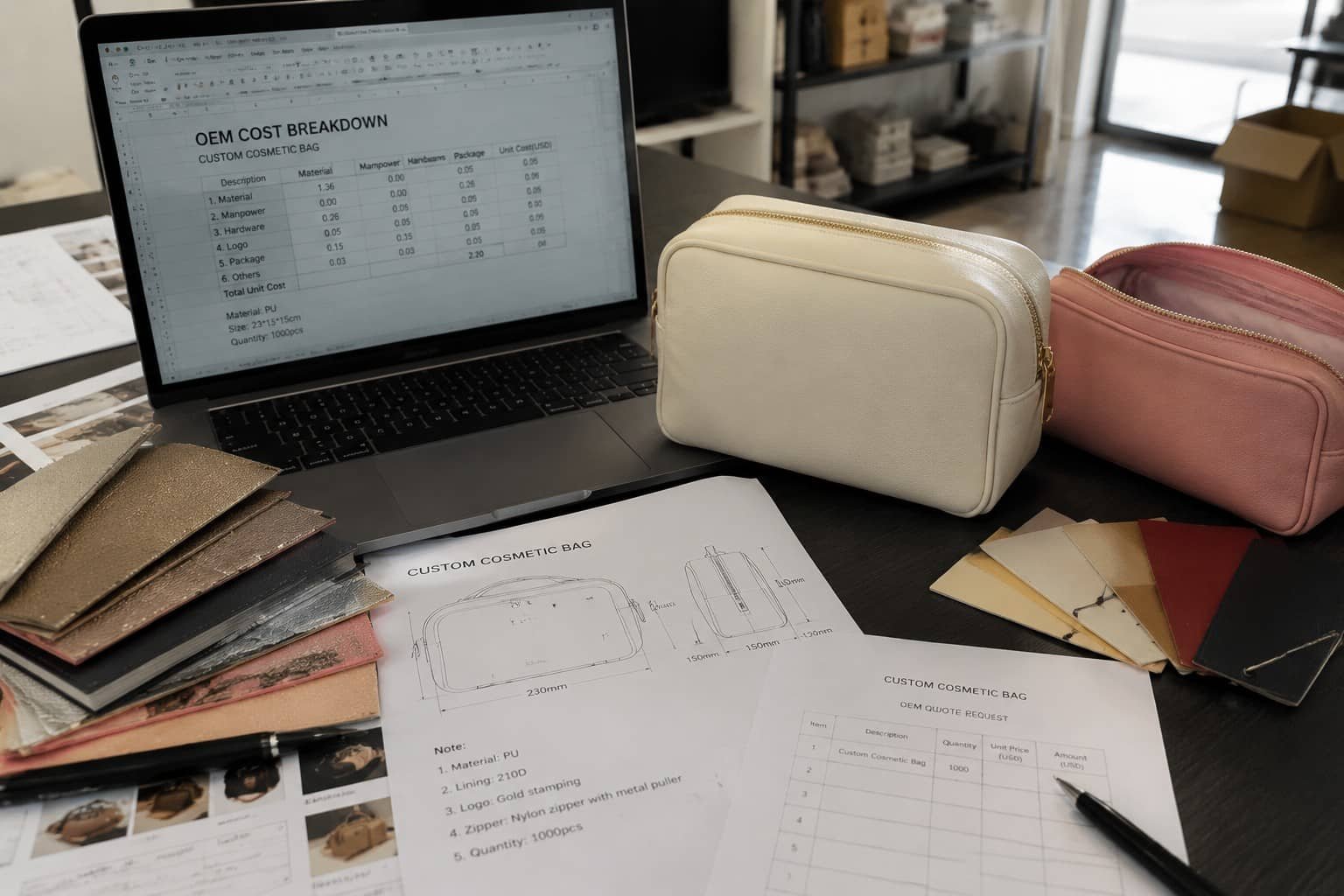
To get an accurate quotation and smooth the sampling process, prepare: (1) Bag dimensions (length × width × height in cm or inches), (2) Preferred material type or a reference to a material you like, (3) Logo artwork or a description of your branding vision, (4) Target order quantity (even a rough range helps), and (5) Reference images — photos of bags you like, competitor samples, or even rough sketches. The more visual the brief, the faster the manufacturer can deliver an accurate prototype.
What is the minimum order quantity for custom makeup bags?
MOQs typically start from 100 pieces per design for custom production runs, though this varies by material and bag complexity. Some manufacturers work with startup brands and accept lower quantities for initial orders with adjusted pricing. The MOQ is primarily driven by material minimums and production line setup time.
How much do custom makeup bags cost to produce?
Per-unit cost depends on material choice, bag size and complexity, order quantity, logo method, and packaging requirements. A simple PU pouch costs significantly less than a full-grain leather vanity case with custom hardware. Larger order quantities reduce per-unit cost as fixed costs (pattern making, die creation, production line setup) are amortized across more units. Request a quote with your specific design requirements for accurate pricing.
How do I start a custom makeup bag project?
The process begins with five steps: (1) Share your design idea using sketches, reference images, or an existing sample with your manufacturer. (2) Confirm materials and receive a quotation based on your specifications and order volume. (3) The factory develops a prototype sample for your review. (4) Approve the pre-production sample after any needed revisions. (5) Bulk production begins, followed by QC inspection and shipment. A clear, visual design brief at step one shortens the entire timeline significantly.