Quick Summary:
Ranges below are FOB Guangzhou as of Q3 2026, based on our own production data. We revise them when PU, nylon or hardware pricing moves more than 5%.
Custom cosmetic bag cost is driven by six layers, not five. Material sets 30–50%. Order quantity moves the unit price 5–10% at each of the 300 / 1,000 / 3,000 thresholds — 15–25% cumulative from 100 to 3,000 pieces. Design complexity adds labour hour by hour. Logo splits into a one-time die cost plus a per-unit application cost. Packaging runs from poly bag to rigid box. Overhead, waste and margin take the remaining 15–25% — the layer quotations rarely show.
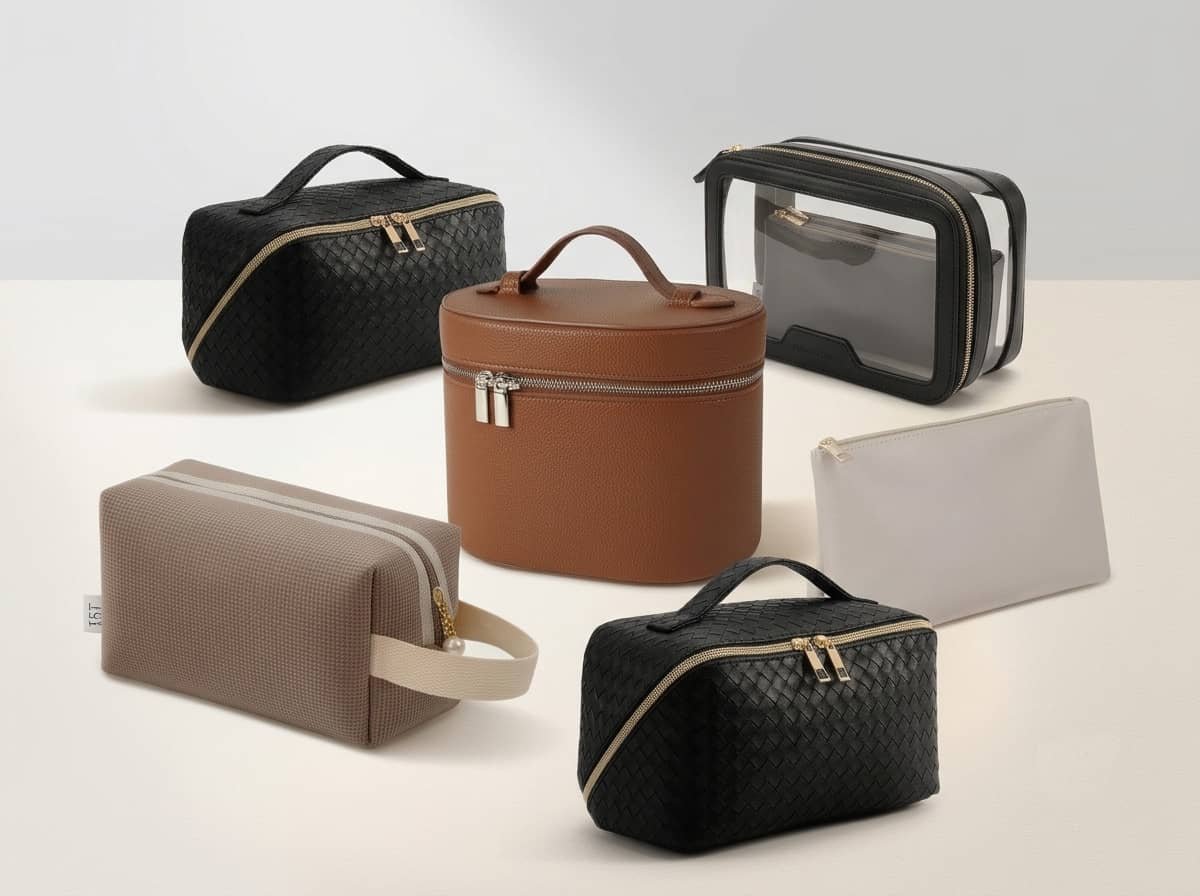
At 1,000 units: canvas pouch $1.50–3.00 · PU leather bag $3.00–12.00 · travel organizer $5.00–12.00 · structured vanity case $8.00–18.00 · genuine leather case $12.00–25.00 · TPU pouch $2.50–6.00.
Five things to know before you read the numbers
- Material is the biggest lever — leather costs 3–7× canvas and drags labour, hardware and packaging with it.
- MOQ creates cliffs, not slopes. The breaks sit at 300, 1,000 and 3,000.
- Quotes are not comparable by default — $5.00 FOB in a poly bag is not $5.50 DDP in a gift box.
- Hidden costs are predictable. Budget 15–20% above the unit price for a first order.
- Experience beats a low quote. Extra sampling rounds and defect rates cost more than $0.30/unit.
Table of Contents
Introduction: Why Your Cosmetic Bag Quotes Vary by 3×
If you’ve requested custom cosmetic bag quotes from three manufacturers and received prices ranging from $2.80 to $11.50 for what looks like the same bag — you’re not being played. You’re seeing five independent cost variables at work, and understanding them is the difference between a smart sourcing decision and an expensive mistake.
Based on our experience working with beauty brands and private label buyers, the single biggest predictor of a smooth sourcing experience isn’t the brand’s budget or design taste. It’s whether the buyer understands what drives the quote before they open it.
This guide isn’t here to give you a fixed price list — because honest OEM factories don’t give flat price lists for custom products. It’s here to teach you how to read a cosmetic bag quotation the way a factory actually builds it. By the end, you’ll know which line items to question, which ones are standard, and which suppliers are quoting a number designed to win the first email — not deliver the product you’re imagining.
The 6-Layer Anatomy of a Cosmetic Bag Quote
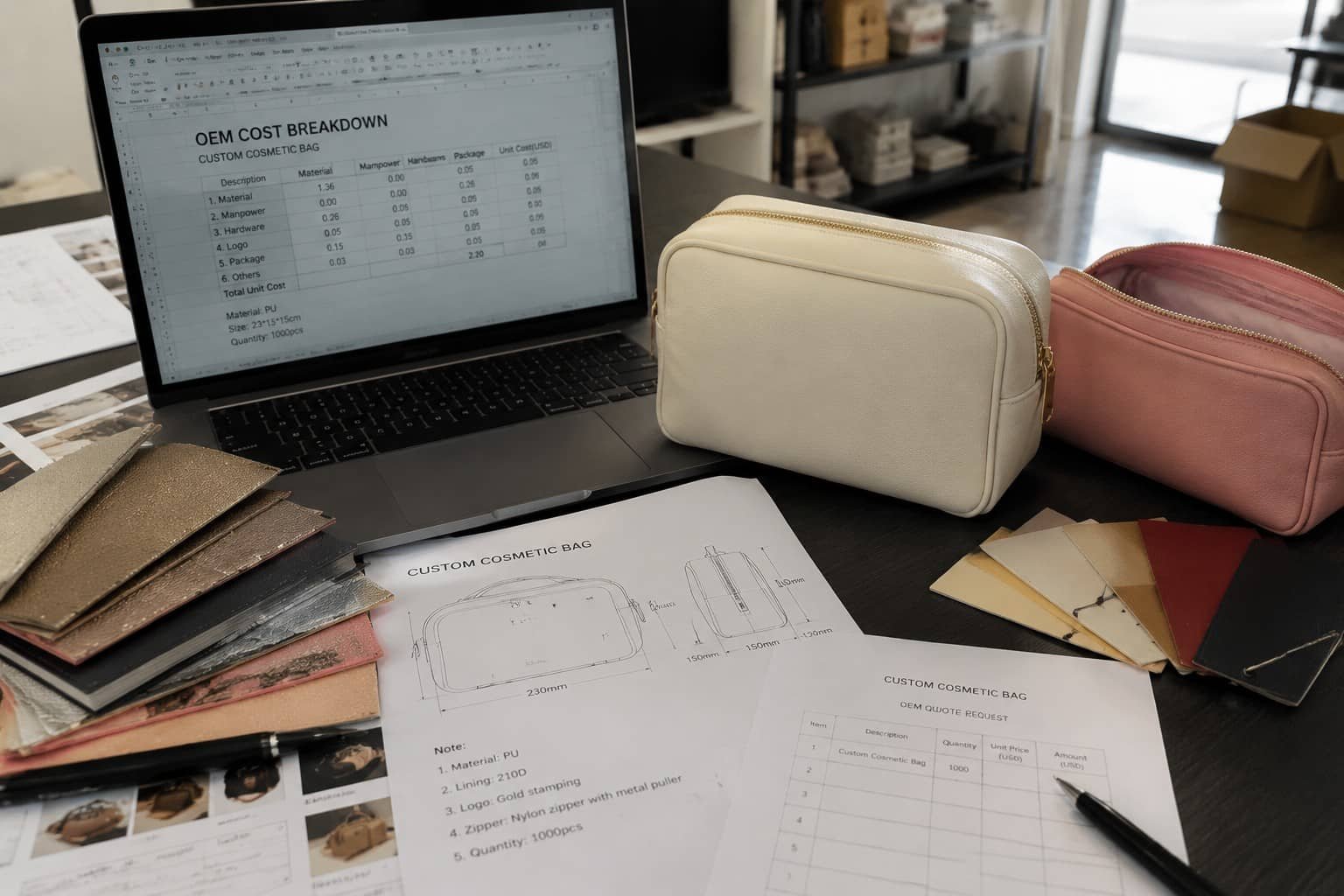
Most custom cosmetic bag quotes arrive as a single number. They’re not. Every OEM price is the sum of six cost layers, and each one moves independently. Here’s how the math actually works.
| Cost Layer | Typical Share of Total | What It Includes | What Moves It |
|---|---|---|---|
| 1. Raw Materials | 30–50% | Outer fabric, lining, interfacing, thread, zipper tape | Material type, thickness, supplier grade, custom dyeing |
| 2. Direct Labor | 20–30% | Cutting, stitching, assembly, QC inspection | Panel count, seam complexity, skilled vs. unskilled operations |
| 3. Hardware & Components | 5–15% | Zipper, puller, metal accents, elastic, mesh pockets | Branded vs. generic, metal vs. nylon, custom mold requirements |
| 4. Logo & Customization | 3–10% | Logo application, branding decoration per unit | Method (silkscreen vs. embossing), one-time setup amortization |
| 5. Packaging | 5–15% | Inner packaging, export carton, pallet, freight | Poly bag vs. gift box, FOB vs. DDP, shipment volume |
| 6. Overhead, Waste & Margin | 15–25% | Factory management costs, utilities, rent, material waste, and reasonable profit | Order size, material (leather wastes 15–25%), payment terms |
The key insight: when one factory quotes $4.00 and another quotes $5.80 for the “same bag,” they’re rarely building the same cost profile. Factory A might be quoting 0.4mm PU with a standard nylon zipper, poly bag packaging, and FOB terms. Factory B might be quoting 0.6mm PU with a YKK zipper, branded gift box, and DDP delivery. The $1.80 difference isn’t margin — it’s a different product.
How Much Do Custom Cosmetic Bags Cost?
Rather than giving you a fixed price that will be outdated before you read it, here’s how brand spending actually distributes across real OEM cosmetic bag projects — drawn from our production data.
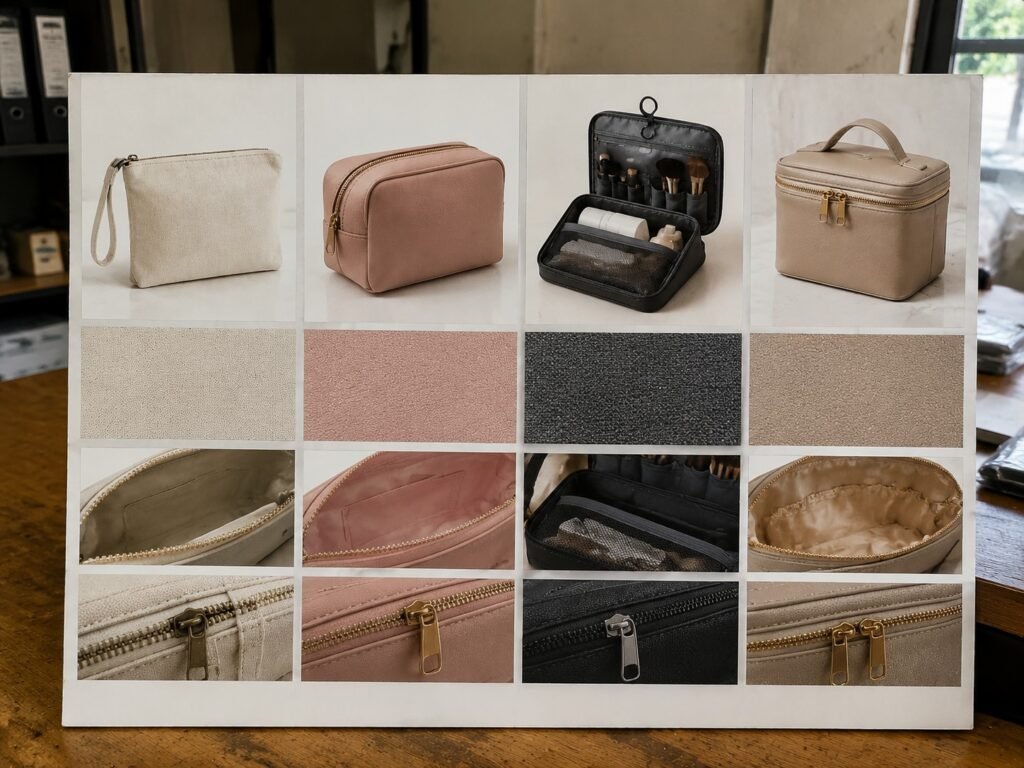
Cosmetic Bag Cost Range by Product Type
| Cosmetic Bag Type | Typical FOB Range (per unit) | Material Examples | Industry-typical MOQ | Best For |
|---|---|---|---|---|
| Simple Canvas Pouch | $1.50–3.00 | 10–12oz cotton canvas, basic nylon zipper | 300–500 | Promotional giveaways, subscription box inserts, trade show handouts |
| PU Leather Cosmetic Bag | $3.00–12.00 | 0.6–0.8mm PU, microfiber backing, custom color | 300–1,000 | Private label beauty brands, mid-market retail, fashion accessory lines |
| Travel Organizer Bag | $5.00–12.00 | 420D nylon or PU, multi-compartment, waterproof lining | 500–1,000 | Travel accessory brands, airline amenity kits, outdoor retailers |
| Structured Vanity Case | $8.00–18.00 | PU or genuine leather, structured panels, metal hardware, internal organization | 300–500 | Professional MUA kits, premium gift sets, department store retail |
| Genuine Leather Cosmetic Case | $12.00–25.00+ | 1.0–1.4mm full-grain or top-grain leather, metal YKK zippers | 300–500 | Luxury beauty brands, high-end hotel amenity kits, limited-edition collaborations |
| Transparent TPU Pouch | $2.50–6.00 | 0.4–0.5mm TPU, ultrasonic welded seams | 500–1,000 | TSA-compliant travel, duty-free retail, modern minimalist beauty brands |
Solton accepts 100 pcs per style per colour on most of these constructions, at a 10–20% per-unit premium over 1,000-piece pricing.
Three things this table should tell you:
Most brands cluster in the $3.00–12.00 range. About 45% of the custom projects we produce sit here — structured PU or entry-level leather, custom color, branded packaging. If you’re a beauty brand or private label launching your first collection, this is almost certainly where you land.
Luxury doesn’t always mean high quantity. Premium brands often order 300–500 units of a leather vanity case at $15–25/unit — higher per-unit investment, lower total inventory risk. The math works because their retail price supports it.
Your cost tier is set by your customer, not your factory. A brand selling $60 skincare sets at Nordstrom can’t use a $1.80 giveaway pouch. A brand selling $12 lip kits on Instagram can’t use a $16 leather case. Work backwards from your retail price, not forwards from the factory quote.
Important: These are FOB cost ranges — the price ex-factory, before international freight, import duties, and local delivery. If you’re comparing quotes across suppliers, confirm whether each quote is FOB, CIF, or DDP. An FOB quote at $5.00 can end up costing $6.50–7.00 landed after freight and duties. See the Hidden Costs section for a full breakdown, or how we quote custom cosmetic bags for the same six layers in the order we price them.
One Bag, Costed From the Bottom Up
Abstract percentages only get you so far. Here is a single specification costed layer by layer — structured PU cosmetic bag, four panels, 1,000 units, FOB Guangzhou.
| Layer | Share | Per unit | What sits inside |
|---|---|---|---|
| Raw materials | 40% | $2.00 | 0.6mm PU (1.4 m), 210D lining, base board, zip tape |
| Direct labour | 22% | $1.10 | 4-panel construction, ~18 minutes cut-to-pack |
| Hardware | 10% | $0.50 | #5 nylon zip, metal puller, internal pocket zip |
| Logo | 4% | $0.20 | Deboss: brass die $120 ÷ 1,000 = $0.12, pressing $0.08 |
| Packaging | 8% | $0.40 | Poly bag, brand sticker, export carton share |
| Overhead, waste & margin | 16% | $0.80 | Factory overhead, waste, margin |
| FOB per unit | 100% | $5.00 | Excludes freight, duty and testing |
Now change one variable at a time and watch which layer moves:
| Change | New FOB | Which layer moved, and by how much |
|---|---|---|
| 1,000 → 300 units | $5.85 +17% | Material +15% at small-lot pricing ($2.30); logo die amortises to $0.40; packaging +10% ($0.44) |
| PU → 12oz canvas, silkscreen logo | $3.50 −30% | Material $1.30; labour $1.00; hardware $0.32 (nylon zip, no metal); logo $0.11 (screen $40 ÷ 1,000) |
| PU → 1.2mm genuine leather, at 300 units | $13.70 +174% | Material $6.50 incl. 15–25% hide waste (+225%); labour $1.55; hardware $0.70; logo $0.65 (die $150 ÷ 300) |
Read the second column, not the first. The point is not that canvas is cheaper — you already knew that. It’s that a 30% material saving becomes a 30% saving on the finished bag, while a 15% material premium at low volume becomes a 17% premium once a die designed to spread over 1,000 units has to spread over 300.
1. Material Selection: The Biggest Factor in Custom Cosmetic Bag Cost
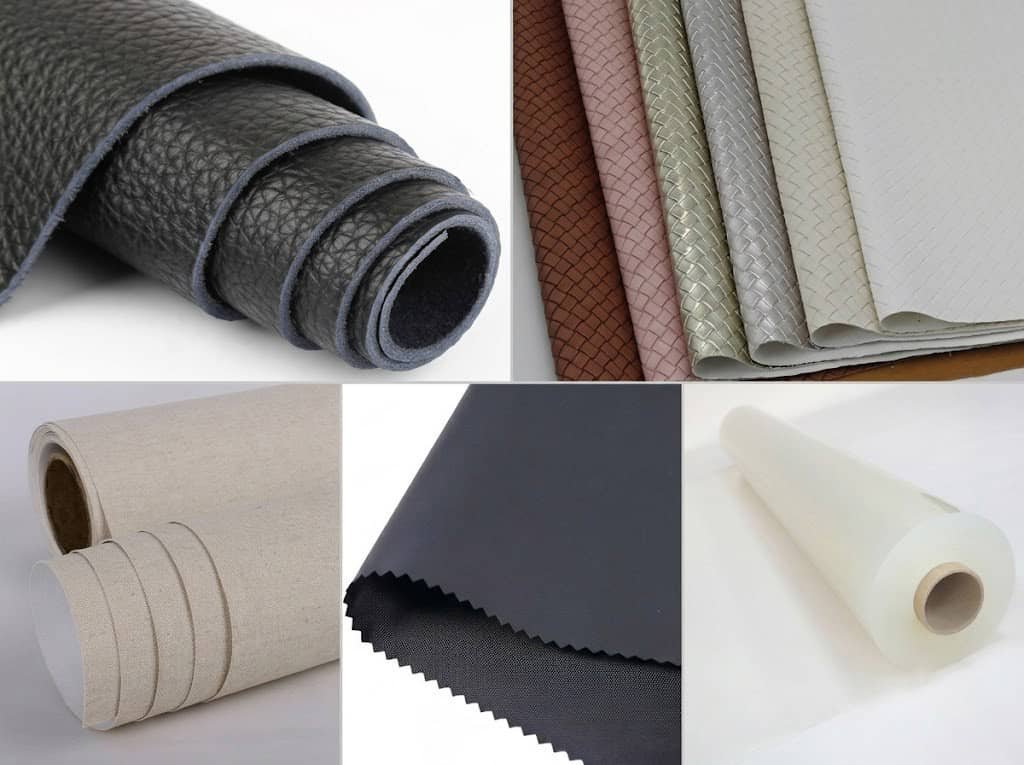
Material doesn’t just set the raw fabric price. It dictates which machines are used, how skilled the operator needs to be, what waste rate to expect, and which logo methods will work. All of that ripples through your OEM quotation.
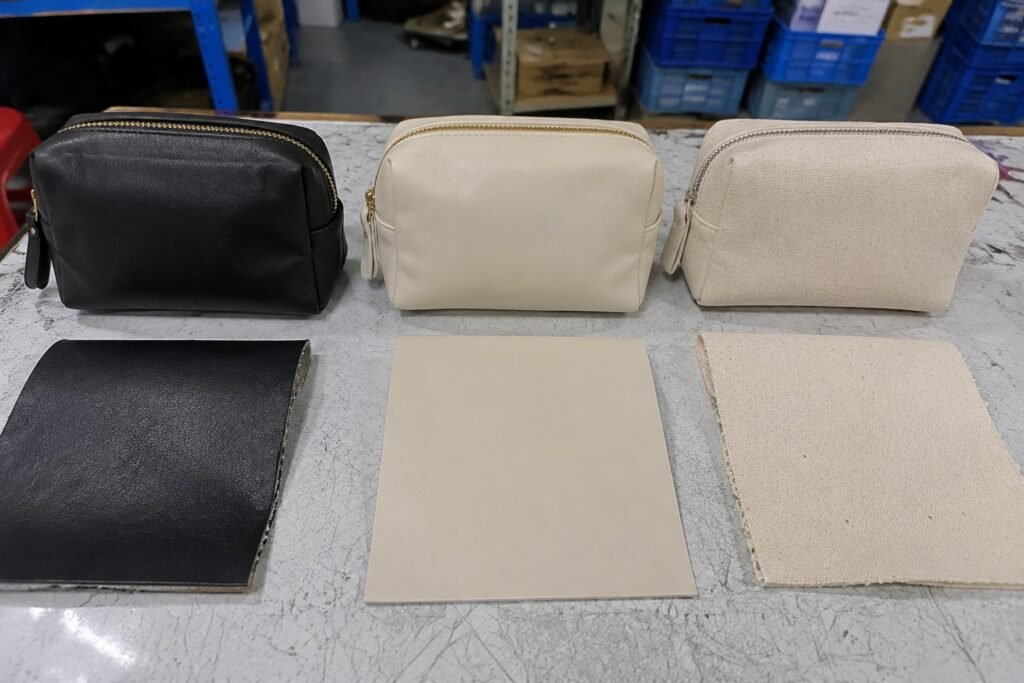
How Material Choice Flows Through to Your Quote
Here’s a real comparison — same bag design, same dimensions (20 × 15 × 8 cm), 1,000 units, from the same factory floor:
| Specification | 12oz Canvas | 1.0mm PU Leather | 1.2mm Genuine Leather |
|---|---|---|---|
| Raw Material Cost | Base | +40–60% vs. canvas | +200–400% vs. canvas |
| Material Waste Rate | 5–8% | 5–8% | 15–25% (hide-dependent) |
| Cutting Labor | Standard — CNC or manual, forgiving material | Standard — consistent surface, low rework | Skilled — hide utilization expertise required |
| Stitching Labor | Standard flatbed machine | Standard flatbed machine | Walking-foot industrial machine, experienced operator |
| Logo Application | Silkscreen or digital print (lowest cost) | Debossing / foil stamping (medium cost) | Brass-die embossing / foil stamping (premium cost) |
| Quality Risk | Low — rework-friendly | Low-Medium — batch consistency high | Medium — natural hide variations, dye lot control |
| Perceived Value | Casual, approachable | Premium fashion | Luxury, heirloom quality |
The takeaway: material cost isn’t a line item you can isolate. It’s a package deal with labor, waste, hardware compatibility, and customer perception. When a brand asks us “how can we get the leather look at a PU price?” — we show them 0.8mm matte-finish PU with microfiber backing alongside a leather sample. You get about 80% of the premium feel at roughly 30–40% of the material cost. The remaining 20% is whether your customer genuinely values the natural grain and aging character — or just wants something that looks and feels premium on a shelf.
For a complete breakdown of material options with durability ratings and OEM tips, read our cosmetic bag materials guide.
2. How MOQ Affects Your Custom Cosmetic Bag Unit Price
This is the question every startup brand asks, and the answer is never just “more is cheaper.” MOQ pricing has structure. Understanding where the actual cost breaks happen changes how you plan your order — and how you evaluate supplier quotes.
The Three MOQ Thresholds in Custom Cosmetic Bag Production
In our production experience, meaningful per-unit cost breaks happen at three specific thresholds:
| MOQ Range | What Changes | Typical Unit Price Reduction vs. Previous Tier | Best For |
|---|---|---|---|
| 100–300 units | Baseline setup costs covered. Materials bought at small-lot pricing. | Baseline | Startups testing a new design, first production run, market validation |
| 300–1,000 units | Bulk material purchasing activates. Setup cost amortized across more units. | ~5–10% drop from sub-300 pricing | First serious production order, private label launch, seasonal collection |
| 1,000–3,000 units | Full wholesale material pricing. Dedicated production line becomes viable. | ~5–10% drop from 300–1,000 pricing | Established brands on reorder, proven SKUs, annual collection launch |
| 3,000+ units | Maximum purchasing leverage. Line production at peak efficiency. | ~5–8% drop from 1,000–3,000 pricing | Large-scale brands, promotional campaigns, subscription box programs |
The Startup MOQ Dilemma
Here’s something most pricing guides won’t tell you: for a startup testing the market, a higher unit cost at lower MOQ is often the smarter financial move. At 100 units you are buying information, not inventory — you find out whether the bag actually sells before you commit working capital to 900 more units you may end up discounting, storing, or writing off. A 30% higher unit price on a 100-piece run costs you a few hundred dollars. Guessing wrong on 1,000 pieces costs you thousands.
A brand testing their first cosmetic bag design orders 100 units at $8/unit = $800 total cash outlay. At 1,000 units, the price drops to $5/unit — but now they’re committing $5,000 in cash and sitting on 900 units of inventory they haven’t validated yet.
The “cheaper” unit price costs them $4,200 more in total cash and creates significant inventory risk. For a market test, the lower-MOQ, higher-unit-cost option preserves cash and flexibility.
Our OEM MOQ Approach
Our standard MOQ is 100 pieces per style per colour on most constructions. We will tell you when moving to 500–1,000 buys a real material break, and when it does not — that call is worth more than the discount.
3. Design Complexity and Manufacturing Cost
This is where design decisions meet factory-floor reality. Every additional panel, seam, and compartment adds a specific amount of cutting time, stitching time, and QC checkpoints. The fastest way to overshoot your budget isn’t choosing leather — it’s designing a bag with twice the assembly time of a simpler version that looks nearly identical.
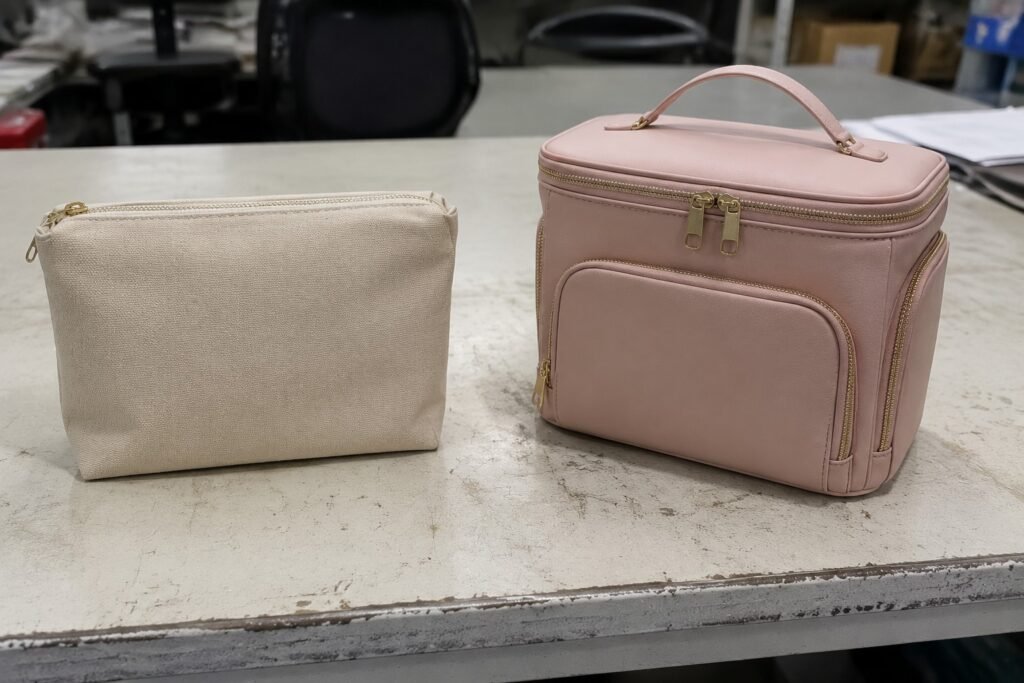
Cosmetic Bag Complexity Self-Assessment
Use this framework to estimate where your design lands for cosmetic bag styles before you contact a manufacturer:
Score 1 point for each feature your design includes:
- ☐ More than 2 main body panels (a basic flat pouch uses 2 panels; a structured case uses 4–6)
- ☐ Internal divider or separate compartment
- ☐ Elastic brush loops or internal organization
- ☐ Waterproof lining in one or more sections
- ☐ Non-rectangular shape (curved edges, trapezoid, custom silhouette)
- ☐ Detachable strap, wristlet, or handle
- ☐ Metal hardware beyond the zipper (buckles, D-rings, frame closure)
- ☐ Custom-shaped gusset or base panel
| Your Score | Complexity Level | Labor Impact | Typical Lead Time | Best For |
|---|---|---|---|---|
| 0–2 | Simple | Baseline labor. Fastest production. | 15–25 days | Promotional giveaways, subscription box inserts, budget-conscious launches |
| 3–5 | Moderate | +20–40% labor vs. simple. Standard for branded cosmetic bags. | 25–35 days | Private label beauty brands, mid-market retail, fashion accessory lines |
| 6+ | Complex | +50–100%+ labor. Requires experienced operators. | 35–45 days | Professional MUA kits, luxury vanity cases, premium gift sets |
A real example from our floor: A brand came to us with a 6-panel structured vanity case — separate base gusset, two internal mesh pockets, detachable wristlet, custom metal feet. Beautiful design. Complexity score: 7. At 500 units, the quote landed above their $12 budget.
The fix: we consolidated 6 panels into 4 by integrating side panels with the gusset, replaced metal feet with reinforced bottom corners, kept the mesh pockets and wristlet. Complexity score dropped to 4. The bag looked 90% the same. The unit cost dropped 28%. They launched on budget.
The design-to-cost rule: every time you add a feature, ask — “does this solve a specific customer problem, or am I adding it because it looks good on a sketch?” If you can’t name the user benefit, leave it out for version one.
Every design choice — zipper placement, compartment count, gusset depth — directly affects
your production cost. See how to make cost-smart design decisions in our custom makeup bag design guide.
4. Customization Options: One-Time Setup vs. Per-Unit Costs
This is the pricing detail that separates experienced buyers from first-timers. Most customization has two cost components that buyers often confuse: a one-time setup fee and a per-unit application cost. Mixing these up — or not knowing which is which — leads to sticker shock when the OEM quote arrives.
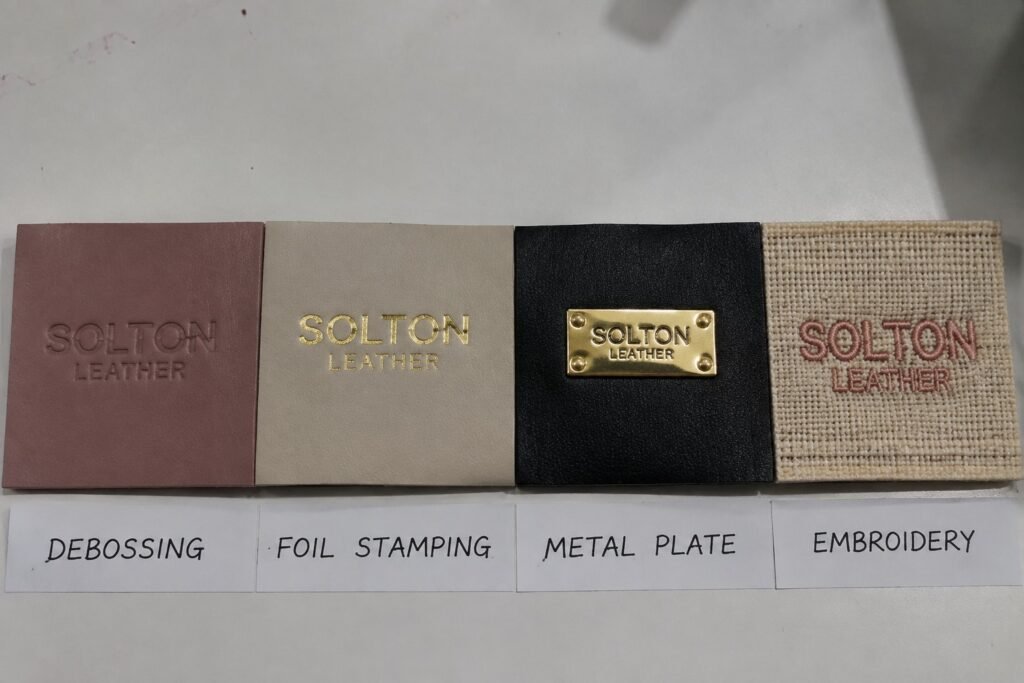
| Logo Method | One-Time Setup | Compatible Materials | Durability |
|---|---|---|---|
| Silkscreen Print | $30–50 (screen) | Canvas (best), PU, Nylon | Medium — may fade with heavy abrasion |
| Heat Transfer | $40–80 (film) | Canvas, PU, Nylon | Medium — depends on application quality |
| Debossing / Embossing | $80–150 (brass die) | Leather (best), PU leather | High — permanent, won’t wear off |
| Foil Stamping | $80–150 (brass die) | Leather (best), PU leather | High — metallic finish, permanent |
| Metal Logo Plate | $100–200 (mold) | Leather, PU, Canvas (sewn-on) | Highest — physical metal, premium |
| UV Digital Print | $0 (no setup) | TPU (best), Canvas, PU | Medium-High on TPU, medium on fabric |
| Embroidery | $40–60 (digitizing) | Canvas (best), Nylon | High — thread, permanent |
What this means for your cosmetic bag quotation:
- Ordering 300 units?One-time setup fees (brass die $120, mold $150) add roughly $0.90/unit at 300 units but only $0.09 at 3,000 units. Low-volume orders feel customization costs more acutely. Consider silkscreen or UV print for first runs — lower setup costs, easier to iterate.
- Custom zipper pullers with your logo?Great for branding, but the mold costs $150–300. At under 1,000 units, we often recommend a standard YKK puller plus a branded hangtag ($0.05–0.10/unit) instead. Upgrade to custom pulls on the reorder when volume justifies the mold.
- Custom Pantone dyeing?Standard supplier color catalogs: no surcharge. Matching a specific Pantone shade: $50–150 per custom dye lot, and may increase the material MOQ.
Pro tip:
Test your logo on your actual material before commissioning tooling. A debossing die designed for 1.2mm leather won’t register cleanly on 0.6mm PU. A 10-minute test press on a material swatch costs nothing and catches this mismatch before you spend $120 on a die.
5. Packaging: The Cost Most Brands Forget to Budget
Packaging is the line item that shows up late in the sourcing process and surprises brands the most. A factory quotation for “$5.00/unit FOB” rarely includes the packaging your brand actually needs at retail.
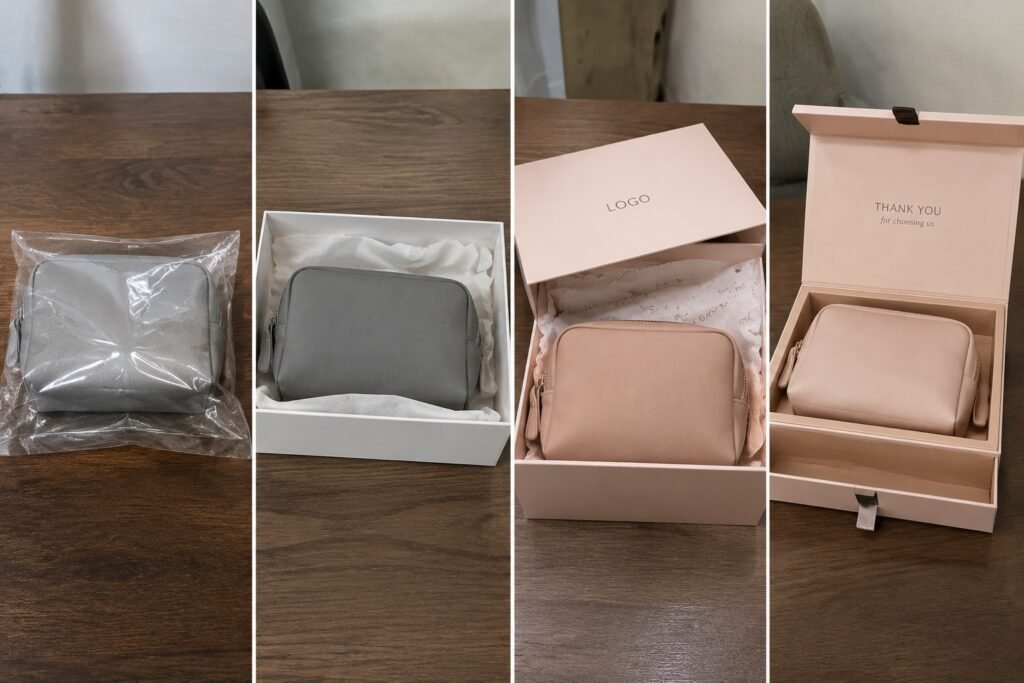
| Packaging Level | What’s Included | Cost Impact | Best For |
|---|---|---|---|
| Basic | Individual poly bag, export carton | Included in most FOB quotes | Wholesale distribution, Amazon FBA, warehouse stock |
| Branded Basic | Poly bag with brand sticker or simple insert card | +$0.10–0.25/unit | Direct-to-consumer brands on a budget |
| Retail-Ready | Individual gift box, branded hangtag, care instruction card | +$0.50–1.50/unit | Department store retail, boutique shelves, premium unboxing |
| Luxury Unboxing | Rigid gift box, custom insert tray, dust bag, tissue paper, outer shipping carton | +$1.50–4.00/unit | Premium beauty brands, gift sets, limited editions |
Private label packaging-budget rule: Decide your packaging level during the design phase, not after the sample is approved. Retrofitting luxury packaging onto a quote built for basic packaging is the #1 cause of “the final cost is higher than we expected.”
6. Hidden Costs: What to Budget Before You Order
These are the costs that experienced buyers budget for and first-timers discover the hard way. Every factory knows about them. Not every factory volunteers them upfront. None of them are scams — they’re standard in custom OEM manufacturing. But they’re only predictable if you know to ask.
| Hidden Cost | What It Is | Typical Range | When It Hits |
|---|---|---|---|
| Custom color matching | Standard supplier color swatches: free. Custom Pantone matching: dye lot setup + potential material MOQ increase. | $50–150 per custom color | Material sourcing phase |
| Custom hardware tooling | Zipper pullers, metal logo plates, custom buckles all require molds that are yours to keep and reuse. | $100–500 one-time per component | Before production begins |
| Inner packaging & labeling | Barcode stickers, price tags, care labels, branded insert cards — often quoted separately. | $0.10–0.40/unit | Final quote stage |
| Third-party lab testing | REACH, CPSIA, Proposition 65 compliance testing for regulated markets. | $200–600 per test batch | Before shipment; budget during planning |
| Freight & import duties | Most OEM quotes are FOB (ex-factory). Sea/air freight, insurance, customs clearance, duties are additional. | Varies by volume, destination, and HS code classification | Post-production, pre-delivery |
How to handle hidden costs proactively:
Ask every manufacturer the same question: “Does your quotation include samples, custom color matching, inner packaging, and shipping? If not, what are those costs separately?” A factory that answers with specific numbers is organized. A factory that says “don’t worry about it” is one you should worry about.
Budget 15–20% above the quoted unit price for your first production order. If the quote is $5.00/unit at 1,000 units — plan for $5.75–6.00 landed. If you come in under, great. If you don’t, you’re not scrambling.
7. Cost Optimization: Strategies We Recommend to OEM Clients
These aren’t generic suggestions. They come from 400+ brand conversations where the goal was “make it work at this budget” — not “spend less by cutting corners.”
A skincare brand wanted full-grain leather exterior + genuine suede interior for a $6/unit budget at 500 units. The math didn’t work — suede lining alone would consume roughly $2 of that budget before we addressed the exterior.
What we recommended: Top-grain leather exterior (same premium look, 30% lower material cost than full-grain) + microfiber interior (suede-like hand-feel, more stain-resistant, 50% less than genuine suede). Result: 90% of the premium feel at roughly 60% of the material cost. The brand hit their $6 budget and the unboxing experience was indistinguishable from the original specification.
Strategy 2: Structural Simplification
A 3-panel structured cosmetic case with a separate bottom gusset requires approximately 40% more stitching time than a 2-panel design with an integrated base. On a 1,000-unit order, that structural difference alone shifts labor cost by $0.40–0.80/unit — without changing the bag’s external appearance.
Simplify your design: can any panels be combined? Can a separate base gusset integrate into the side panels? Every seam you eliminate saves cutting time, stitching time, and one fewer QC checkpoint.
Strategy 3: Hardware Phasing
Custom zipper pulls with your brand logo: excellent for branding, but the mold costs $150–300. For a first production run under 1,000 units, that mold amortizes to $0.15–0.30/unit on top of the per-unit pull cost.
Alternative: Use standard YKK pulls for the first order. Add a branded hangtag ($0.05–0.10/unit, no mold) and a custom-printed care card ($0.03–0.08/unit). Total branding impact is comparable. On the reorder, when volume justifies the mold, upgrade to custom pulls — your customers won’t notice the difference in version one.
Strategy 4: Production Timing
Every OEM factory has a seasonal rhythm. February through April, brands rush for spring/summer launches. September through November, everyone pushes for holiday and Q1 planning. Lead times stretch, and factories running at full capacity have less incentive to negotiate on pricing.
If your timeline is flexible: plan production during slower windows (November–January, July–August). You’ll typically get faster turnaround, more factory attention, and better pricing leverage. If your timeline isn’t flexible, plan 12–14 weeks door-to-door from design brief to delivery, and accept that peak-season production commands a premium.
8. Why Working With an Experienced Cosmetic Bag Manufacturer Matters
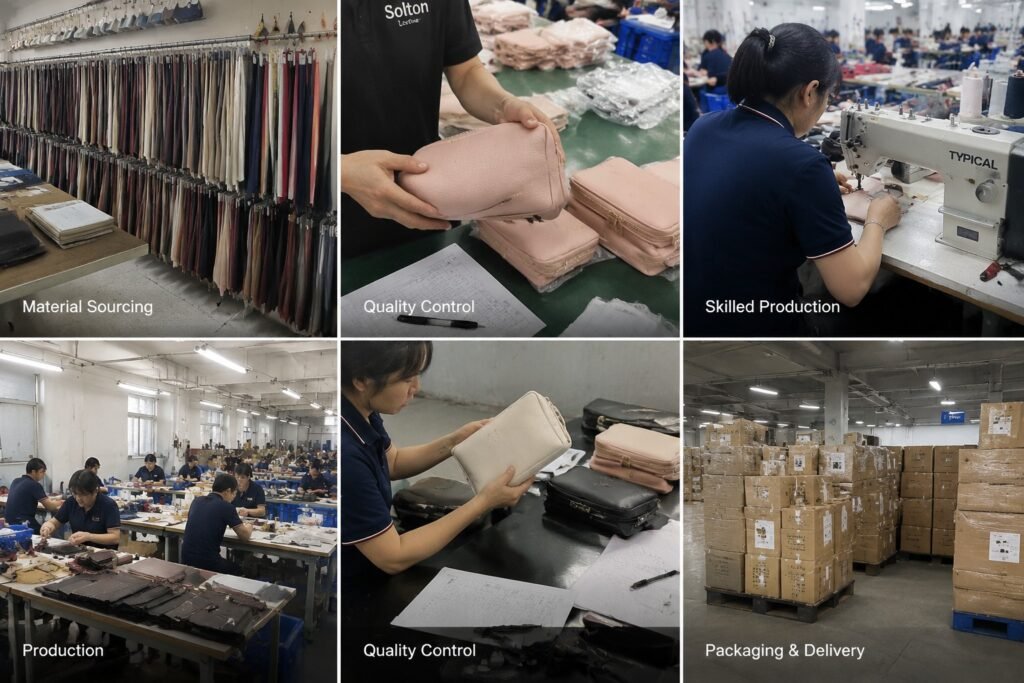
Why Experience Shows Up in the Price
Three places, all measurable.
Hide utilisation is the clearest. A factory that cuts leather daily runs 80–85% utilisation; a canvas shop that “can also do leather” runs closer to 70%. On a 1.2mm hide that gap is roughly 20% more material cost for the same finished bag — invisible in the quote, visible in the invoice.
Sampling rounds are the second. Each extra round adds 7–14 days. A factory that knows your material signs off in 1–2 rounds; one that doesn’t takes 3–4. That is a month of launch timing, which usually costs more than any per-unit difference you negotiated.
Disclosure is the third. A quote broken down by layer lets you cut cost deliberately — reduce packaging, simplify a panel, phase the tooling. A single bottom-line number doesn’t protect the factory’s margin; it prevents you from making an informed decision.
We work the first way. If you want the breakdown, ask for it before you ask for a discount.
More Resources for Cosmetic Bag Buyers
Frequently Asked Questions
What is the MOQ for custom cosmetic bags?
MOQ varies by material and design complexity. Canvas and basic PU cosmetic pouches typically start at 200–300 units. Genuine leather bags usually start at 300–500 units due to hide sourcing economics. TPU and multi-compartment designs may require 500+ units. At Solton Leather, our standard MOQ starts at 100 pieces per style per color for most materials and designs, with flexible low-MOQ options available for brands testing new products. If your target quantity is under 300 units, expect a 10–20% per-unit premium over 1,000-unit pricing.
Does a custom logo increase cosmetic bag cost?
Yes — through two separate costs: a one-time setup fee (e.g., brass die for embossing: $80–150; mold for metal logo plate: $100–200; silkscreen: $30–50) and a per-unit application cost ($0.05–1.50/unit depending on method). One-time fees become negligible at high volumes (e.g., $120 die ÷ 3,000 units = $0.04/unit) but are significant at low volumes ($120 ÷ 300 units = $0.40/unit). For first production runs under 500 units, consider silkscreen or UV digital print to keep setup costs low, then upgrade to embossing or metal plates on reorders.
How do I compare OEM quotes from different cosmetic bag manufacturers?
Don’t compare the final number — compare what’s inside it. Request a cost breakdown by layer (material, labor, hardware, logo, packaging) from each supplier. Confirm whether each quote is FOB, CIF, or DDP. Ask what packaging is included. Verify material thickness specifications — one factory’s “PU leather cosmetic bag” might be 0.4mm; another’s might be 0.6mm. A factory that provides a transparent cost breakdown on the first quotation is almost always a better long-term partner than one that gives you only a bottom-line number.
What's the difference between FOB and DDP pricing for cosmetic bags?
FOB (Free On Board): the factory’s price covers production and delivery to the export port. You handle and pay for sea/air freight, insurance, customs clearance, import duties, and local delivery separately. Most OEM quotes default to FOB. DDP (Delivered Duty Paid): the factory or their logistics partner handles everything door-to-door, including duties and taxes. DDP is more convenient but typically 15–25% more expensive, as the factory builds in a risk buffer for duty and logistics variables. For first-time importers, DDP simplifies the process; for experienced buyers with their own freight forwarder, FOB usually offers better cost transparency and control.