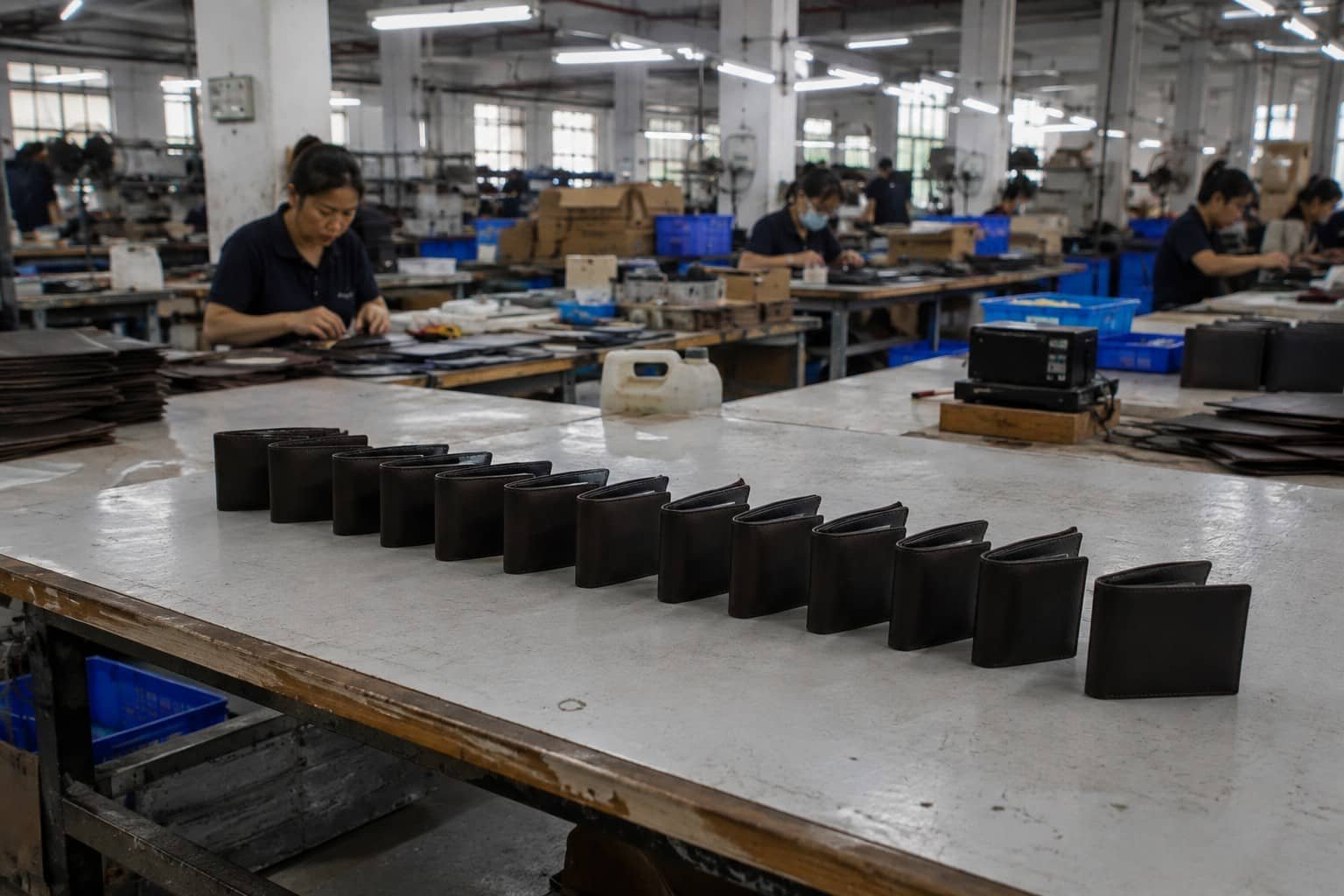
A leather wallet may look like a simple small leather accessory, but producing a consistent, retail-ready wallet requires precise control over materials, construction, thickness, stitching, edge finishing, branding and quality. For a brand, wholesaler or private label buyer, understanding the full leather wallet manufacturing process is not a technical curiosity — it is the difference between a product that sells and a product that gets returned.
This guide walks through every stage of custom wallet production, from the design brief and material selection to sampling, assembly, quality control and mass production. By the end, you will know what to prepare before contacting a factory, what to check during sample approval, and how to evaluate a manufacturing partner. Whether you are launching your first small leather goods line or scaling an existing collection, the principles below will help you specify better, sample faster and order with confidence.
Table of Contents
1. Leather Wallet Manufacturing Process at a Glance
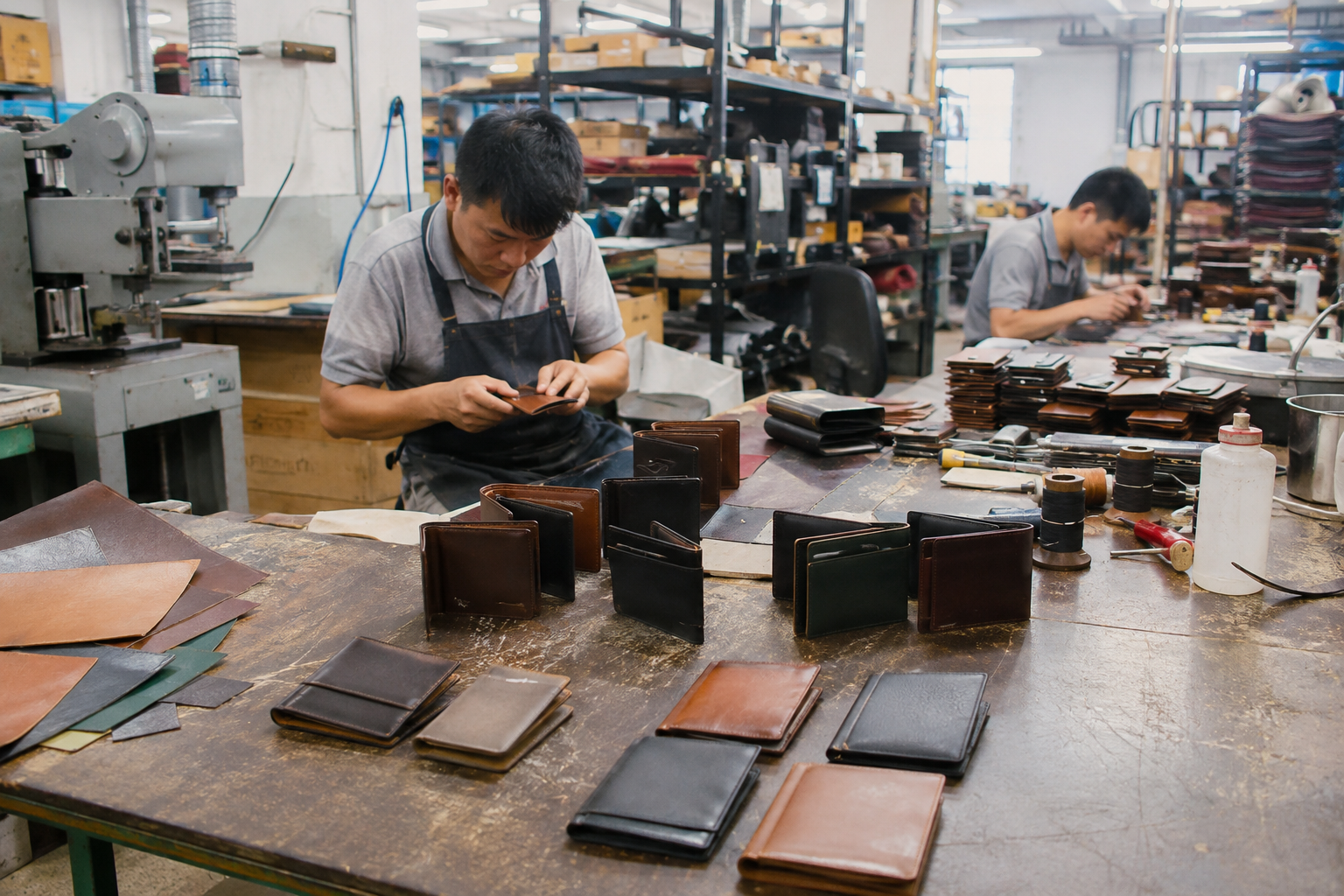
Most people imagine wallet manufacturing as simply “cutting leather and sewing it together.” In reality, a professional production run follows a defined sequence that spans several weeks and includes multiple quality checkpoints.
→ QC → Mass Production
Each stage affects the one after it. A poorly written brief leads to sampling revisions. Inconsistent cutting creates assembly problems. Skipped edge finishing produces a wallet that looks cheap. Understanding this chain is what lets a buyer write a better specification and hold a supplier to a higher standard.
2. Product Design & Specification Development
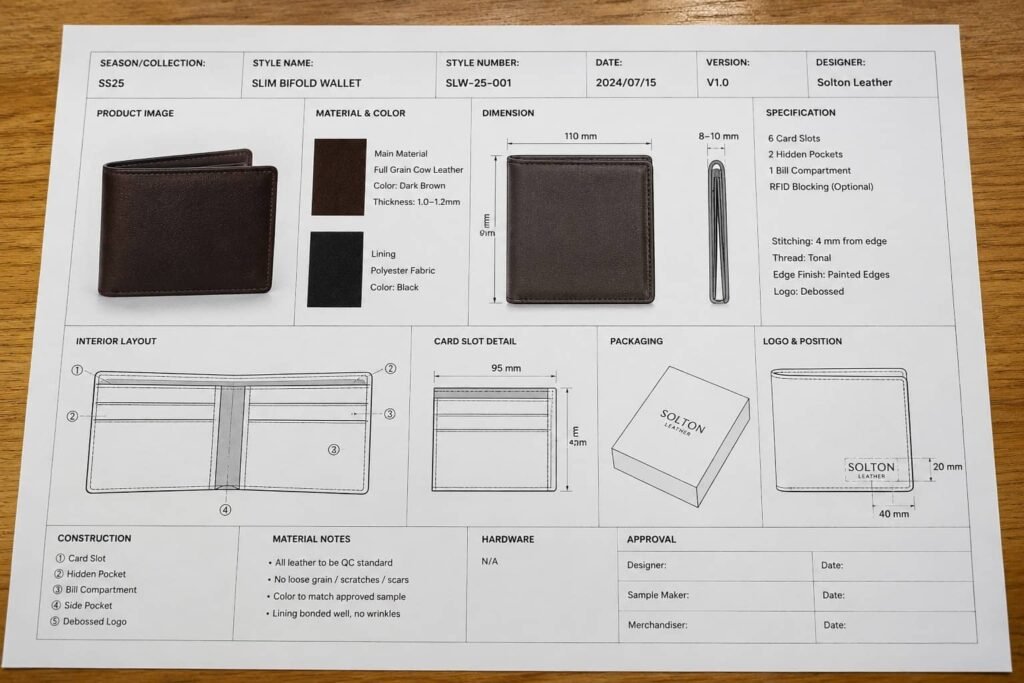
Many brands approach a wallet manufacturer with only a reference photo and a rough idea. The result is usually a long back-and-forth of revisions. A complete product brief shortens the process dramatically — and it is the first signal to a factory that they are working with a professional buyer.
What should buyers provide to a wallet manufacturer?
| Specification | Example |
|---|---|
| Wallet type | Bifold / slim / zip-around |
| Dimensions | L × W × T (closed & open) |
| Leather | Full-grain / top-grain / PU |
| Thickness | Target range (exterior & interior) |
| Card slots | 6 / 8 / 10 |
| Lining | Polyester / microfiber |
| Branding | Deboss / foil stamping |
| Hardware | Zipper / magnetic snap |
| Packaging | Box / dust bag |
| Quantity | Target order volume |
Beyond the technical specification, a complete brief also includes the commercial context that shapes material and construction choices:
The more complete the product brief, the fewer revisions are usually required during sampling. This is why experienced OEM manufacturers ask detailed questions before quoting — it saves both sides time and money.
A common brief mistake
The most frequent error is specifying the finished look without specifying the material thickness. Two wallets can look identical in a photo yet feel completely different in the hand if one uses thicker leather than the other. Always state your preferred thickness range alongside the leather type, because thickness drives both cost and construction decisions downstream.
3. Choosing Leather and Materials for Wallet Manufacturing
Material choice is the single biggest factor in a wallet’s cost, feel and durability. To understand leather properly, it helps to separate the three dimensions that buyers often confuse — grain grade, tanning method and material type. For a full reference, see our leather materials guide.
Leather by grain grade
| Leather Grade | Characteristics | Best For |
|---|---|---|
| Full-grain leather | Natural grain surface left intact and unsanded, showing natural markings; ages beautifully |
Luxury and premium lines |
| Top-grain leather | Top-grain leather retains the outer grain layer but may be lightly corrected or finished for a more uniform appearance. Corrected-grain leather has undergone more extensive surface correction and may be embossed with an artificial grain pattern | Retail and mid-premium collections |
| Split leather | The lower layer separated from the top grain; thinner, softer, with no natural grain |
Linings and economy products |
Leather by tanning method
Tanning is a separate dimension from grain grade. Vegetable-tanned leather is tanned using natural plant extracts and develops a rich patina over time — a favourite for heritage and artisanal brands. Chrome-tanned leather is softer, more uniform and more colour-stable, making it the standard choice for most fashion and retail wallets. A full-grain leather can be either vegetable-tanned or chrome-tanned.
Surface texture vs leather grade
It is worth separating surface texture from leather grade. Full-grain, top-grain and split leather describe how much of the original hide surface is retained, while the finish — smooth, pebbled, Saffiano or embossed — is a separate surface treatment applied on top. This means a full-grain leather can have a smooth, pebbled or embossed appearance, and a top-grain leather can be finished to mimic almost any texture.
Synthetic alternatives
For vegan or cost-driven lines, PU leather and microfiber leather offer a uniform, easy-to-work surface without animal hide. If you’re deciding between animal and synthetic materials, our vegan leather vs real leather guide walks through the trade-offs.
How thickness affects manufacturing
A wallet layers multiple pieces of material, so thickness control matters throughout production. Exterior leather is commonly specified between 0.8mm and 1.2mm depending on the desired feel, while linings and interior panels are typically lighter. The key point is not a single number but consistency — a 0.2mm variation between panels can make a wallet feel lopsided or bulky.
The interior matters as much as the exterior. Polyester and nylon linings are lightweight and affordable for everyday wallets, while microfiber suede offers a premium soft-touch feel for higher-end lines. Hardware — zippers, magnetic snaps and money clips — is equally important: a wallet that looks premium but uses a cheap zipper will fail at the closure first. Ask your manufacturer to specify lining and hardware on the quotation, not just the leather.
4. Pattern Development and Prototype Sampling
Once the design is agreed, the factory creates a paper pattern — the technical template that defines every panel, fold and seam. This is where the wallet’s usability is actually engineered, and where an experienced pattern maker adds the most value.
Pattern development covers
A skilled pattern maker will flag construction issues before any leather is cut — a seam that will pucker at a given material thickness, a card slot positioned so the fold strains, or a gusset that leaves too little interior volume. Catching these at the pattern stage prevents costly sampling rounds later.
Prototype development flow
Design → Pattern → Prototype → Testing → Revision → Final Sample
Most first prototypes need one or two rounds of adjustment — a card slot that is too tight, a fold that doesn’t sit flat, or a zipper that catches at the corner. A professional factory expects this and builds revision rounds into the timeline. Pre-production samples typically take 5-7 working days, with each revision adding a few more.
What should buyers check during sample approval?
– Overall dimensions match the specification
– Card-slot tension is right (not too loose, not too tight)
– Folded thickness is acceptable
– Logo position and clarity are correct
– Stitching is straight and consistent
– Edge finish is smooth
– Color matches the approved swatch
– All functions work (closure, coin pocket, RFID)
5. Cutting, Skiving and Thickness Control
This stage separates a professional wallet manufacturer from a general bag factory. Wallets are small and layered, so cutting precision and thickness control determine whether the final product feels premium or bulky.
Leather inspection before cutting
Before a single panel is cut, incoming hides are checked for grade, thickness, colour consistency and surface defects such as scars, scratches or uneven grain. This incoming inspection is what prevents a batch of wallets from shipping with mismatched panels.
Precision cutting
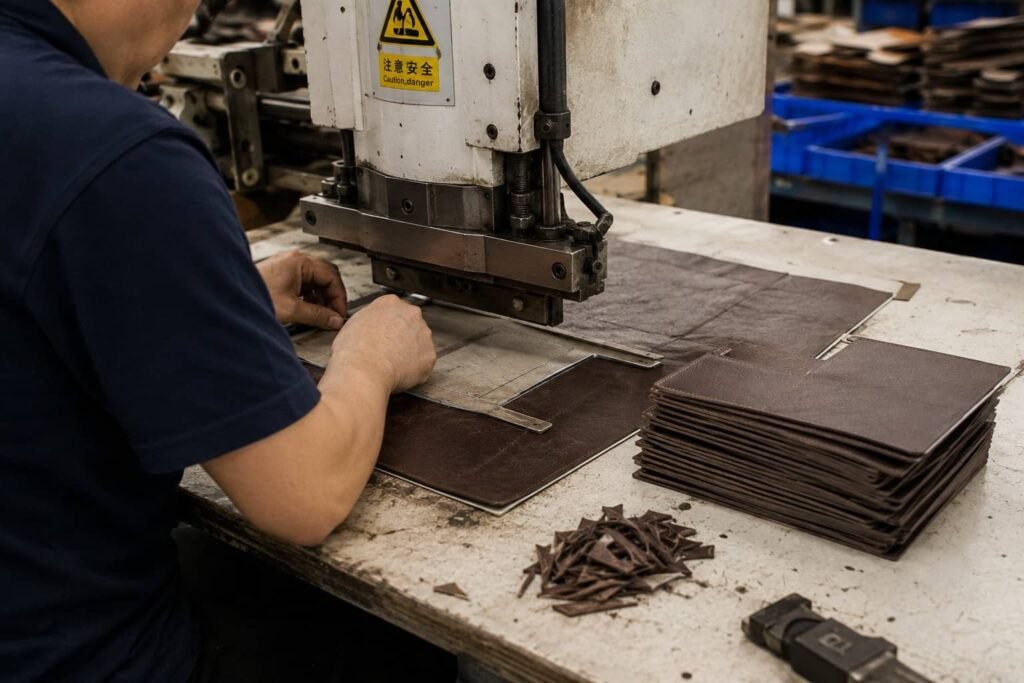
Factory cutting uses steel cutting dies or CNC cutting for consistent panel shapes across hundreds of pieces. Skilled cutters also pay attention to grain direction and material utilization — grain direction affects how the leather bends, and efficient utilization directly lowers the per-unit cost.
Skiving: why it matters
Skiving thins the leather at specific points — along edges, at fold lines, and around card-slot openings. At a folded edge, the leather may be skived down significantly so that several layered panels still produce a slim, clean finished edge. Without proper skiving, a three-layer wallet edge looks thick and unfinished; with it, the wallet folds cleanly and sits flat in a pocket. The exact skiving depth depends on the leather type and construction, so this is a detail to confirm with your manufacturer rather than assume.
Thickness control is equally important for the card slots. If the interior leather is too stiff, cards become difficult to insert; too soft, and the slots lose their shape. The best factories standardize these thicknesses with skiving machines and calipers rather than relying on the operator’s eye.
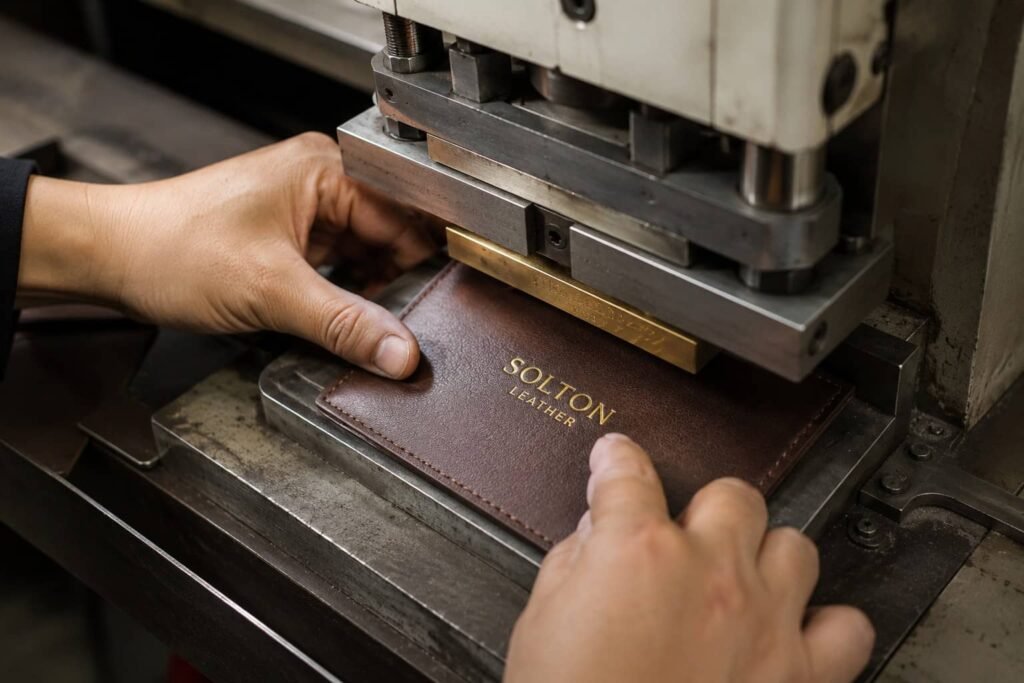
6. Logo Branding and Customization
For private label and OEM buyers, branding is where a generic wallet becomes your product. The right branding method depends on the leather surface, and choosing wrong produces a logo that looks cheap or fades quickly.
Common wallet branding methods
| Branding Method | Effect | Best For |
|---|---|---|
| Blind debossing | Recessed, tone-on-tone logo | Smooth, firm leathers |
| Foil stamping | Metallic logo (gold / silver / rose gold) | Smooth surfaces and TPU |
| Printed logo | Colourful or detailed artwork | Linings and canvas |
| Metal logo plate | Premium metal badge | All materials |
| Laser engraving | Fine, precise, modern lines | Firm, flat leathers |
A critical purchasing tip: logo samples should be tested on the actual leather, not approved only from digital artwork. Different grain textures affect how a logo appears, and a method that looks perfect on smooth PU may look flat on pebble grain. We cover these options in detail on our private label manufacturing page.
7. Wallet Assembly and Stitching
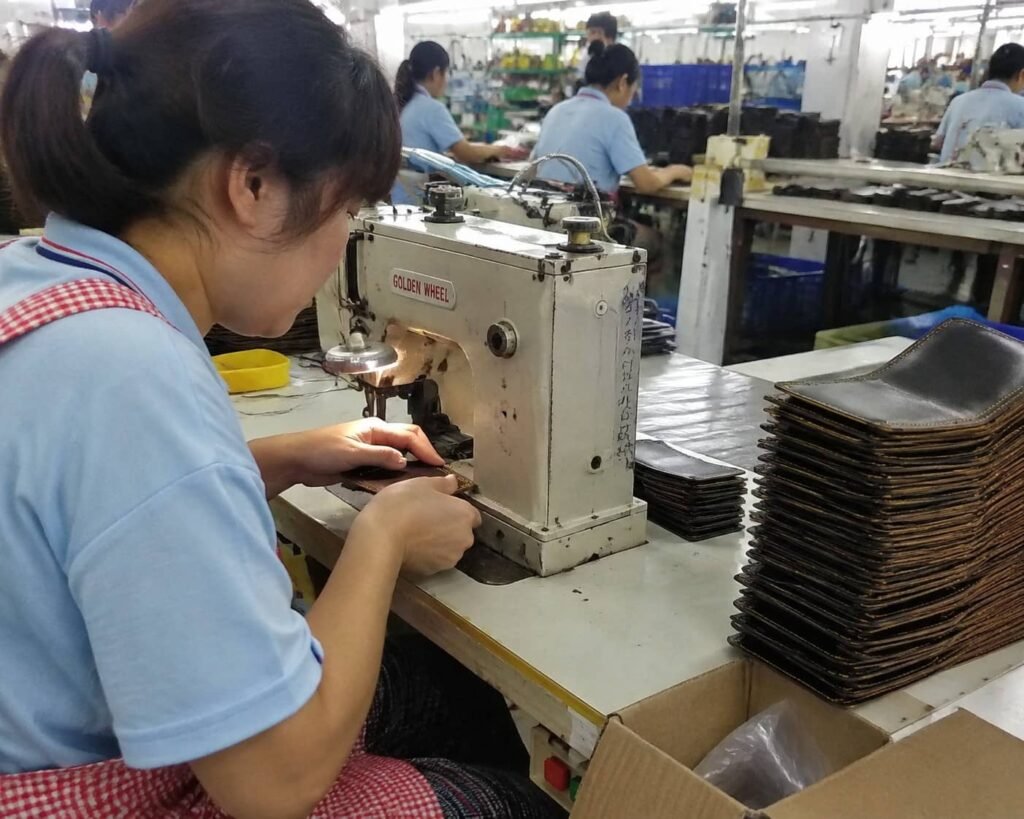
Assembly is where the wallet’s components come together. For a buyer, the key question is not “how is it sewn” but “what determines consistency across a 500-piece order?”
Assembly
The card slots, bill compartment, coin pocket and lining are aligned and bonded before stitching. Precise positioning at this stage is what keeps every card slot level and every fold square across the entire order.
Batch consistency factors
– Stitch spacing
– Stitch tension
– Panel alignment
– Card-slot position
– Thread colour
– Seam allowance
Stitching quality checkpoints
When reviewing a sample, look for these specific defects — each one signals a quality problem that will repeat across the bulk order:
Stitch density for wallets is typically around 7–9 stitches per inch, but it varies by construction, leather thickness and design — this is a typical range, not a universal specification. The consistency of the stitching matters far more than any single number. A well-organized factory uses jigs, templates and standardized workstations to keep these variables controlled — which is what lets a sample produced in week one match the wallets produced in week six.
8. Edge Finishing and Surface Finishing
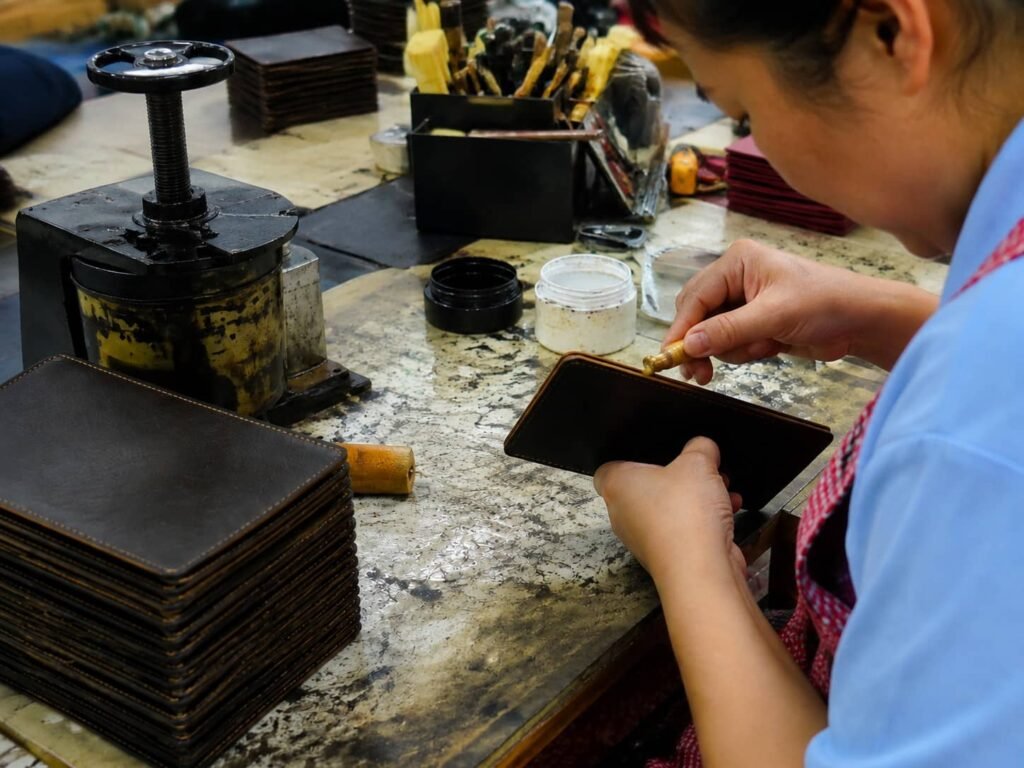
Edges are where wallets show their quality most visibly. Unlike a bag, a wallet’s edges are handled constantly — opened, closed and gripped many times a day — so unfinished or poorly sealed edges become visible very quickly.
Edge finishing methods
Common signs of poor edge finishing include uneven edge paint, cracking, rough sanding, inconsistent thickness, and exposed material layers. When reviewing a sample, run your finger along every edge — if it catches, your customer will notice too. Edge finishing is a detail buyers rarely think to ask about, but it is one of the first things an end customer notices.
9. Quality Control in Leather Wallet Manufacturing
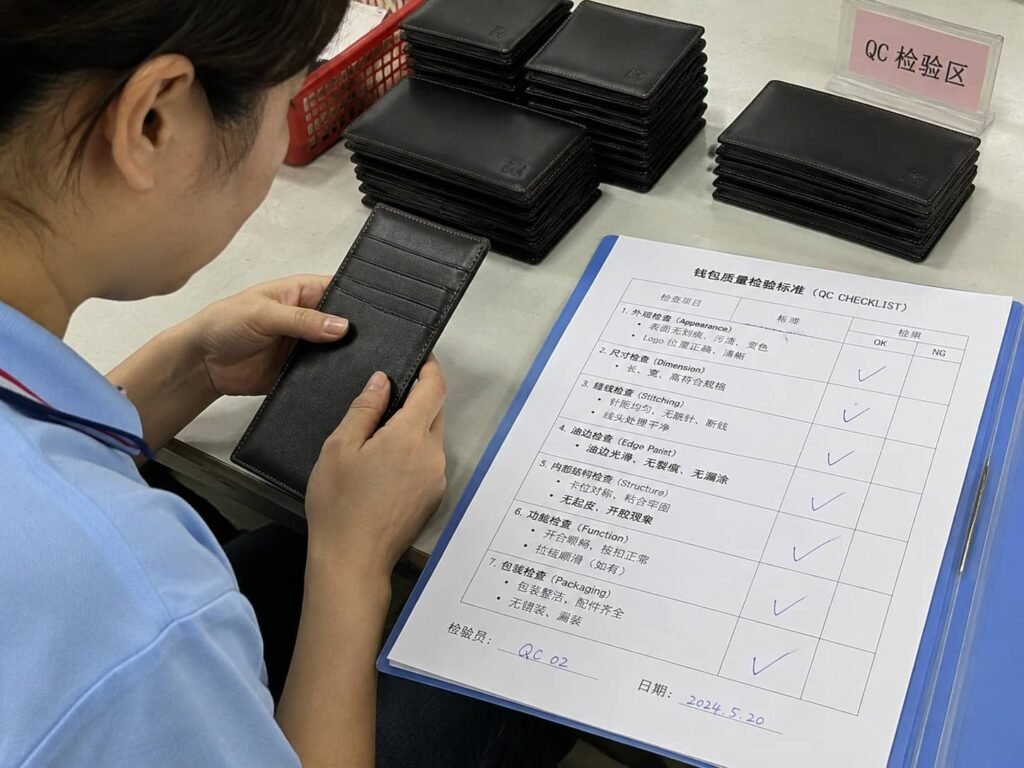
Quality control should begin before a single wallet is assembled — not just at the end of the line. A structured QC system operates at three levels, each with its own focus.
| QC Stage | What Is Checked | Why It Matters |
|---|---|---|
|
Incoming material inspection | Leather grade, thickness and colour; lining and thread; hardware function; RFID lining (where applicable) | Catches defects at the source and avoids batch rework |
|
In-process inspection | Cutting accuracy, skiving consistency, stitching tension and alignment, logo position, assembly fit | Corrects problems before they accumulate through the line |
| Final inspection | Dimensions, appearance, functionality, edge finishing, packaging and labelling | The last line of defence before shipment |
What does a wallet QC inspection check?
Some buyers use AQL-based final inspections, with the inspection level and acceptable limits agreed before production begins. The most valuable discipline for a buyer, however, is simpler: approve a pre-production sample and require that every wallet matches it. If a manufacturer cannot clearly explain how their QC works beyond “we check everything,” that is a warning sign.
10. Sample Approval and Mass Production
The path from first inquiry to bulk delivery follows a defined, end-to-end sequence:
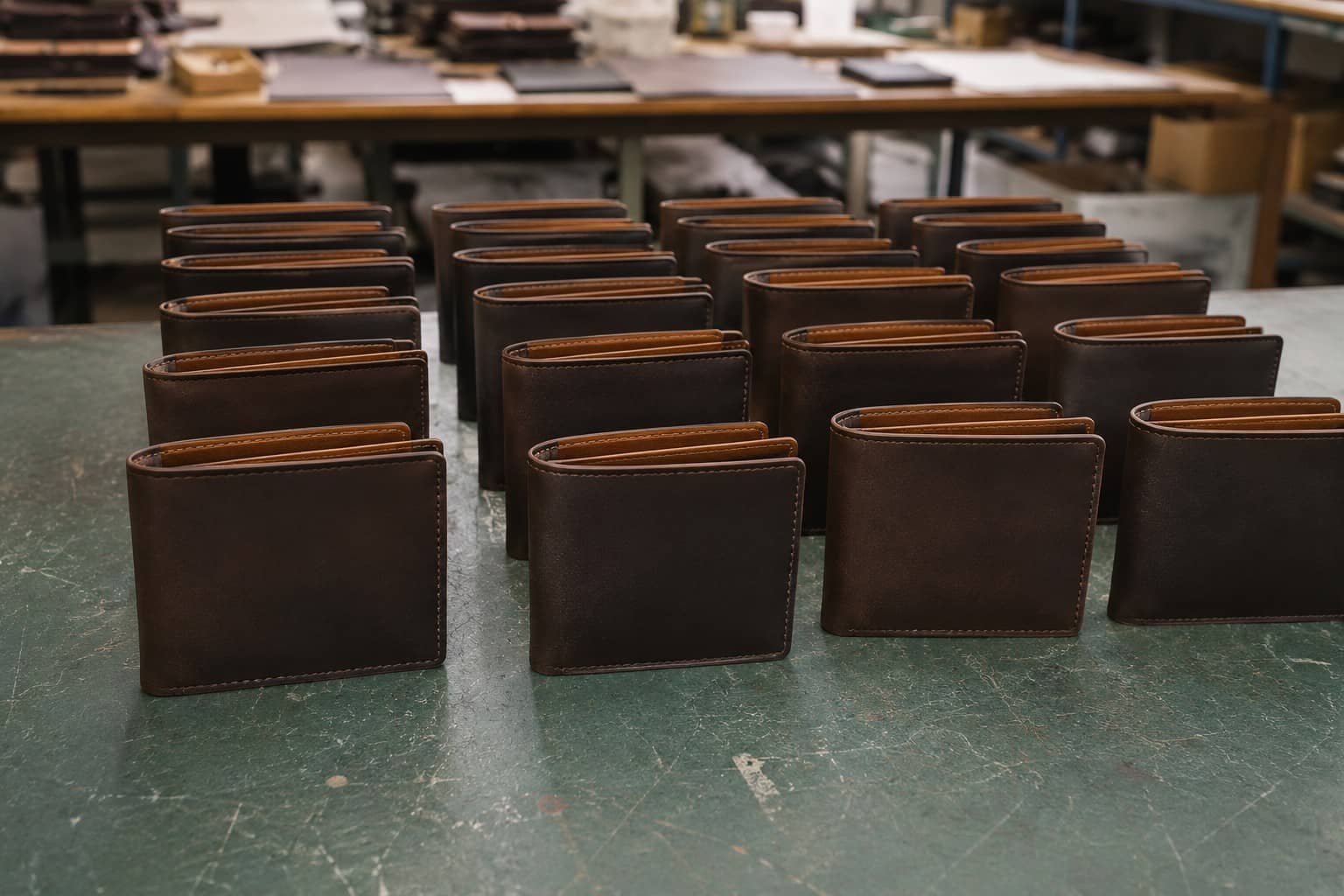
The single most important discipline for a buyer is approving a pre-production sample before bulk manufacturing begins. This approved sample becomes the reference standard for the entire order — every wallet should match it in material, construction, colour and branding. Skipping this step is the most common cause of costly, disappointing bulk orders. After final approval, bulk production typically takes 25–35 working days, depending on order size, design complexity and material availability.
11. What Affects Leather Wallet Manufacturing Cost?
Custom wallet pricing is never a flat number — it is the sum of several variables that move independently. Understanding these helps you read a quotation accurately.
Material and structure are usually the two biggest cost drivers, while logo tooling and packaging are the most commonly forgotten budget items. A metal logo plate, for example, carries a one-time mould or tooling cost before per-unit production begins — a line item that surprises many first-time buyers. A detailed cost breakdown is a topic worth its own guide, but these factors are the framework to keep in mind when comparing quotes.
12. How to Choose a Leather Wallet Manufacturer
Before committing to a supplier, evaluate them against a practical checklist rather than price alone. The cheapest quote rarely reflects the product you actually want. For a step-by-step evaluation framework — including a sample checklist, red flags, and a manufacturer scorecard — see our guide on how to choose a leather wallet manufacturer
What should buyers evaluate?
| Factor | What to Check |
|---|---|
| Manufacturing experience | Years of wallet production and sample quality |
| Pattern development | In-house pattern makers vs. outsourced |
| Material sourcing | Genuine leather / PU / microfiber options |
| Sampling | Sample lead time and revision policy |
| MOQ | Minimum order quantity and flexibility |
| Branding | Debossing / foil / metal logo capability |
| QC | Incoming + in-process + final inspection |
| Production capacity | Monthly capacity and lead time |
| Packaging | Custom private label packaging |
| Communication | Responsiveness and project management |
| Export experience | US / EU / Australia and other markets |
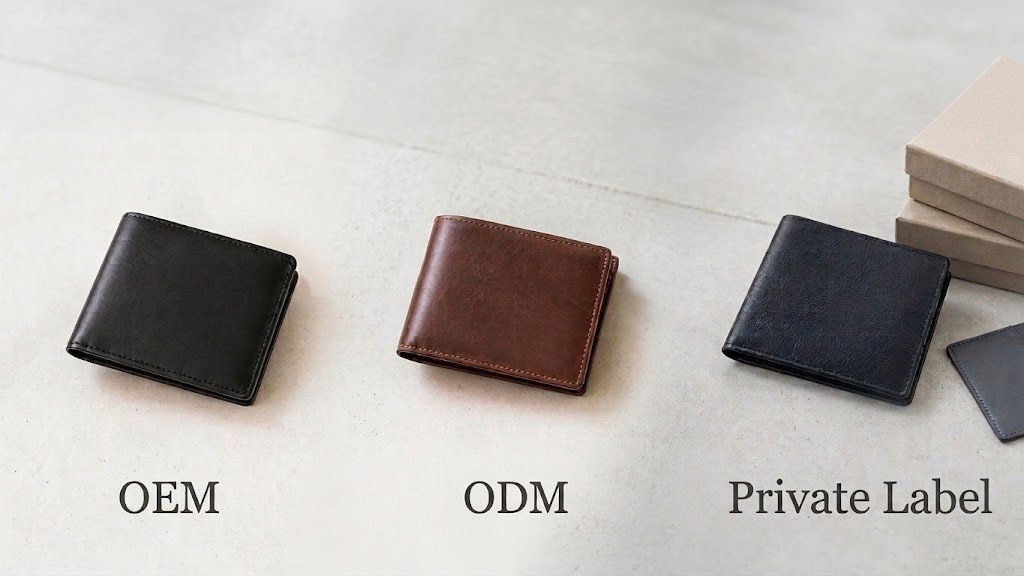
A manufacturer that asks detailed questions about your brief — rather than quoting instantly — is usually a stronger partner. Understanding the difference between OEM vs ODM will also help you brief the right kind of project. If you’re ready to start, explore our custom leather wallets and card holders, or see our broader OEM/ODM leather goods manufacturing capabilities.
Key Takeaways for Buyers
If you take only a few points from this guide, make it these:
– Start with a complete product specification.
– Choose leather based on both appearance and construction requirements.
– Approve a final pre-production sample before bulk production.
– Check quality at material, in-process and final inspection stages.
– Compare manufacturers by capability and consistency, not price alone.
13. Frequently Asked Questions
What types of leather wallets can manufacturers produce?
A professional wallet manufacturer can produce bifold, trifold, slim, zip-around and long wallets, plus card holders, coin purses, passport holders and money clip wallets — each with custom structure, material and branding.
What leather is best for custom wallets?
Full-grain leather is best for luxury lines, top-grain for retail collections, and microfiber or PU for vegan and mass-market products. The right choice depends on your price point and brand positioning.
What information should I provide when requesting a wallet quote?
Provide the wallet type, dimensions, card-slot layout, material and preferred thickness, logo method and target quantity. The more complete the brief, the more accurate the quotation.
What is the typical MOQ for custom leather wallets?
MOQ typically starts from 100 pieces per design per color, though flexible arrangements are often available for startups and growing brands.For how MOQ is calculated per style and per color, see our leather wallet MOQ guide.
How long does wallet sampling take?
Pre-production samples usually take 5–7 working days, with revision rounds included to refine the final product.
Can I add my own logo and packaging?
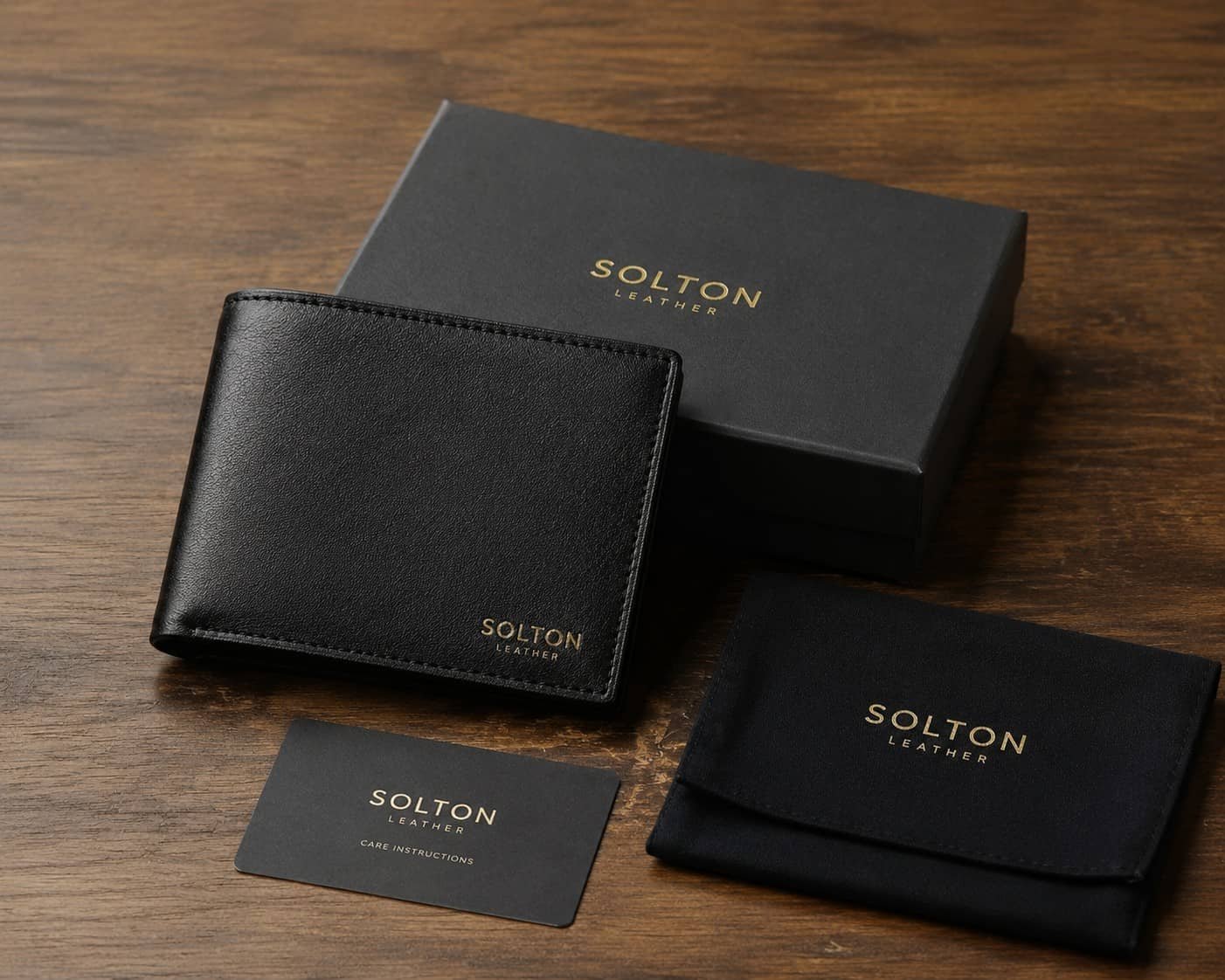
Yes. Logo options include debossing, foil stamping, metal plates and laser engraving. Private label packaging — boxes, dust bags and hang tags — can be designed to match your brand.
How can I ensure consistent quality during bulk production?
Approve a pre-production sample as your reference standard, and work with a manufacturer that runs structured incoming, in-process and final inspections.