OEM, ODM or Private Label: Which Wallet Manufacturing Model Fit Your Brand?
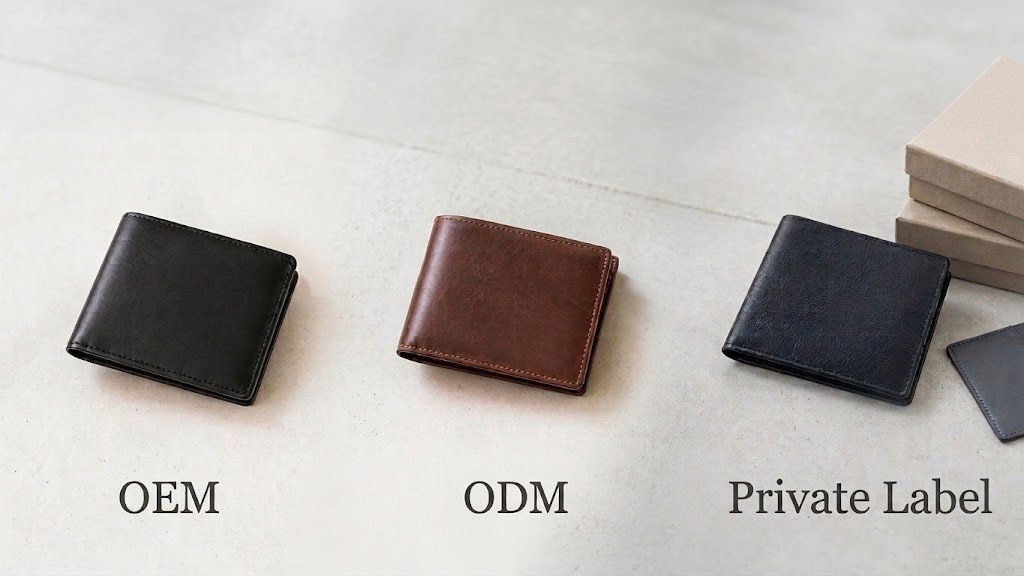
If you are sourcing wallets for a brand, the first question a factory will usually ask is whether you want OEM, ODM, or private label production. The terms get thrown around a lot, and not everyone means the same thing by them.
Rather than treating these as three fixed boxes, it helps to think of them as different levels of design and development involvement. The real questions behind the labels are simpler: who controls the design, what can be customized, who does the development work, and who ends up owning the design after production.
Different manufacturers may use the terms OEM and ODM differently. Before placing an order, confirm who is responsible for design, development, tooling, and ownership rather than relying on the label alone.
This guide walks through each model the way it actually plays out on a wallet order, and gives you a framework to decide which route fits your project.
Table of Contents
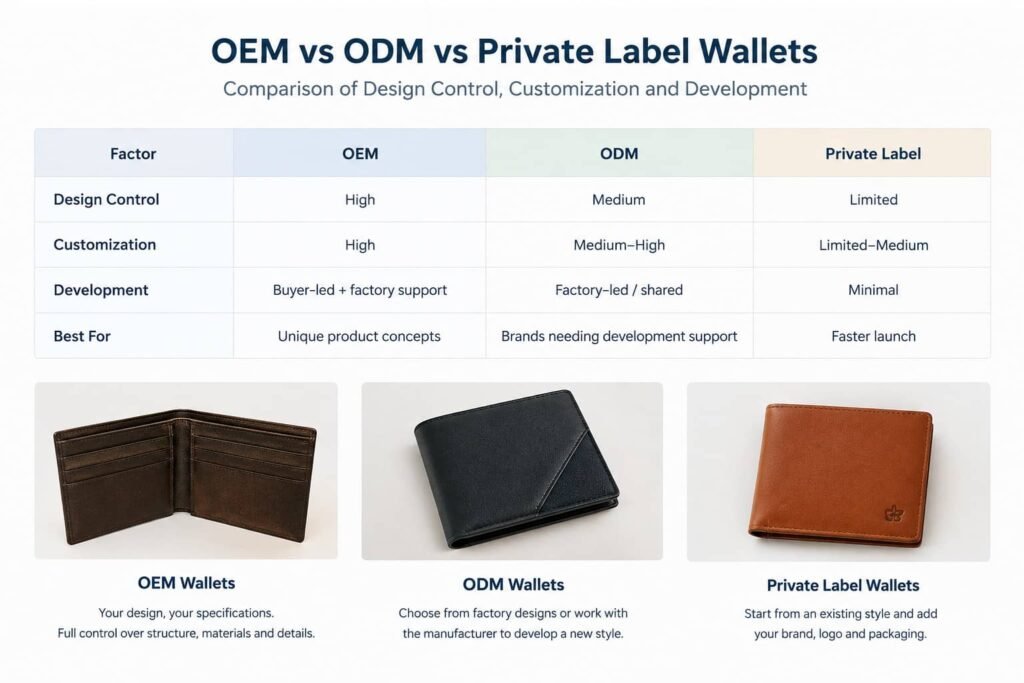
OEM vs ODM vs Private Label Wallets at a Glance
| Factor | OEM Wallets | ODM Wallets | Private Label Wallets |
|---|---|---|---|
| Starting point | Your design / specification | Manufacturer-developed design | Existing / established style |
| Design control | High | Medium | Limited |
| Customization | High | Medium–High | Limited–Medium |
| Development | Buyer-led + factory support | Factory-led / shared | Minimal |
| Sampling | Usually required | Usually required | Usually simpler |
| Product differentiation | High | Medium–High | Depends on customization |
| Development investment | Higher | Moderate | Lower |
| Launch speed | Slower | Medium | Faster |
| Best suited for | Unique product concepts | Brands needing development support | Brands seeking faster launch |
What Is OEM Wallet Manufacturing?
OEM stands for Original Equipment Manufacturer. In wallet production it means the factory builds the wallet to your design and specification. You supply the product definition; the factory supplies the manufacturing.
How OEM Wallet Development Works
- Buyer design / specification
- Technical review
- Material and construction confirmation
- Prototype / sample
- Sample revision
- Approval
- Bulk production
What the Buyer Usually Controls
When you pursue a fully custom design, working with a custom leather wallet manufacturer that can support your tech pack, tooling, and sampling is the most reliable way to turn your spec into a production-ready product.
- Wallet dimensions
- Card slot layout
- Construction
- Leather or material
- Color
- Hardware
- Logo
- Packaging
- Functional requirements
What Is ODM Wallet Manufacturing?
ODM stands for Original Design Manufacturer. Here the factory develops the wallet design, or starts from one it already has, and you adapt it to your brand.
The same OEM-versus-ODM decision also applies to other product lines — see our guide on OEM vs ODM for custom bags if you source handbags or accessories as well.
How ODM Wallet Development Works
- Brand concept
- Factory design / existing design
- Material and structure discussion
- Customization
- Sample
- Approval
- Production
What Can Usually Be Customized?
- Leather
- Color
- Card capacity
- Logo
- Hardware
- Lining
- Packaging
- Selected dimensions / construction
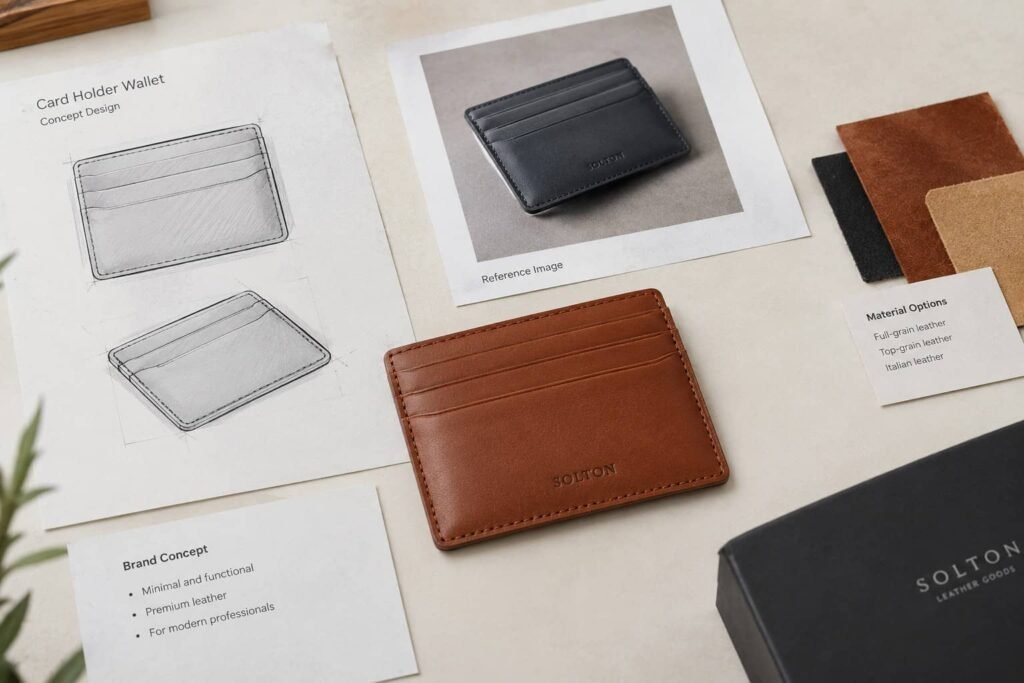
ODM does not mean “no customization.” A factory can offer technical suggestions on an OEM project, and can support fairly deep changes on an ODM project. The two overlap more than most articles suggest.
What Is Private Label Wallet Manufacturing?
Private label wallet manufacturing generally starts from an existing or established product design that the manufacturer can brand and, depending on the supplier, customize to a defined extent.
How Private Label Wallets Work
If you want to move faster and avoid development work, private label leather goods manufacturing lets you brand an existing factory style under your own name.
- Existing wallet design
- Select material / color
- Add brand logo
- Packaging
- Sample
- Production
Typical Private Label Customization
- Logo
- Brand label
- Color
- Packaging
- Minor material changes
- Minor product modifications
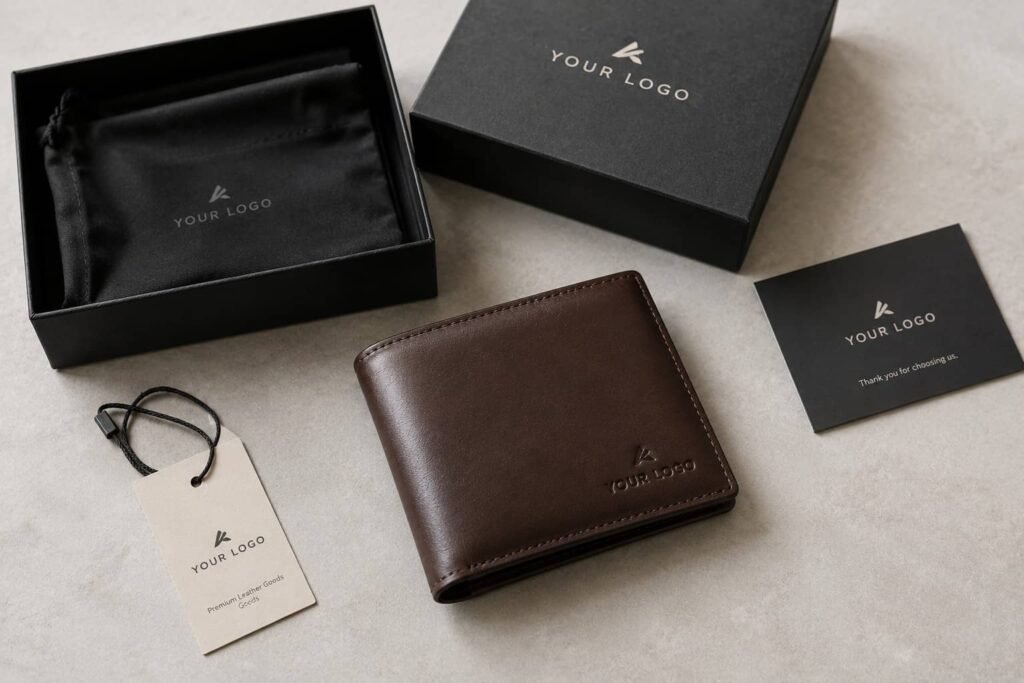
Private label does not automatically mean your brand owns the underlying wallet design. The base design, exclusivity, and ownership are all points to confirm with the manufacturer before you order.
Private Label vs White Label: What's the Difference?
The two terms are used interchangeably in a lot of factories. The common distinction is that white label usually means a generic, unbranded product that multiple buyers can brand, while private label can imply a more exclusive arrangement. The boundaries are not fixed, so confirm what your supplier’s terms actually include, especially around exclusivity.
OEM, ODM and Private Label in Practice: Three Wallet Project Scenarios
The easiest way to see the difference is to look at how a wallet order actually starts. Here are three common wallet project scenarios.
Case 1 — An OEM bifold wallet
A client sends a finished bifold sample and a spec sheet: six card slots, full-grain cowhide, a debossed logo, and custom packaging. The factory reviews the construction, confirms the materials, and develops a pre-production sample from the spec. The client controls the design throughout, which makes this an OEM-oriented project.
Case 2 — An ODM card holder
A brand approaches a manufacturer with only a reference photo, a rough brand concept, and a target cost. The factory proposes the structure, dimensions, leather, and card capacity, then develops the sample. Because the factory led the development, this is a development-led ODM project.
Case 3 — A private label wallet
A client picks an existing factory wallet style, changes the color, adds their logo, and orders custom packaging. No new development is involved, which is what makes this private label.
OEM vs ODM vs Private Label: What Really Changes?
Wallet Design Control: Who Decides the Final Product?
Design control is the clearest dividing line. It decides who determines the shape, dimensions, structure, materials, and construction:
- OEM — you decide; the factory builds to spec.
- ODM — the factory provides the base design; you shape it through customization.
- Private label — the design already exists; you choose branding and finish.
Because control and responsibility shift with each model, it pays to first learn how to choose a leather wallet manufacturer that matches the level of involvement you want.
Wallet Customization: What Can Actually Be Changed?
It is easy to overstate the difference between the models. A more realistic view of what you can usually change:
- Change leather color — possible in all three models.
- Change logo — possible in all three models.
- Change card-slot structure — depends on the model and supplier.
- Develop a completely new construction — typically needs a custom development project (OEM-oriented).
So the practical question is not “can I customize?” but how deep the customization can go, and at what cost and lead time.
Who Develops the Product: Buyer, Factory, or Both?
- OEM — buyer-led development.
- ODM — manufacturer-supported or manufacturer-led.
- Private label — existing product-led.
Wallet Sampling: How OEM, ODM and Private Label Samples Differ
All three routes normally involve sampling, but the depth differs. An OEM project usually needs more sample rounds (development, revision, approval, pre-production) because the product is being built from your spec. Private label sampling is usually faster because the base product already exists.
For a detailed walkthrough, see our guide to the wallet manufacturing process.
Wallet MOQ: Why the Number Depends on More Than the Model
A common mistake is to assume fixed MOQs like “OEM = 500, ODM = 300, private label = 100.” That is misleading. MOQ is affected by far more than the manufacturing model, including:
- Material
- Color
- Custom leather
- Hardware
- Packaging
- Tooling
- Production setup
- Quantity
For a full breakdown, see our wallet MOQ guide.
OEM vs ODM vs Private Label Wallet Cost
One thing worth saying up front: the manufacturing model itself is not a fixed price category. A highly customized private-label wallet can require more development work than a simple OEM production run, depending on materials, tooling, construction, and order quantity. So avoid the assumption that OEM is always expensive and private label is always cheap.
What Affects OEM Wallet Cost?
Material choice is usually the biggest single cost driver, so review the available OEM and ODM leather materials with your supplier before locking in a quote.
- New development
- Sampling
- Materials
- Tooling
- Hardware
- Packaging
- Quantity
What Affects ODM Wallet Cost?
- Existing design
- Modification
- Materials
- Branding
- Packaging
- Quantity
What Affects Private Label Wallet Cost?
- Existing design
- Logo
- Packaging
- Material / color
- Quantity
For a detailed breakdown, see our leather wallet manufacturing cost guide.
Which Model Is Faster to Launch?
Private label can often reach production faster because the base product already exists. ODM usually requires some development work, while a new OEM project may require more sampling and approval rounds. Actual lead time depends on product complexity, materials, and customization, so treat any specific number of days as an estimate rather than a guarantee.
Who Owns the Wallet Design?
Design ownership is the question most buyers overlook, and it is the one that causes the most problems later.
OEM Design Ownership
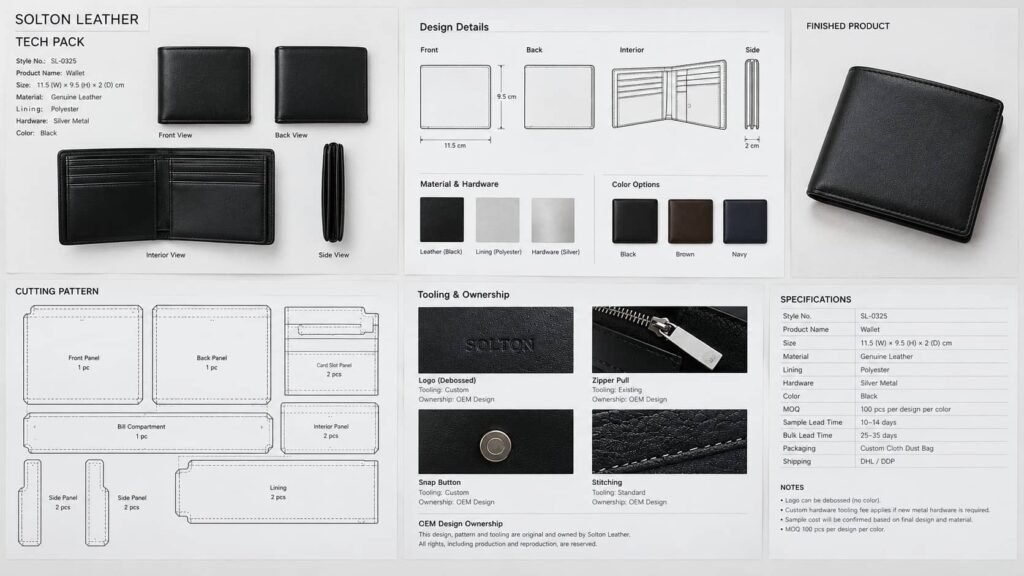
In an OEM project, the buyer typically provides the design, tech pack, custom pattern, custom hardware, and tooling. Ownership of these should be confirmed in writing, because paying for development does not always automatically mean you own every element of it.
ODM Design Ownership
Do not assume the factory owns everything, and do not assume you do either. The ownership of the base design, modifications, patterns, molds, and exclusivity should be clearly defined in the agreement.
Private Label Design Ownership
Brand assets such as logos and packaging artwork are generally controlled by the brand, while ownership of the underlying product design depends on the agreement and applicable intellectual-property rights. These are two separate things, and it is worth keeping them separate in any discussion with a supplier.
Questions to Ask Your Manufacturer
- Who owns the base design?
- Who owns custom modifications?
- Can the manufacturer sell the same design to other customers?
- Is exclusivity available?
- Does exclusivity cover the whole product or only customized elements?
- Who owns molds / patterns / custom hardware?
Which Wallet Manufacturing Model Fits Your Brand?
Choose OEM When...
- You already have a complete design
- You need a unique product
- You control product specifications
- Product differentiation is important
Reconsider if: speed to market matters more than uniqueness, or you cannot fully specify the design yourself.
Consider ODM When...
- ou have a concept but not a complete technical design
- You need factory development support
- You want customization without starting entirely from zero
Reconsider if: you need guaranteed design exclusivity without additional negotiation.
Consider Private Label When...
- You want to launch faster
- Existing styles fit your market
- Your main customization is branding / packaging
- You want to test a product before deeper development
Reconsider if: your market is already saturated with identical styles.
Not Sure Which Model You Need? Start With These Questions
Two angles usually settle the question. The first is where you are starting from:
| Question | If Yes | Then ask |
|---|---|---|
| Do you already have a complete wallet design? | OEM | Do you accept buyer-led development? |
| Do you only have a concept / reference image? | ODM / development support | Who will own the resulting design? |
| Do you want to use an existing factory style? | Private Label | What customization (material / color / slots) is allowed? |
| Do you need a completely new structure? | OEM / deeper ODM | Is this OEM or deep ODM customization, and who owns it? |
| Is speed more important than uniqueness? | Private Label / ODM | What is the current lead time for that style? |
| Do you need extensive customization? | OEM / deeper ODM | Which changes are included vs. charged as new development? |
The second angle is what matters most to your project:
| Priority | Potential Route |
|---|---|
| Maximum product control | OEM |
| Factory development support | ODM |
| Faster launch | Private Label |
| Unique construction | OEM / deeper ODM |
| Existing style + branding | Private Label |
If your project falls between two categories, describe your product requirements rather than choosing a label first. A good manufacturer can then tell you the sensible route.
What to Prepare Before Contacting a Wallet Manufacturer
Product Information
- Wallet type
- Reference images
- Dimensions
- Card capacity
- Material
- Color
- Construction
- Hardware
Branding
- Logo
- Logo method
- Logo position
- Packaging
- Labels
Order Information
- Quantity
- Target market
- Target price
- Required delivery date
- Sample requirement
Frequently Asked Questions
What is the difference between OEM and ODM wallets?
OEM means the factory builds your own design to your specification; ODM means the factory provides the design and you customize it. The core difference is who controls the design and development.
Is private label the same as ODM?
No. Private label starts from an existing or established factory style that you brand, while ODM usually involves customization of a factory design. Private label has the least design involvement.
Is private label the same as white label?
They are often used interchangeably, but white label typically refers to a generic unbranded product multiple buyers can brand, while private label may imply a more exclusive arrangement. Always confirm what the term includes in your supplier’s terms.
Which model offers more wallet customization?
OEM offers the deepest customization, followed by ODM. Private label generally offers less design flexibility because it starts from an existing product design, but the actual customization range depends on the manufacturer and product.
Does OEM always have a higher MOQ?
Not necessarily. MOQ depends on materials, tooling, hardware, packaging, and quantity, not just the manufacturing model.
Who owns the wallet design in an ODM project?
It depends on your agreement. The ownership of the base design, modifications, patterns, molds, and exclusivity should be defined in writing.
Can a wallet project combine OEM and ODM development?
Yes. Many real projects are hybrids: a factory can develop from your spec while also contributing technical design input.