Quick Answer
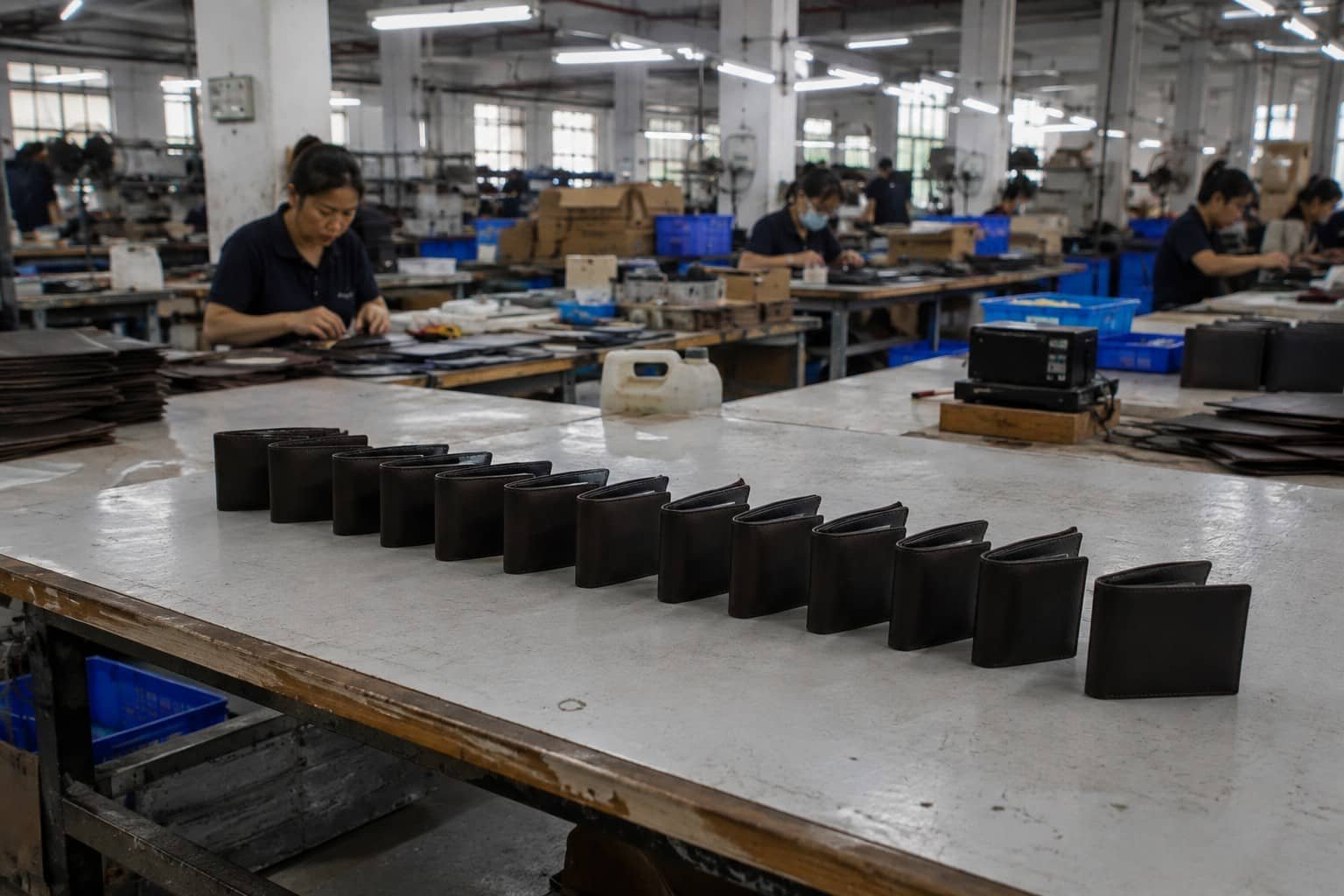
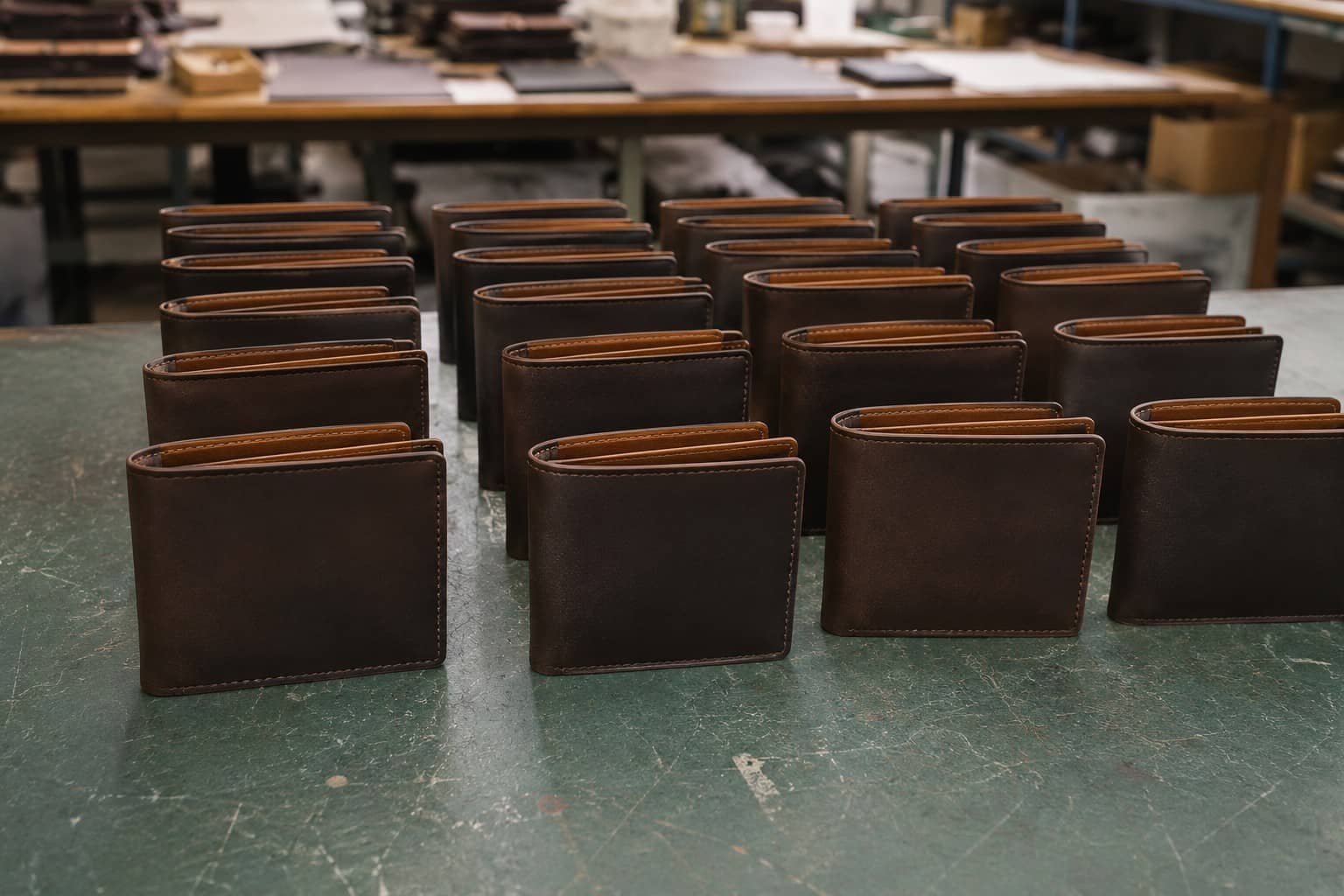
A leather wallet MOQ (minimum order quantity) is the smallest number of wallets a factory will accept per order. There is no universal figure — depending on the supplier, materials, construction, and customization, buyers may encounter minimums ranging from around 50 pieces to 1,000+ pieces. Custom and private label wallets usually carry higher MOQs because of tooling, material minimums, and branding setup, while stock and wholesale wallets can start lower. Your MOQ directly affects unit price and total upfront investment, so it should be one of the first numbers you confirm.
Key Takeaways
- There is no universal leather wallet MOQ — it varies by supplier, product complexity, materials, and customization.
- MOQ is often set per style and per color, not as a single total — clarify this before quoting.
- Negotiating material substitution, shared tooling, or phased orders can sometimesreduce your initial order requirement.
- Private label wallet MOQ sits between wholesale and fully custom — branding with lower inventory risk.
- Always confirm what is includedin an MOQ quote — sampling, packaging, and freight can shift your real landed cost.
Introduction
For most B2B buyers, the first question when sourcing custom leather wallets isn’t about design — it’s about the leather wallet MOQ. Minimum order quantity is the number of wallets a manufacturer requires you to purchase in a single order, and it shapes everything downstream: your unit cost, your cash flow, your inventory risk, and whether a supplier is even worth your time.
The problem? MOQs are all over the map. A small workshop might accept 50 pieces, while a large leather wallet manufacturer may insist on 1,000 or more. Without understanding what drives these numbers, you’ll either overpay on a small test run or lock up capital in inventory you can’t sell yet.
This B2B guide breaks down leather wallet minimum order quantities from every angle: what MOQ really means, typical reference ranges by manufacturer type, how the MOQ is calculated per style and color, and the negotiation tactics that can sometimes reduce your initial order requirement. By the end, you’ll know exactly how to source custom leather wallets at an MOQ — and a price — that works for your brand.
Table of Contents
1. What Is MOQ in Leather Wallet Manufacturing?
MOQ — minimum order quantity — is the smallest number of leather wallets a manufacturer will produce in a single purchase order. In leather wallet manufacturing, this number is set by the factory, not the buyer, and it acts as a gatekeeper: if you can’t meet it, the supplier won’t take your order.
The leather wallet MOQ matters because it directly sets your entry cost, unit price, and inventory exposure. A low MOQ of 50–100 pieces lets you test a design cheaply, while a 1,000-piece minimum commits you to serious upfront capital.
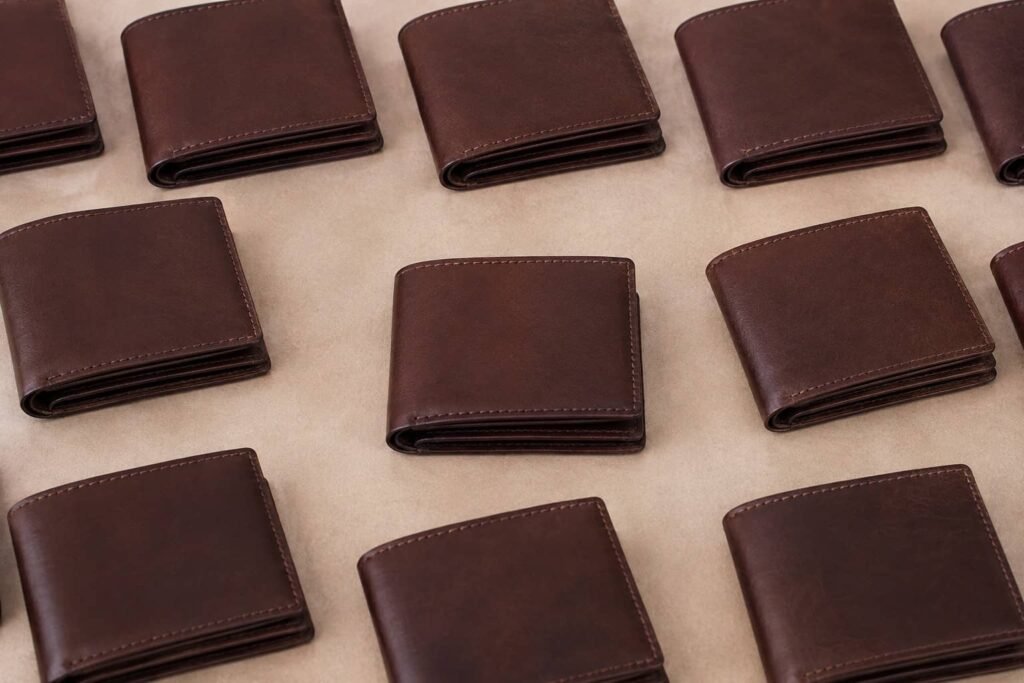
OEM Tip: Before negotiating anything, ask the factory two clarifying questions: (1) Is the MOQ per style, per color, per SKU, or per total order? and (2) What exactly does the quote include — sampling, tooling, packaging, or freight? Many buyers assume the MOQ covers a finished, boxed product when it actually only covers bare production. Lock the definition down in writing.
Best for: first-time B2B importers, new brands, and e-commerce sellers who need to understand the cost and risk mechanics of sourcing before committing capital.
2. What Is the Typical MOQ for Custom Leather Wallets?
There is no universal MOQ for leather wallets. Depending on the supplier and project, buyers may encounter minimums ranging from around 50 pieces to 1,000+ pieces. The ranges below are typical reference points, not fixed industry standards — treat them as a starting point for comparing suppliers, not a promise of what you’ll be quoted.
| Supplier / Order Type | Typical Range |
|---|---|
| Small-batch workshop | 50–100+ pieces |
| Mid-size manufacturer | 100–500+ pieces |
| Large-volume manufacturer | 500–1,000+ pieces |
| Custom / private label | Depends on project |
Supplier type is one of several factors that can affect the MOQ you are quoted. Larger orders can reduce unit costs, although the actual savings depend on the product and production setup. Knowing these tiers upfront tells you which suppliers are even worth contacting.
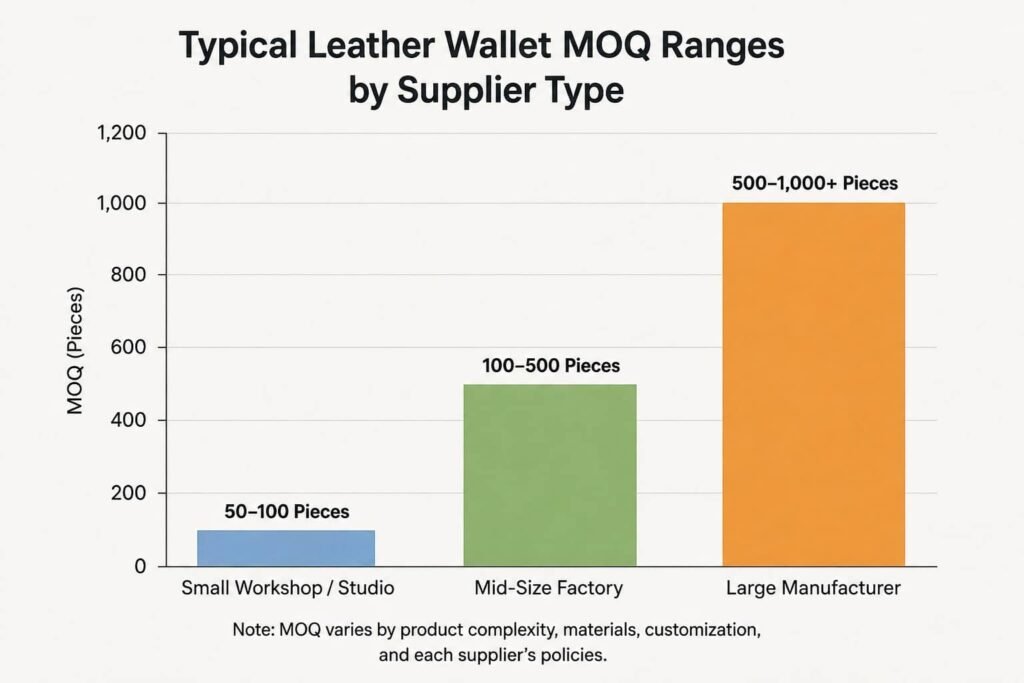
OEM Tip: Match your order size to the right supplier tier — don’t overpay a large factory for a 100-piece run, and don’t expect a small workshop to hit 1,000 units on a tight deadline. Ask for a tiered quote (100 / 300 / 500 / 1,000 units) so you can see the per-unit price curve and the breakpoints where your cost drops.
3. Stock vs. Semi-Custom vs. Fully Custom Wallet MOQ
The clearest way to understand why one buyer can order 50 pieces while another needs several hundred is to look at the level of customization. The more you change, the more setup and tooling the factory has to absorb — and the higher the minimum becomes.
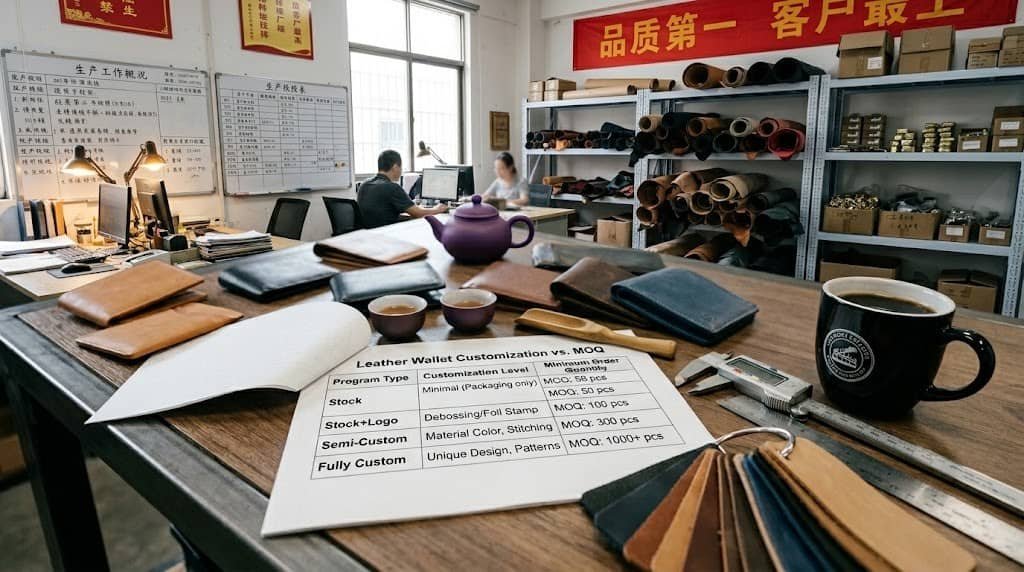
| Order Type | Design | Branding | Material | MOQ Tendency |
|---|---|---|---|---|
| Stock | Existing | None | Existing | Lowest |
| Stock + Logo | Existing | Logo added | Existing | Low |
| Semi-Custom | Existing with modifications | Custom | Selected | Medium |
| Fully Custom | New design | Fully custom | Custom | Higher |
This is why a semi-custom or stock-plus-logo program is usually the most cost-effective entry point for a new brand — you get branding without paying the full MOQ of a bespoke design.
4. How Is Leather Wallet MOQ Calculated? Per Style, Color, and SKU
Leather wallet MOQ is rarely one flat number. The most important distinction in any quote is:
MOQ per order ≠ MOQ per style ≠ MOQ per color ≠ MOQ per SKU
Many manufacturers calculate MOQ per style and per color, not as a single total. The reason is material minimums: a single leather hide yields only so many cut pieces, dye lots require minimum quantities per color, and custom hardware or thread must be ordered in bulk.
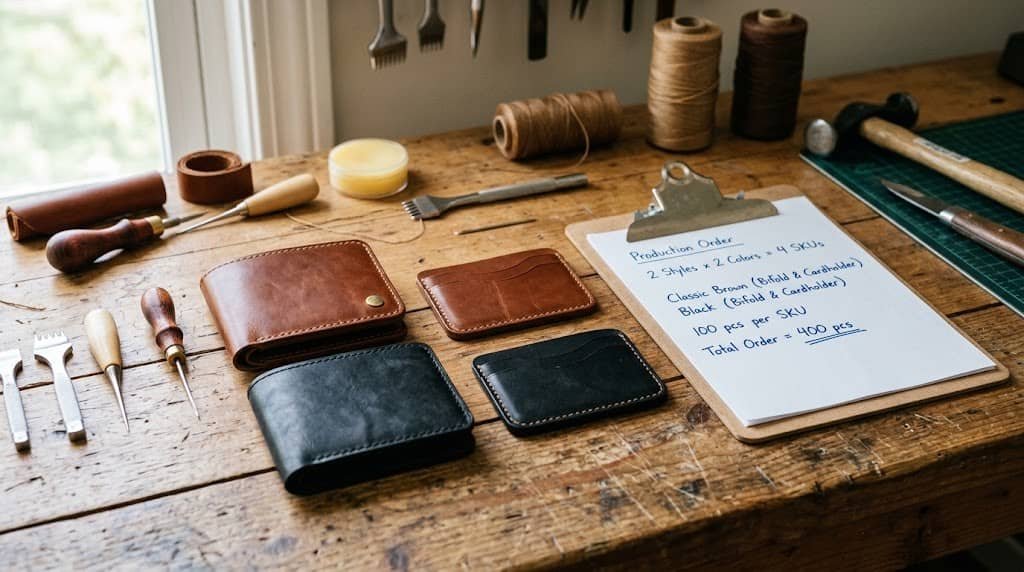
| MOQ Structure | Example | Total |
|---|---|---|
| 100 pcs per order | 2 styles / 2 colors | 100 pcs |
| 100 pcs per style | 2 styles | 200 pcs |
| 100 pcs per style/color | 2 styles × 2 colors | 400 pcs |
Worked example — how “per style / per color” multiplies your total
You want 2 styles (a bifold and a cardholder), each in 2 colors (black and tan). The factory quotes “MOQ 100 pcs per style per color.”
- Bifold, black = 100
- Bifold, tan = 100
- Cardholder, black = 100
- Cardholder, tan = 100
Total order = 400 pieces — not 100.
If the factory instead allows colors to be combined per style (100 pcs per style, any color mix), the same brief becomes 2 × 100 = 200 pieces. That one clause cuts your total in half.
As a simple formula:
Total MOQ = Number of Styles × Number of Colors × MOQ per Style/Color
This calculation applies when the manufacturer requires the MOQ separately for each style and color. If colors can be combined per style, drop the “Number of Colors” multiplier.
OEM Tip: Always ask: “Is that MOQ per style, per color, or combined?” Launch with two core colors (black and tan) instead of six to keep your total within one dye lot and one production run. Some manufacturers may allow you to split the MOQ across colors of the same style, depending on material availability and production requirements — always confirm this before finalizing your colorways.
5. What Factors Affect Leather Wallet MOQ?
Several factors push a leather wallet MOQ up or down, and understanding them is how you negotiate a lower minimum:
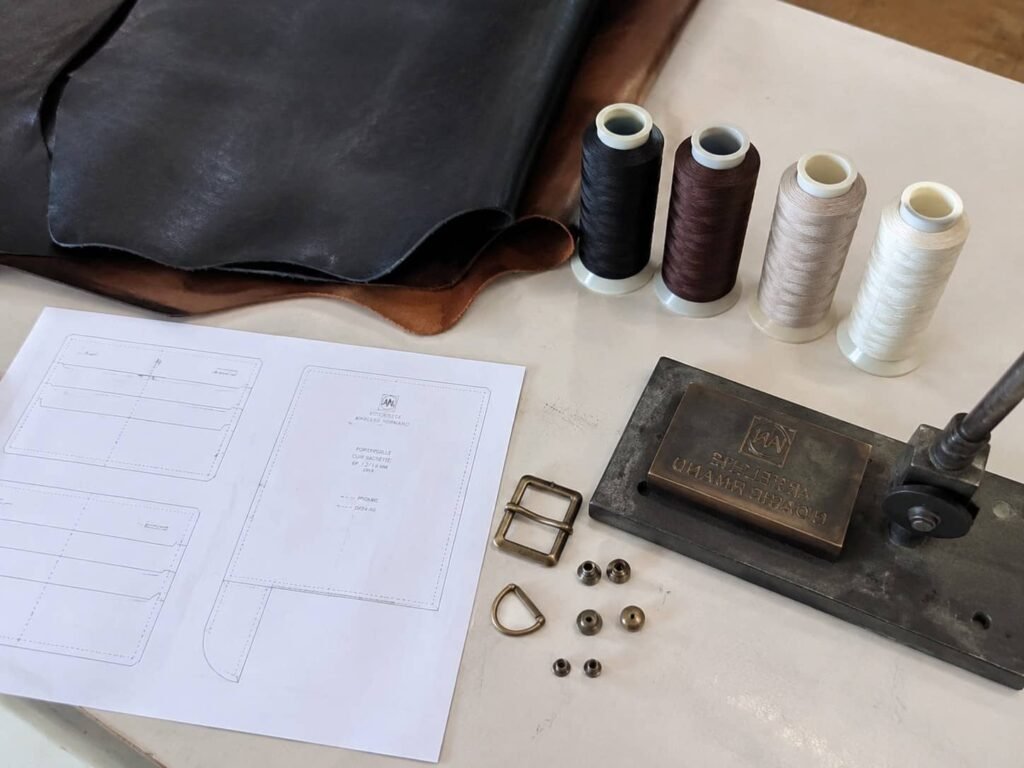
| Factor | How It Affects MOQ |
|---|---|
| Leather type | Stock leather is flexible; premium or custom-tanned hides carry their own minimum purchase |
| Tooling & dies | A new die for your exact pattern adds setup cost the factory recovers via a higher minimum |
| Branding | Embossed logos, foil stamping, and custom hardware raise the bar |
| Construction | Hand-stitched edges or intricate interior slots drive labor and minimums |
| Packaging | Custom boxes can carry a separate MOQ of their own |
Leather availability is often an important MOQ driver, especially when the project requires a special leather, finish, or custom color — see our leather materials guide for the full breakdown of grades like full-grain vs. genuine leather.
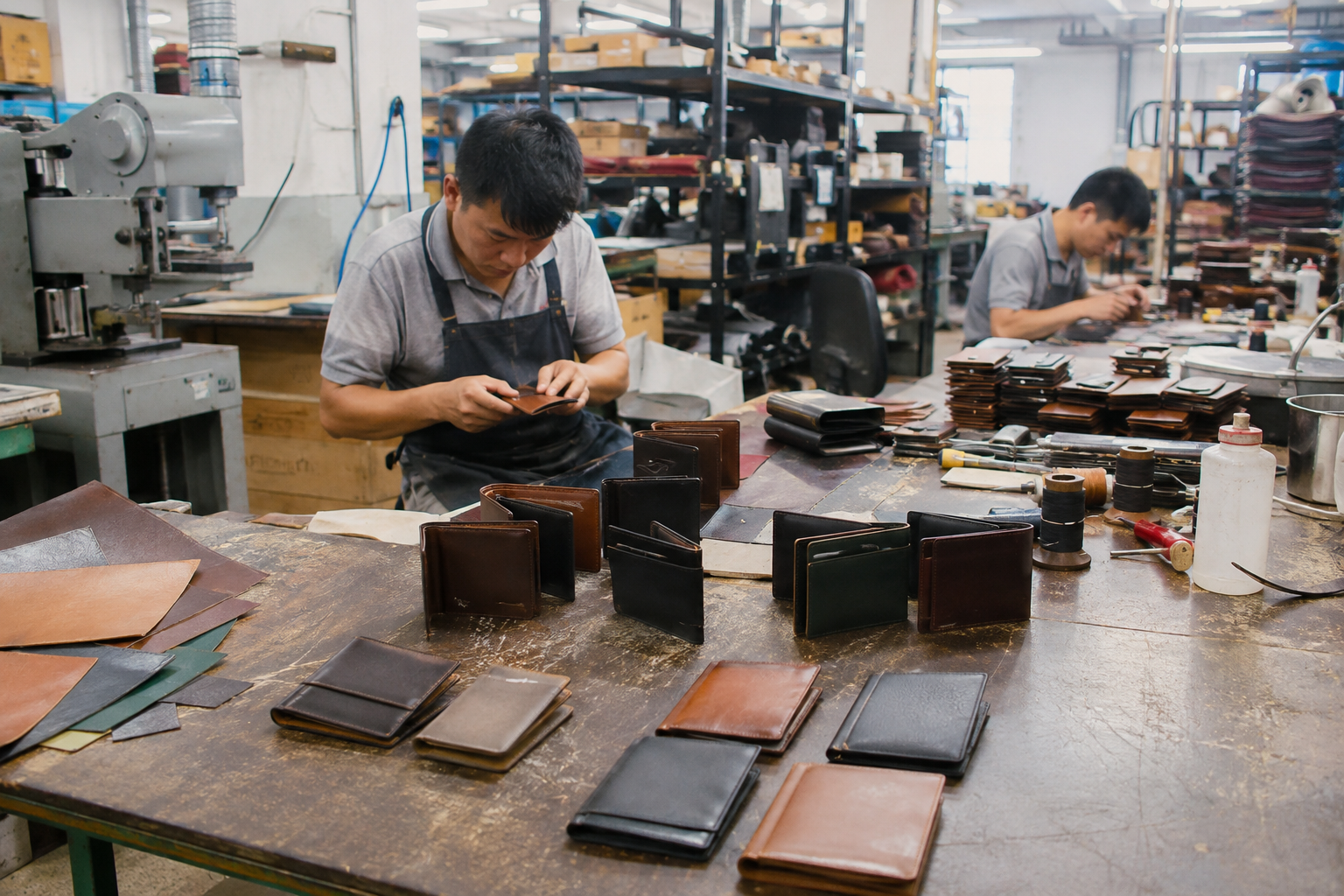
Custom tooling and dies — used to cut your exact pattern — add setup costs that factories recover through higher minimums. Branding and complex construction (hand-stitched edges, multiple card slots) raise the floor too. For a closer look at how construction drives production, see how leather wallets are made.
OEM Tip: The fastest way to lower a custom leather wallet MOQ is to swap custom components for stock ones — factory leather colors, standard thread, and off-the-shelf hardware instead of custom zippers or snaps. Ask about shared tooling: if the factory already has a die close to your design, you can adapt to it and avoid a new die setup fee and the higher minimum that comes with it.
6. MOQ vs. Unit Price: Does Ordering More Always Reduce Cost?
Ordering more units nearly always lowers your per-unit price, but the relationship is not a straight line — and “more” does not always mean “cheaper overall.”
Higher volumes spread fixed setup costs (pattern making, die cutting, debossing plates) across more wallets and unlock bulk material pricing. However, savings follow the law of diminishing returns: once setup costs are fully absorbed, the price curve flattens. At the same time, larger orders increase the capital tied up in inventory, warehousing, and the risk of dead stock.
The real question for a B2B buyer is not unit price alone but total landed cost per unit sold — which includes freight, storage, and markdown risk. For a full line-by-line breakdown of leather, labor, packaging, and shipping, see our Leather Wallet Manufacturing Cost guide.
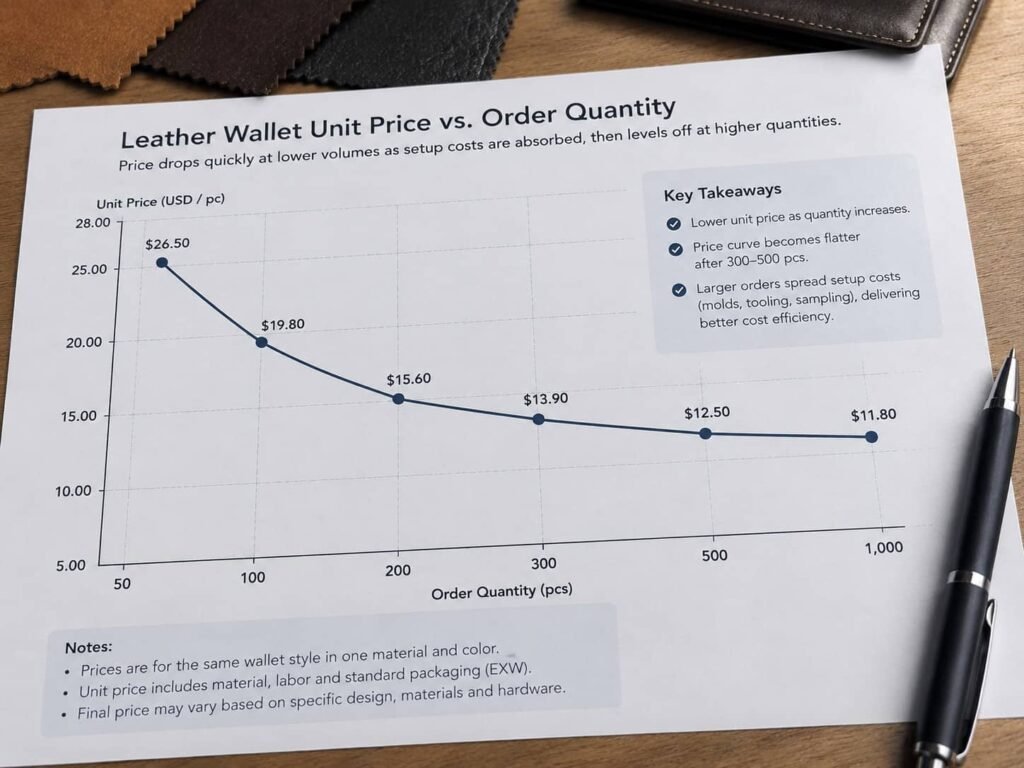
OEM Tip: Always request a tiered quote (100 / 250 / 500 / 1,000 pieces) so you can see exactly where each price break lands. Ask whether tooling and plate fees are quoted separately or amortized into the unit price, and confirm whether freight is included.
7. How Many Leather Wallets Should a New Brand Order?
For a new brand, the instinct is often to order deep to secure a low unit price — but first orders should prioritize learning over margin. The ranges below are practical planning ranges, not industry standards:
| Stage | Practical Planning Range | When to Use |
|---|---|---|
| Market testing | 50–100 pcs | New product, small brand, crowdfunding |
| Small brand launch | 100–300 pcs | First commercial order, private label |
| Growing brand | 300–1,000 pcs | Proven products, wholesale, retail |
| Established distribution | 1,000+ pcs | Large retailers, distributors |
For most new brands, one style + one color + around 100 pcs is a practical starting point — it reduces inventory risk while keeping production commercially viable.
OEM Tip: If the manufacturer allows MOQ sharing across styles or colors, use that flexibility to test more SKUs without significantly increasing your first order. Otherwise, start with fewer styles and colorways. Ask for the reorder lead time upfront so you can restock proven styles quickly without overbuying on the first run.
8. How to Lower Your Wallet MOQ Without Increasing Risk
A lower leather wallet MOQ is achievable if you are willing to trade some customization depth for flexibility. The lowest-risk path is a semi-custom program: choose an existing factory pattern and leather, then add your logo, color selection, or packaging. This avoids new tooling and lets factories run your order on shared production lines, which may allow a lower MOQ than a fully custom project.
What you can usually negotiate vs. what rarely moves:
| You can usually negotiate | Rarely negotiable |
|---|---|
| Splitting MOQ across colors of one style | Custom metal tooling minimums |
| Mixing styles into one combined run | Special-tannage leather minimums |
| Phased / partial delivery | Custom packaging print-run minimums |
| Stock materials & standard hardware | Per-color dye-lot minimums |
| First-order trial at a small surcharge | Hard quality / safety compliance requirements |
The tradeoff is a higher per-unit price — so the risk shifts from inventory to margin, which is usually the safer bet for a new or uncertain product line.
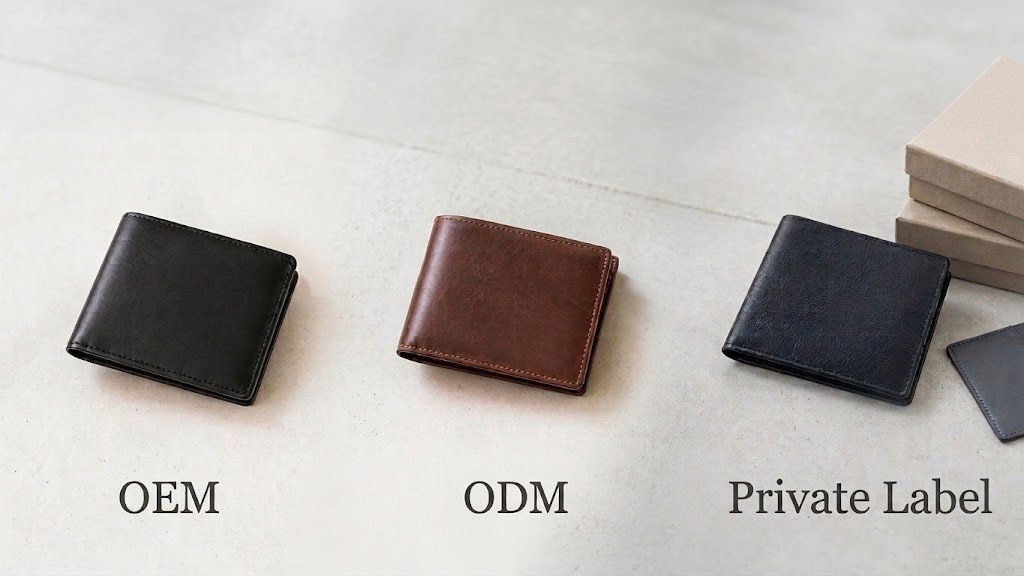
OEM Tip: Ask whether your factory offers a stock-style-plus-logo program or phased delivery to spread one order across two or three shipments. Confirm whether the lower MOQ applies per style, per color, or to the combined order. For private label and OEM/ODM routes, see our private label wallet manufacturer page.
9. Common MOQ Buying Mistakes to Avoid
- Choosing the lowest MOQ without checking the unit price.A smaller MOQ often carries a higher per-unit price than a larger production run. → Always request tiered pricing and calculate total landed cost per unit sold.
- Assuming the MOQ applies to the whole order.MOQ is often per style and per color, not per order. → Confirm the MOQ structure before finalizing SKUs.
- Skipping the pre-production sample.Without an approved sample, there is no reference for materials, stitching, or logo placement. → Always approve a pre-production sample in writing.
- Ordering only the bare minimum and ignoring reorder lead time.A proven style can sell out while the factory needs 30–60 days to reproduce it. → Factor reorder lead time into your first order.
- Ordering deep inventory on an unvalidated style to chase a low price.Volume discounts are wiped out by markdowns on dead stock. → Validate demand first, then scale reorders.
- Not clarifying hidden minimums for packaging, colors, or tooling.Add-on minimums can inflate the total order unexpectedly. → Ask for a complete minimum-order breakdown before signing.
10. Solton Leather Wallet MOQ
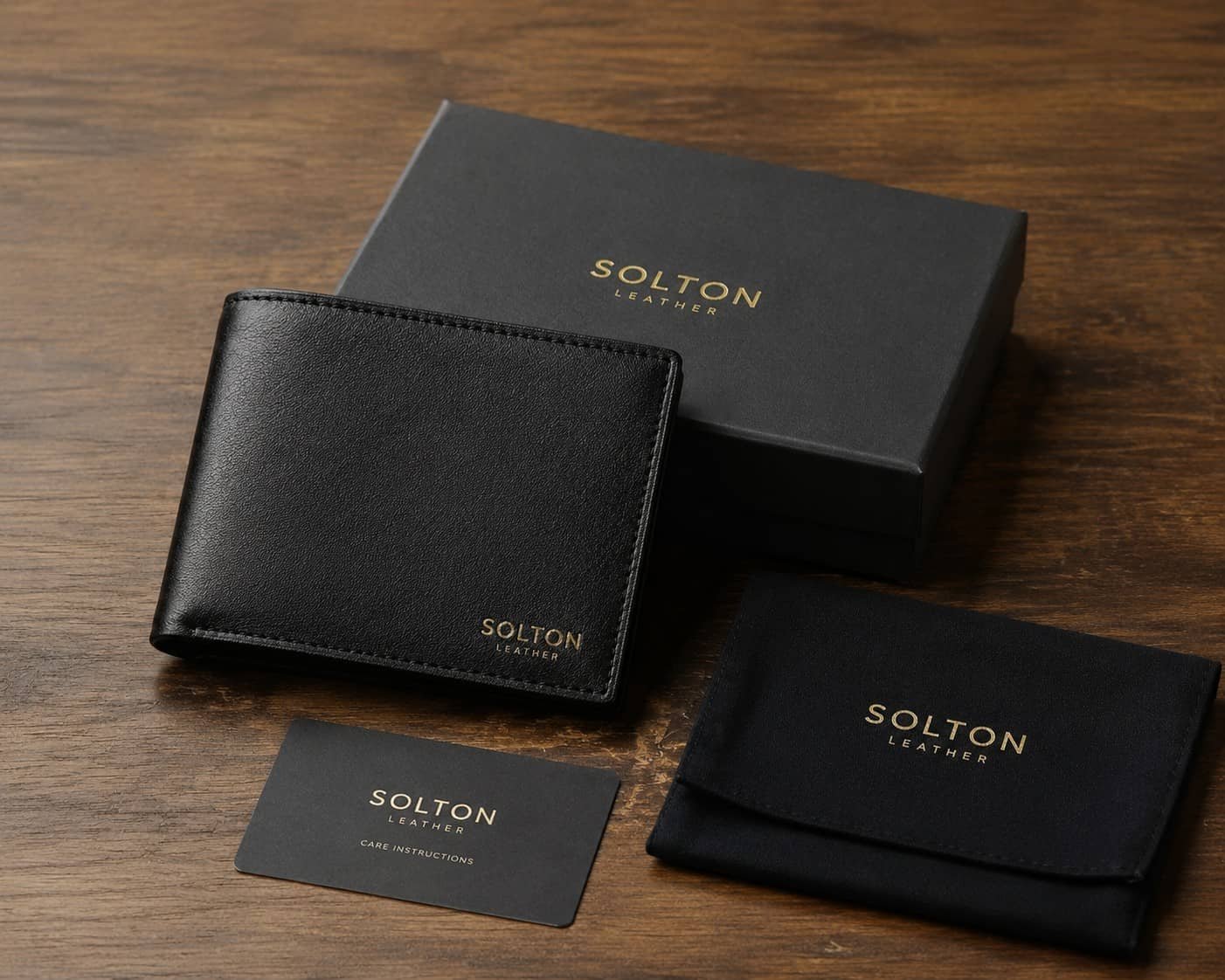
At Solton Leather, our standard MOQ is 100 pcs per style per color — low enough for brands to test the market without over-committing. We support OEM wallet manufacturing, ODM development, custom leather and colors, logo debossing and foil stamping, custom packaging, and private label, with sampling in 5–7 working days and production in 25–35 days.
Please note: the final MOQ may vary depending on the leather, wallet construction, colors, branding, packaging, and other customization requirements. We’ll confirm the exact minimum for your project before you commit.
Browse our wallet & card holder collection for proven constructions you can build on, or learn more about our OEM/ODM leather goods manufacturing capability.
Frequently Asked Questions
Q1. What is a typical leather wallet MOQ?
There is no universal MOQ for leather wallets — it varies by supplier, complexity, materials, and customization. Depending on the supplier and project, buyers may encounter minimums ranging from around 50 pieces to 1,000+ pieces. Small-batch workshops may accept 50–100 pieces, mid-size manufacturers commonly require 100–500, and large-volume manufacturers often ask for 500–1,000 or more. Custom and private label minimums depend on the project.
Q2. Is leather wallet MOQ calculated per style or per color?
Many manufacturers calculate MOQ per style and per color, not per total order. A “100 pcs” MOQ usually means 100 of one design in one colorway. When the factory requires the minimum separately for each, Total MOQ = number of styles × number of colors × MOQ per style/color. Always confirm whether colors can be combined before finalizing SKUs.
Q3. Why do custom leather wallet MOQ requirements differ?
Custom leather wallet MOQ varies because production is driven by fixed costs — cutting dies, plates, leather hides, thread, and setup labor each have their own economic threshold. A factory that owns in-house tooling and buys hides in volume can offer lower minimums, while a smaller workshop may need higher MOQs to cover overhead.
Q4. How can I lower my custom wallet MOQ?
Choose semi-custom over full-custom, limit colorways, select stock leather and standard hardware, and consolidate SKUs into one shared construction. Ordering off-season, bundling designs into a single run, or committing to a repeat order gives a manufacturer more room to negotiate a smaller initial quantity.
Q5. What is the MOQ for private label wallets?
Private label wallet MOQ depends on the project but typically sits between stock and fully custom — often in the 200–500 piece range per design. Because the tooling already exists, the minimum is often lower than a fully custom project. Confirm whether the private label wallet MOQ applies per color and whether logo embossing carries a separate setup fee.
Q6. What MOQ should a new wallet brand order?
For most new brands, one style and one color at around 100 pieces is a practical starting point — enough to test demand without over-committing inventory. Balance cash flow, storage, and sell-through, use the factory’s MOQ as a floor, and scale reorders on proven styles rather than optimistic projections.
Conclusion
Understanding leather wallet MOQ is the difference between a profitable first order and a costly miscalculation. The key takeaway is that lower minimums almost always come from strategy: semi-custom designs, fewer colorways, stock materials, and a willingness to negotiate with a long-term view. Treat MOQ not as a fixed obstacle but as a lever you can pull. Solton Leather helps brands and startups navigate these decisions with transparent minimums and more than ten years of OEM/ODM manufacturing experience. Once you’ve confirmed the MOQ, the next step is evaluating the factory itself — see our guide on how to choose a leather wallet manufacturer.
Get your custom leather wallet MOQ quote today. Tell us your target quantity and design, and the Solton Leather team will respond with transparent pricing within 24 hours. → Contact Solton Leather