Introduction
Every buyer starts with the same question: “What does a leather wallet actually cost to manufacture?” And the honest answer is that a useful number is impossible to give without a specification. Two factories quoting the “same” wallet can legitimately be far apart — not because one is overcharging, but because they are pricing different leather, different construction, and different volumes.
This guide does two things most costing articles don’t. First, it walks through every cost driver in the order it hits a quote — leather, design, labor, branding, MOQ, tooling, packaging, and location. Second, it shows a worked cost calculation so you can see how those drivers add up into a real per-unit price — and what “landed cost” means once freight and duty are in. By the end, you’ll be able to read a factory quote the way a manufacturer does.
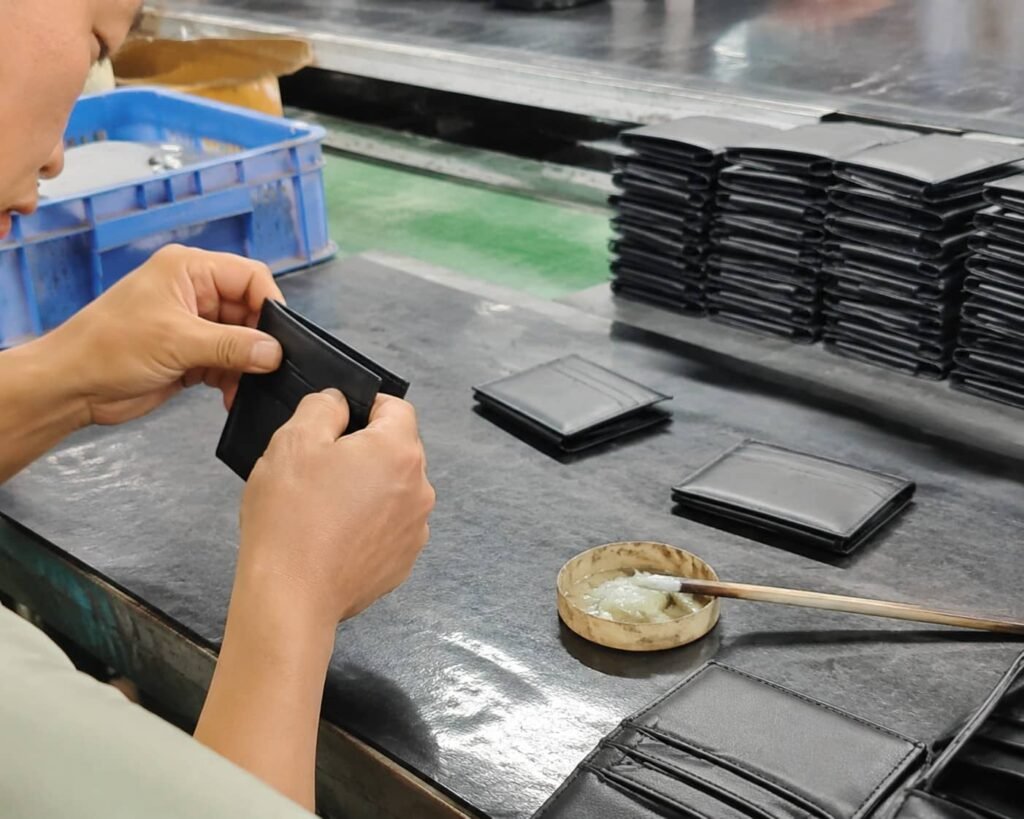
Table of Contents
How Much Does It Cost to Manufacture a Leather Wallet?
Cost is driven by four levers: leather grade, design complexity, order quantity, and manufacturing location. Rather than quoting a “standard” price that would be misleading, the table below ranks the main material tiers by relative cost.
| Material tier | Relative manufacturing cost | Where it typically sits |
|---|---|---|
| PU / Microfiber (synthetic) | Lowest | Vegan lines, entry price points, promotional goods |
| Split leather / general cowhide | Low | Mass-market and promotional wallets |
| Top-grain leather | Mid | Mid-to-premium wallets, the workhorse |
| Full-grain leather | High | Premium and heritage brands |
| Specialty veg-tan / Japanese leather | Highest | Luxury and artisan lines |
The takeaway is not a number — it is that the material tier alone can move your cost several-fold before design or volume enter the picture. The sections below explain each moving part, and the worked example near the end adds them up.
What Is Included in Leather Wallet Manufacturing Cost?
A factory quote is a stack of components, and knowing which are variable (per unit) versus fixed (one-time) is how you find savings and spot hidden fees.
| Cost category | Variable / Fixed | Typical share of unit cost |
|---|---|---|
| Raw materials (leather + lining) | Variable | Largest single share |
| Labor (cutting, skiving, stitching, finishing) | Variable | Second-largest |
| Hardware & components | Variable | Small to moderate |
| Factory overhead & margin | Variable | Moderate |
| Tooling (dies, molds) | Fixed (one-time) | Amortized over volume |
| Sampling & pattern making | Fixed (one-time) | Amortized over volume |
| Packaging | Variable | Small |
Based on typical OEM wallet costing, materials can account for roughly 40–60% of manufacturing cost 【Benchmark】 — although the actual percentage varies significantly with leather grade, construction, yield and labor intensity. A high-end hand-finished wallet and a low-cost PU wallet do not share the same cost structure: in the first, labor and finishing dominate; in the second, the material itself is a small fraction.
The two fixed costs are the most misunderstood. A die costing a few hundred dollars is insignificant on a 5,000-unit order but becomes several dollars per unit on a 100-unit order 【Illustrative】. Always ask which costs are fixed and which are variable before comparing two quotes.
How Leather Type Affects Wallet Manufacturing Cost
Leather is usually the single largest cost driver. But the price difference between grades is not only about the hide itself — it is also about yield: how much usable leather you get out of each hide.
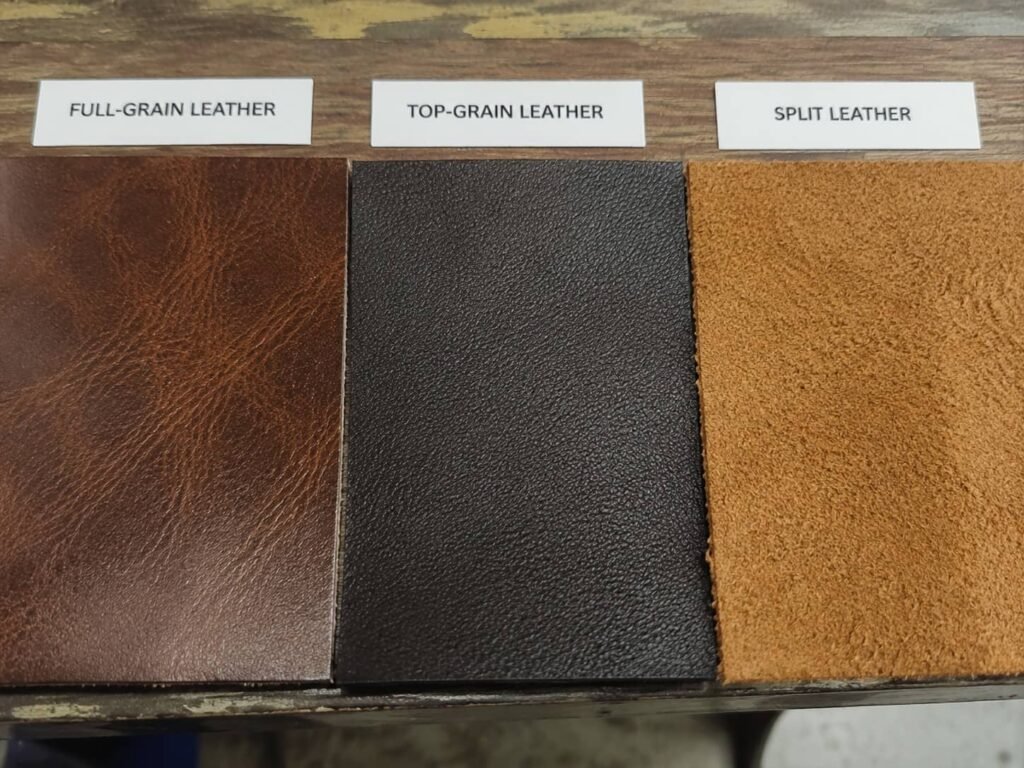
Full-Grain Leather
Full-grain keeps the complete hide surface with its natural grain intact. It is generally more expensive than lower-grade leather, but the actual difference depends on tannery, origin, thickness, finish, hide quality and purchasing volume. Because full-grain retains scars and marks, cutters must work around imperfections, which lowers yield and raises waste. It is the right choice for premium and heritage brands where the grain itself is the product.
Top-Grain Leather
Top-grain is sanded to remove surface imperfections, then finished with a coating. It is more uniform and easier to cut than full-grain, so it yields better and costs less — the workhorse of mid-to-premium wallets.
Split Leather
Split leather is the inner layer of the hide remaining after the top-grain is split off. It is the lower-cost real-leather option, often coated and embossed to imitate a higher grade, and is common in mass-market and promotional wallets. Some suppliers and markets use “genuine leather” as a broad commercial term for “real leather”, but it is not a strict leather-grade definition. Request the exact construction and finishing spec rather than relying on the term alone. See our guide to full-grain vs top-grain vs genuine leather.
Microfiber / PU Leather
Synthetic materials are fully uniform and generate essentially zero cutting waste, giving the lowest and most predictable material cost. They are widely used in vegan lines and entry price points. Note that “vegan leather” and “PU” are not identical — always confirm the exact substrate.
Leather Cost Factors: Why the Same Grade Can Cost Very Differently
Two wallets both labeled “full-grain” can still be far apart in price. The factors below are what procurement teams should pin down before comparing hides:
| Leather factor | Impact on cost |
|---|---|
| Grade | High |
| Tannery | High |
| Origin | Medium–High |
| Hide size | Medium |
| Surface defects | High |
| Yield (usable area) | High |
| Thickness | Medium |
| Finish | Medium |
| Purchase volume | High |
Leather Thickness, Yield & Effective Cost
Thickness is measured in ounces (1 oz ≈ 0.4 mm); a standard wallet uses roughly 3–4 oz leather 【Benchmark】. The number most buyers miss is yield — the usable percentage of each hide after cutting around defects and imperfect edges.
The concept that matters for costing is this:
Effective Leather Cost = Leather Purchase Cost ÷ Usable Yield
Example: if a leather costs $8 per square foot but you can only use 80% of it, your effective cost is $8 ÷ 80% = $10 per usable square foot 【Illustrative】. This is why your hide can cost 20% more but your finished wallet costs much more than 20% extra — yield, cutting efficiency, and defect rate compound on top of the sticker price. Experienced factories plan cutting patterns around yield, not just around the design.
How Wallet Design Affects Manufacturing Cost
Two wallets using identical leather can differ sharply in cost purely from design. Every design decision is, underneath, a labor and material decision.
| Design feature | Cost impact |
|---|---|
| 4 card slots | Low |
| 8 card slots | Medium |
| ID window | Medium |
| Coin pocket | Medium |
| Zipper (zip-around) | Medium–High |
| RFID layer | Medium |
| Multiple interior layers | High |
| Hand-painted edges | High |
| Hand stitching | Very High |
Card Slots & Components
Each card slot is an extra piece to cut, skive, and stitch — and more slots mean a thicker, harder-to-edge wallet. An eight-slot bifold costs more than a four-slot model not because of the material, but because of the added assembly time. Likewise, every separate part — lining, RFID layer, ID window, coin pocket — adds a cut, an alignment step, and a stitch pass, plus more failure points in QC.
Structure & Stitching
Bifold, trifold, zip-around, and card-holder designs each have a different component count and assembly sequence; a zip-around adds a gusset and zipper installation. Structure sets the minimum labor floor. Stitch count, thread weight, and turn corners all drive time — hand-stitching can take many times longer than machine stitching.
Edge Finishing
Edge finishing is where cheap wallets show themselves. The hierarchy runs from raw cut edge, to heat-sealed, to multi-pass painted or burnished edges. A well-finished edge adds real labor minutes — but it is the single strongest visual signal of quality, so decide edge treatment before you request quotes. Our how leather wallets are made guide covers the process in detail.
How Labor and Production Processes Affect Wallet Cost
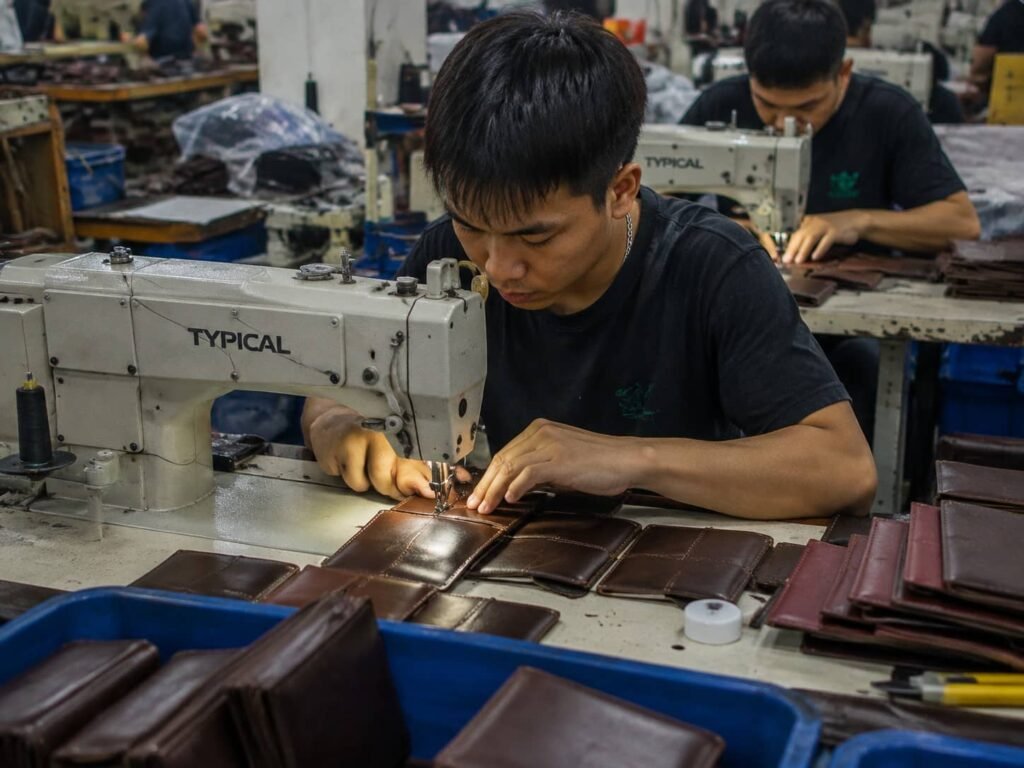
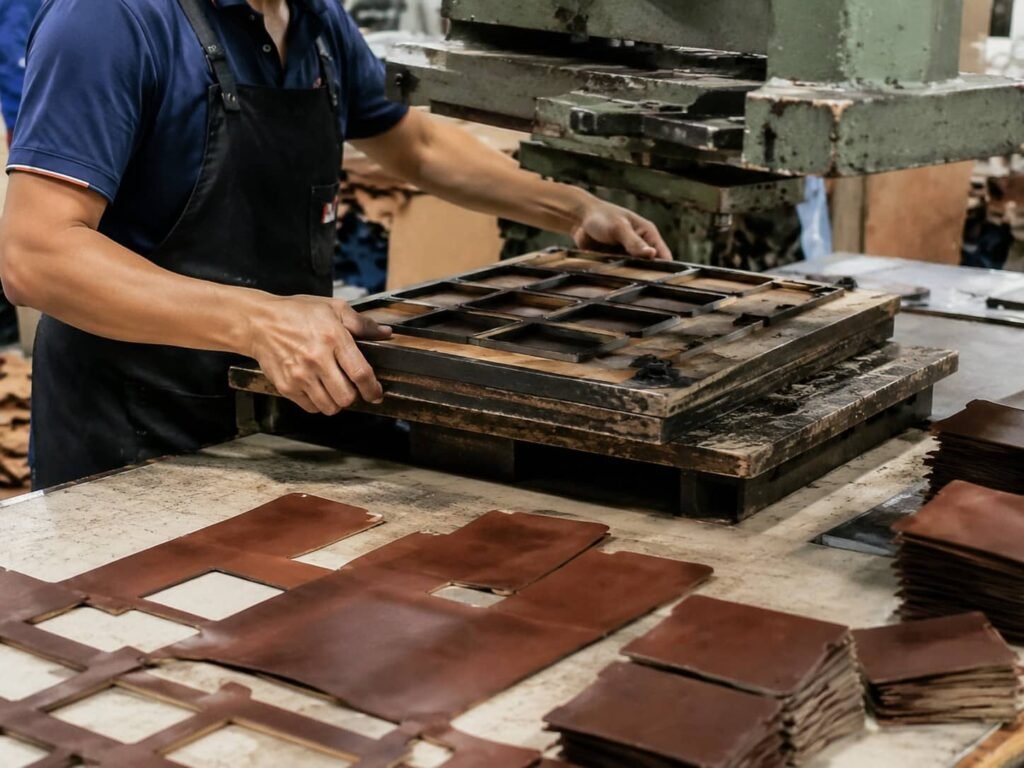
Labor is the second-biggest lever and the most geography-dependent. It can range from a few dollars per unit for automated, assembly-line production to well over a hundred dollars for true handwork 【Benchmark】. Production method matters as much as the country: CNC die-cutting is faster and more consistent than hand-cutting, and edge-painting machines beat manual burnishing.
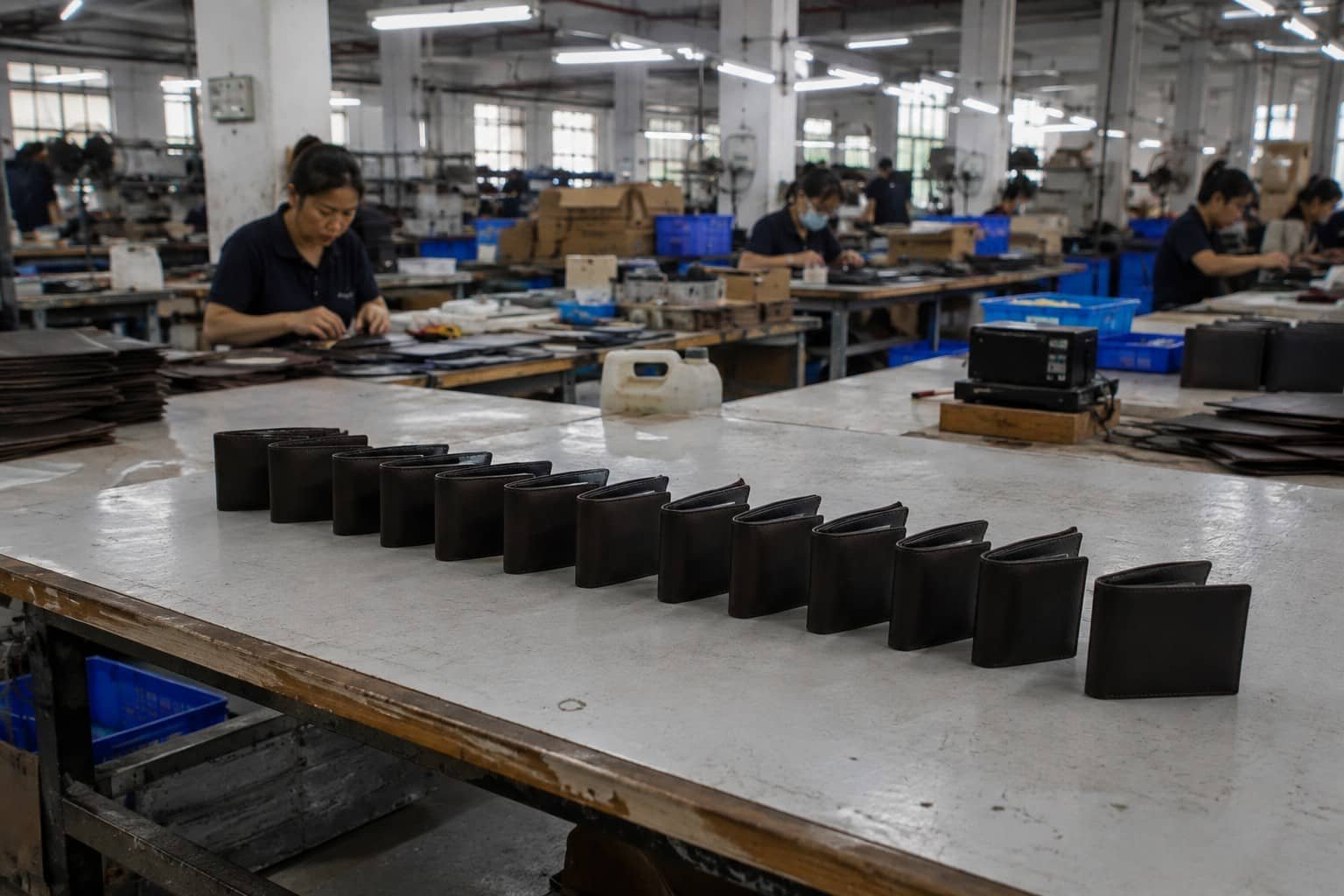
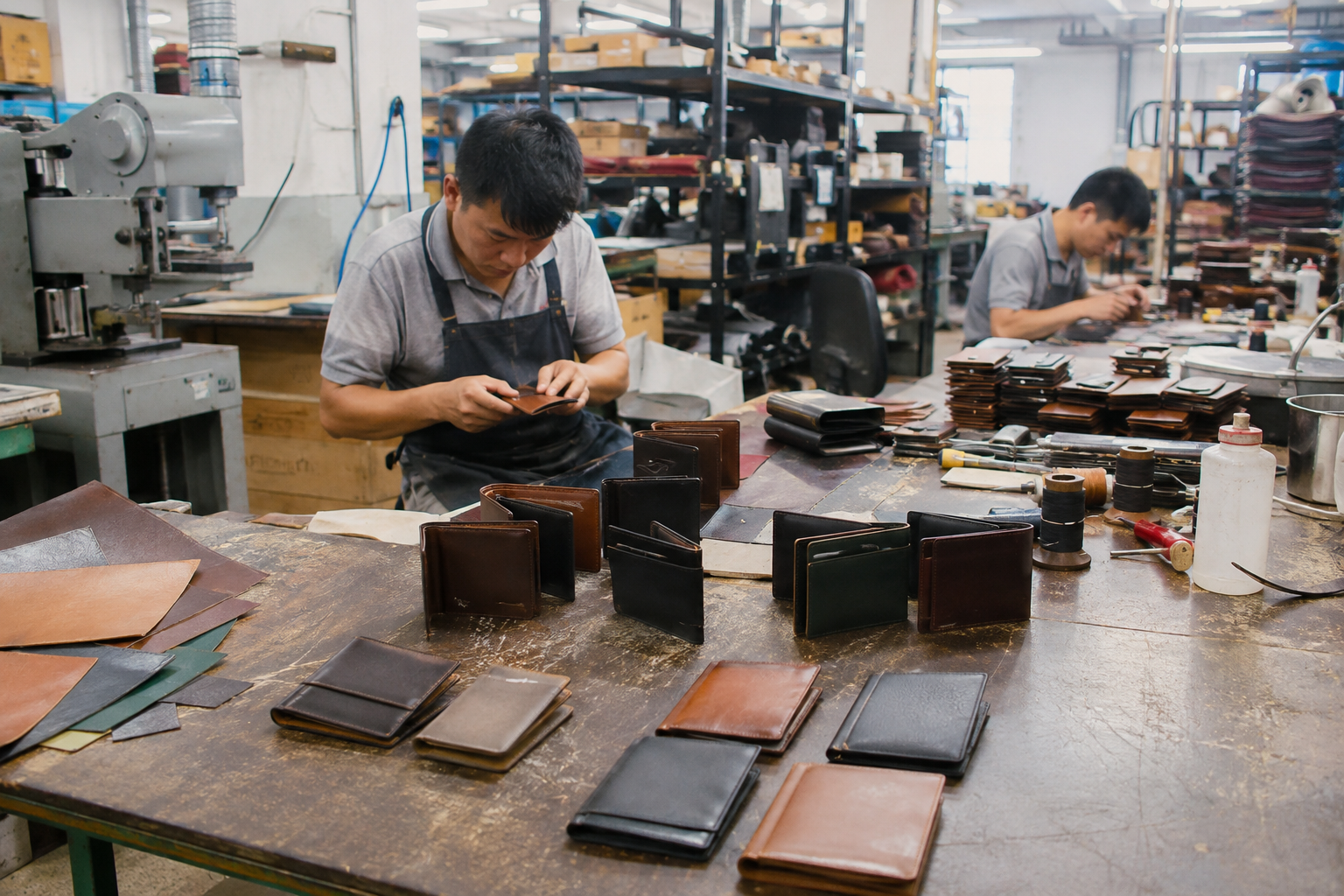
This is also where factory experience and efficiency show up in the price. A manufacturer that runs cutting, skiving, and stitching in-house — rather than subcontracting steps — controls both quality and cost. Solton runs a 2,000+ ㎡ factory with 12+ years of OEM/ODM experience , keeping the full process under one roof so labor is spent on value-adding work, not rework.
How Custom Branding Affects Leather Wallet Cost
Branding is where “custom” and “stock” diverge. Each method carries a one-time tooling cost plus a per-unit cost.
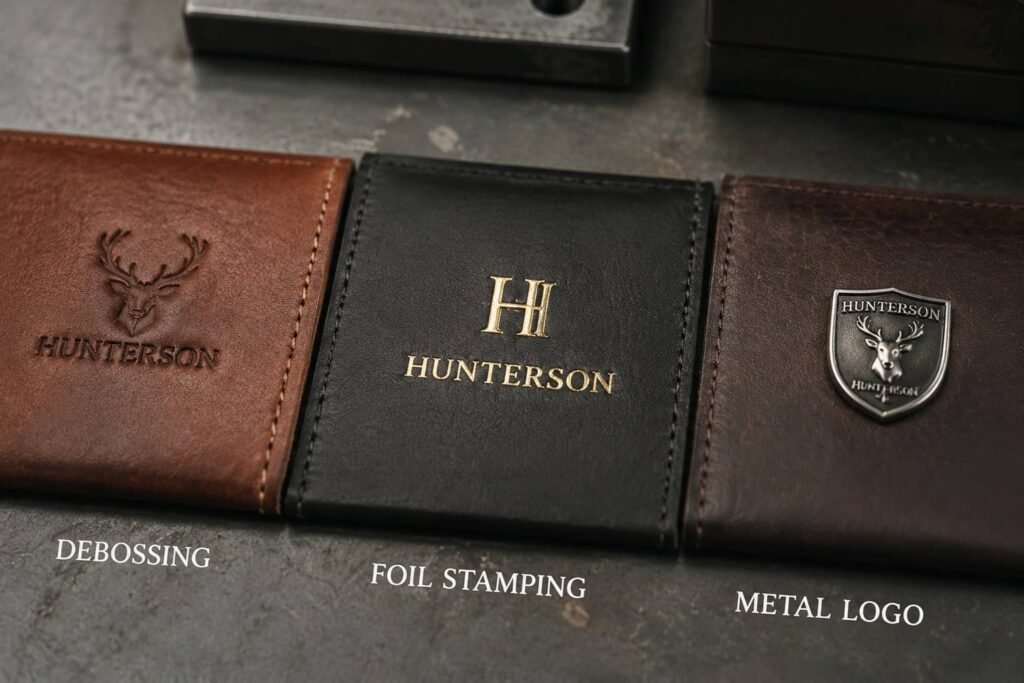
Debossing
A heated die presses your logo into the leather. The die is a low one-time cost with a near-zero per-unit cost — the most cost-effective branding for volume.
Foil Stamping
Gold or silver foil heat-pressed onto leather or lining. A similar one-time die cost plus a small foil cost per unit, delivering high perceived value at low cost — ideal for premium lines.
Metal Logo
A metal plate or badge adds a more premium feel but requires custom metal tooling (a higher one-time cost) plus a per-unit part, and lengthens lead time — best suited to higher-ticket lines.
Custom Hardware
Custom zipper pulls, magnetic closures, and buckles each carry tooling plus a per-unit cost — and quality hardware can rival the cost of the leather itself. Don’t spec cheap hardware on a premium hide.
Which Logo Method for Which Volume?
| Branding | Typically best for |
|---|---|
| Debossing | 500–5,000+ pcs (higher volume) |
| Foil stamping | Premium / gift products |
| Metal logo | High-end positioning |
| Custom hardware | Large-volume programs |
These are typical fits, not hard rules — the right method depends on your order volume and brand positioning.
How MOQ Affects Leather Wallet Manufacturing Cost
MOQ is the biggest unit-price lever after material. Low-MOQ orders typically carry a noticeable unit-cost premium, because pattern setup, line changeover, sampling and QC preparation are spread across fewer units.
The cost curve below shows the mechanism using Solton’s own order quantities — the dollar figures are Solton historical quotation data, shown in anonymized ranges
| MOQ | Estimated unit cost | Why |
|---|---|---|
| 100 pcs | $8.92 | High fixed-cost allocation |
| 300 pcs | $7.38 | Lower setup allocation |
| 500 pcs | $7.07 | Better production efficiency |
| 1,000 pcs | $6.46 | Standard OEM efficiency |
| 3,000 pcs | $6.05 | Higher purchasing efficiency |
The direction matters more than any single figure: a higher MOQ lowers unit cost and shrinks the per-unit impact of fixed costs. Solton offers a low MOQ of 100 pcs per style per color,letting brands test the market without over-committing — see our leather wallet MOQ guide.
Three Ways to Source Leather Wallets
There are three legitimate routes, and the right one depends on your target volume, differentiation needs, and launch timeline:
| Route | What it is | Best for |
|---|---|---|
| 1. Stock wallet + logo | Existing construction, branded with a deboss | Fastest launch, lowest commitment |
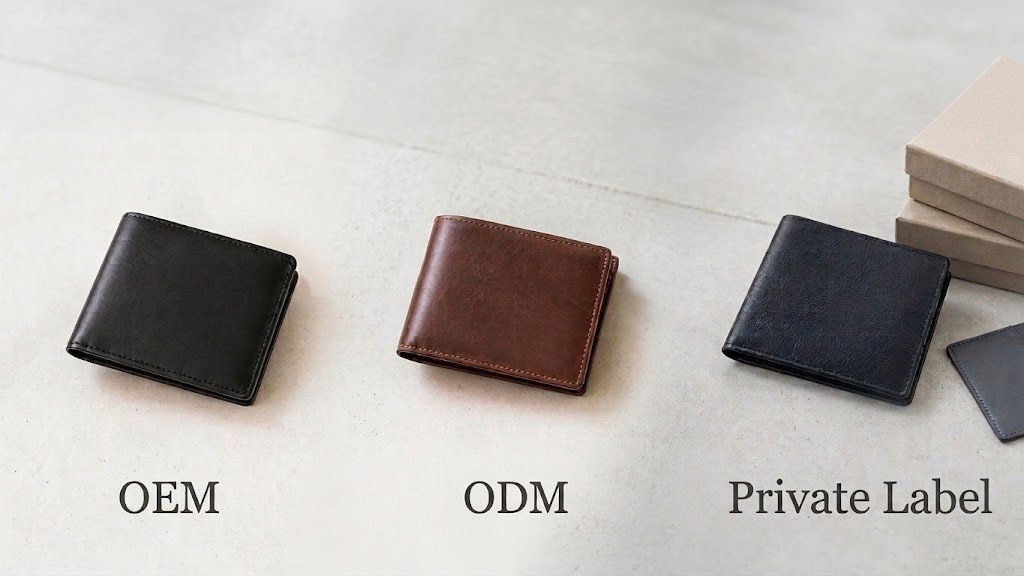
| 2. Private label wallet | Your brand on a proven Solton construction | Building a brand with lower upfront cost |
| 3. Full custom OEM/ODM | Unique design, pattern & tooling built for you | Differentiation, higher volume |
Most brands grow through this order: start private label, then move to custom once volume justifies the tooling. Our private label wallet manufacturer page explains routes 2 and 3 in depth.
How Sampling and Tooling Affect Total Cost
These are the costs buyers forget to budget for — and the ones that make the first order look “expensive.” Typical one-time ranges, which vary by supplier and detail 【Benchmark】:
| Item | Typical one-time cost (confirm with supplier) |
|---|---|
| Pattern making (OEM) | Low |
| Sample — simple bifold | Low to moderate |
| Sample — zip-around / complex | Moderate |
| Debossing / foil stamping die | Low |
| Metal badge tooling | Moderate to high |
| Custom buckle / hardware tooling | Moderate to high |
The math that matters: a fixed tooling package spread across 5,000 units costs almost nothing per unit, but the same package on 100 units adds real dollars to each wallet. Always ask the factory to amortize tooling across the full planned program — and confirm who owns the dies. You should own them, so you can move factories later without paying again. On speed: Solton turns a sample in 5–7 working days and completes production in 25–35 days
How Packaging Affects Leather Wallet Pricing
Packaging is a small share of unit cost and the easiest place to overspend or underspend — from a simple poly bag, to a box with dust bag, to a full gift box with insert, tissue, and outer carton. Each step adds cost and shipping weight.
Match packaging to the selling channel: e-commerce needs protection, gift retail needs presentation, wholesale needs durability in transit. Custom-printed boxes carry their own tooling (printing plates) — ask about it separately so it doesn’t surprise you on the invoice.
Does Manufacturing Location Affect Leather Wallet Cost?
Yes — often as much as the material. Lower-cost regions reduce unit price, but lower unit cost does not equal lower total cost: freight, lead time, communication, IP protection, and QC travel all sit on top of the factory price. A cheaper unit that arrives late or fails inspection costs more than it saves.
Solton manufactures in-house and supports both FOB and DDP terms, with OEM customization and a structured QC process built in — so the “location” question is answered up front, not negotiated after the fact. When comparing factories, weigh total landed cost and reliability together.
Example: Full Cost Breakdown for a 1,000-Piece Leather Bifold Wallet
Here is the worked calculation the search “how much does it cost” is really asking for. The specification below is one Solton quotes regularly, shown anonymized; the dollar figures are Solton historical quotation data
| Specification | Value |
|---|---|
| Order quantity | 1,000 pcs |
| Leather | Top-grain cowhide |
| Construction | 6-card bifold |
| Logo | Debossed |
| Packaging | Standard retail box |
| Destination | USA |
Line-by-line cost breakdown:
| Cost component | Example cost / unit |
|---|---|
| Top-grain leather | $1.65 |
| Lining & reinforcement | $0.90 |
| RFID layer | $0.65 |
| Hardware | $0.25 |
| Cutting & skiving | $0.50 |
| Stitching & assembly | $1.30 |
| Edge finishing | $0.25 |
| Logo debossing | $0.15 |
| Packaging | $0.35 |
| Factory overhead | $1.35 |
| Estimated manufacturing cost | $7.35 |
The point is not a single figure — it is that a quoted price is meaningless until you know the spec behind it. Two factories quoting the “same” 1,000-piece bifold can be far apart because one specs full-grain with hand-finished edges and the other specs split leather with raw-cut edges. First-hand specification is what turns a vague price into a comparable quote.
How to Reduce Leather Wallet Manufacturing Cost Without Sacrificing Quality
This is value engineering, not cost-cutting. Five moves that genuinely work:
- Switch leather grade, not thickness— top-grain instead of full-grain lowers cost while keeping the feel buyers notice.
2. Simplify the structure— fewer components mean less labor and fewer QC rejects.
3. Raise MOQ — the fastest way to cut unit cost and reduce fixed-cost impact.
4. Standardize hardware — off-the-shelf zipper pulls and snaps instead of custom.
5. Brand with debossing instead of metal plates — same logo, a fraction of the tooling.
The rule: cut the things buyers can’t see (structure, hardware spec), never the things they can (leather feel, edge finish, stitching).
How to Compare Leather Wallet Factory Quotes
Two factories quoting different prices for the “same” wallet are often pricing different specifications. Normalize every quote to the same denominator before you compare:
- Is it ex-factoryor landed?
2. Are tooling and samplingincluded or separate?
3. Is the leather spec identical — grade, thickness, tannery, origin?
4. Is the packaging identical?
5. What is the MOQ and the price at your volume?
6. What are the payment terms?
7. Who owns the tooling, and what is the defect/rework policy?
Build a one-row comparison table with these seven fields.For a worked sourcing example, see our slim card holder sourcing guide. The “cheapest” quote that fails on fields 2 and 7 is usually the most expensive in practice. For a full checklist, see our guide on how to choose a leather wallet manufacturer.
Manufacturing Cost vs Landed Cost
The most expensive mistake a buyer makes is budgeting only the manufacturing cost. The three levels:
| Term | What it includes |
|---|---|
| Manufacturing cost | Materials + labor + overhead + tooling + packaging (ex-factory) |
| FOB | Manufacturing cost + local transport to port + export clearance |
| Landed cost | FOB + freight + insurance + import duty + customs brokerage |
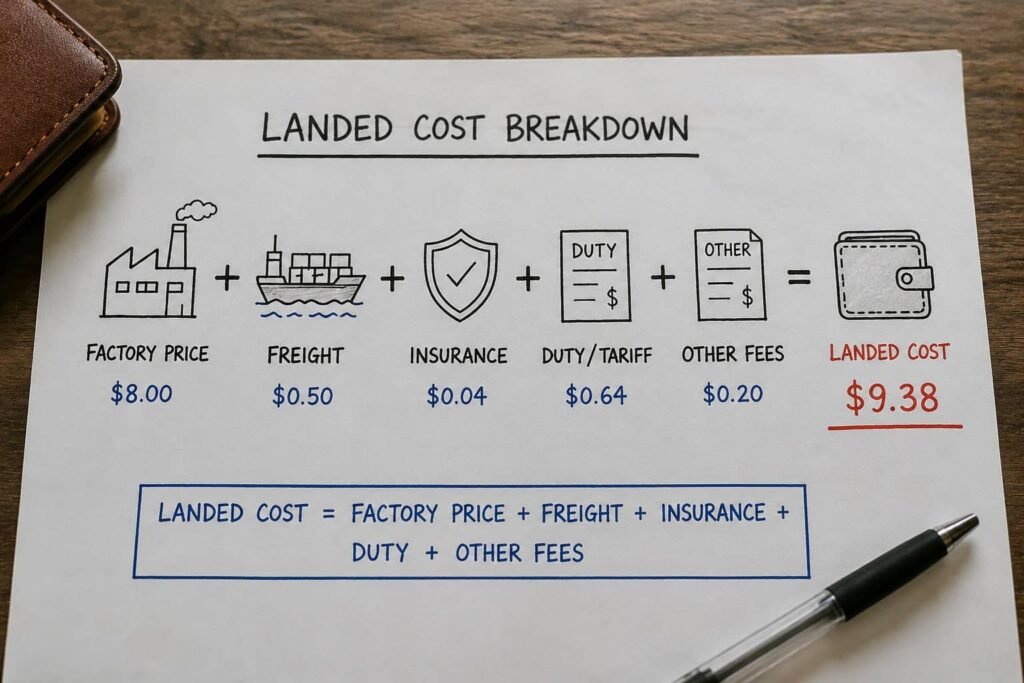
Example of landed cost:
| Item | Cost |
|---|---|
| Factory price (ex-factory) | $8.00 |
| + Freight | $0.50 |
| + Insurance | $0.04 |
| + Import duty | $0.64 |
| + Customs Clearance | $0.20 |
| = Estimated landed cost | $9.38 |
Import duty alone can add a meaningful percentage depending on the destination country and HS code — leather wallets are classified under leather articles, so confirm the exact code with your broker. The core lesson: a $5 factory price is not a $5 landed cost. Always quote landed, never just ex-factory. Solton supports both FOB and DDP terms so you can see the full picture before you commit.
What Information Does a Wallet Manufacturer Need to Quote Your Project?
The fastest way to get an accurate quote is to send a complete specification up front. Prepare these ten details and you will get a line-item quote instead of a vague range:
- Wallet type(bifold, trifold, zip-around, card holder)
2. Dimensions(open and folded)
3. Leather specification (grade, tannery if known)
4. Leather thickness (ounces)
5. Interior construction (card slots, ID window, coin pocket, RFID layer)
6. Logo method (deboss, foil, metal, or none)
7. Hardware (type and finish)
8. Packaging (poly bag, box, gift box)
9. MOQ / target volume
10. Destination country (for landed cost)
This list also works as a checklist when comparing suppliers — any factory that can’t quote against these fields is guessing.
Frequently Asked Questions
How much does it cost to manufacture a leather wallet?
Indicative OEM ranges vary widely — from single-digit prices for simple synthetic wallets to significantly higher costs for premium full-grain or hand-finished products — driven by leather grade, design, volume and location. See the worked cost breakdown above for a concrete example.
What is the biggest factor in leather wallet manufacturing cost?
Leather grade, typically the largest single share of unit cost, followed by labor and design complexity. High-end hand-finished wallets and low-cost PU wallets have very different cost structures.
Is full-grain leather worth the extra cost?
For premium and heritage brands, yes — the natural grain and durability are the selling point. For mid-market lines, top-grain delivers most of the look at a lower cost. The right choice depends on your positioning and target price.
Does MOQ change the unit price?
Yes, significantly. Lower-MOQ runs carry a noticeable premium over high-volume runs because fixed setup costs are spread over fewer units. Solton offers a low MOQ of 100 pcs per style per color.
How much does a logo add to the cost?
A debossing or foil-stamping die is a low one-time cost with a near-zero per-unit cost. A custom metal logo adds higher one-time tooling plus a per-unit part, and lengthens lead time.
How can I reduce manufacturing cost without losing quality?
Switch leather grade (not thickness), simplify the structure, raise MOQ, standardize hardware, and use debossing instead of metal plates — cutting the things buyers can’t see, never the things they can.
What information do I need to get an accurate quote?
Wallet type, dimensions, leather spec and thickness, interior construction, logo method, hardware, packaging, target MOQ, and destination country — so the factory can quote both manufacturing and landed cost.
What is the difference between manufacturing cost and wholesale price?
Manufacturing cost is what you pay the factory to make the wallet. Wholesale price is what you charge retailers and typically includes your margin (often a 2–2.5× markup over manufacturing cost). Retail price adds a further markup. Don’t confuse the factory’s number with your own pricing model.
What is the cheapest way to manufacture a custom leather wallet?
Combine a mid-grade leather (top-grain), a simple low-component structure, a debossed logo, standard hardware, and a higher MOQ. Each of these lowers cost without visibly cheapening the wallet — see the “reduce cost without sacrificing quality” section above.