Quick Answer: how to choose a leather wallet manufacturer?
| Factor | What to Check |
|---|---|
| Manufacturing Experience | Relevant wallet production experience |
| Leather | Grade, thickness, finish and consistency |
| Sampling | Sample quality and revision process |
| Construction | Skiving, folding, stitching and edges |
| MOQ | MOQ per style and color |
| OEM/ODM | Development and customization capability |
| QC | Incoming, in-process and final inspection |
| Production | Capacity and lead time |
| Branding | Debossing, embossing, foil stamping |
| Bulk Consistency | Approved sample vs. mass production |
| Export | International B2B experience |
| Reorders | Consistent quality over repeat orders |
The Buyer Decision Path
Most buyers don’t need a list of “wallet factories” — they need a way to judge whether a factory is reliable before placing an order. The sections below follow a practical decision path:
I need a wallet manufacturer → What should I prepare? → Can this factory make my product? → Is the leather suitable? → Can they make a good sample? → Can bulk match the sample? → Is the MOQ reasonable? → Is the quote comparable? → Can they control quality? → Can they support repeat orders? → Should I place the order?
Key Takeaways
- Relevant wallet manufacturing experience matters more than years in business alone.
- Always approve a physical sample before committing to bulk production — never evaluate a factory on catalog photos or a digital rendering alone.
- A good sample does not automatically mean good mass production; verify how the factory controls bulk against the approved sample.
- Compare quotes by specification, not by unit price — and score each factory on the same criteria before deciding.
- Confirm MOQ per style and per color, and check wallet-specific QC, capacity, and lead time before ordering.
Introduction
Finding a leather wallet manufacturer is easy. Choosing one you can trust to deliver the right product, on time, at a consistent quality — that’s the hard part. A supplier directory or a low quote tells you almost nothing about whether a factory can actually make your wallet the way you spec’d it.
This guide is written for B2B buyers, brands, and importers who are preparing to place an order and want a practical way to evaluate manufacturers before committing capital. It walks through the decision path step by step — from defining your requirements, to checking experience and craftsmanship, to approving a sample, and finally to verifying that bulk production will match it.
Table of Contents
1. Define Your Leather Wallet Requirements
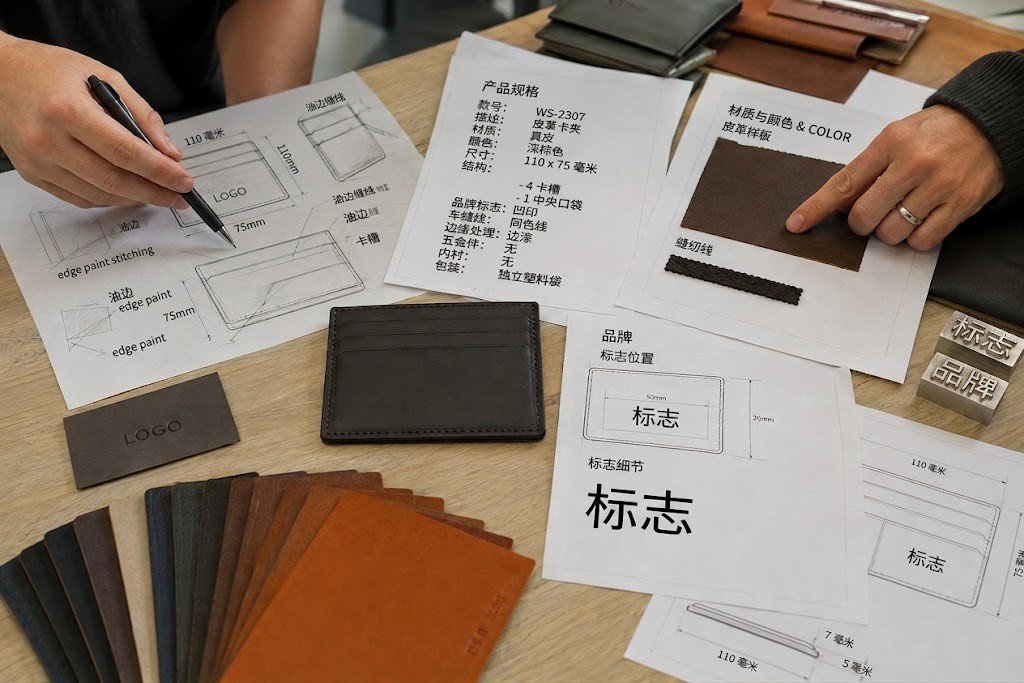
You can’t evaluate a manufacturer until you know exactly what you’re asking them to make. Before contacting any factory, document your requirements in a single brief covering:
- Wallet type— bifold, trifold, zip-around, cardholder, or long wallet
- Dimensions— open and folded
- Card capacity— number and layout of card slots, ID window, coin pocket
- Leather— grade, thickness, and finish
- Color— reference or Pantone target
- Lining— leather, fabric, or synthetic
- Logo— method, position, and size
- Packaging— poly bag, box, or gift box
- Quantity— target MOQ and first-order volume
- Target market— region and sales channel
What Information Should You Send to a Wallet Manufacturer?
Send the same package to every factory you’re evaluating: your design drawing or reference sample, dimensions, leather specification, logo artwork, target quantity, and destination country. A manufacturer that asks clarifying questions about these details — rather than quoting immediately — is usually a good sign. It means they’re reading your specification, not guessing at it.
2. Check the Manufacturer's Wallet Experience
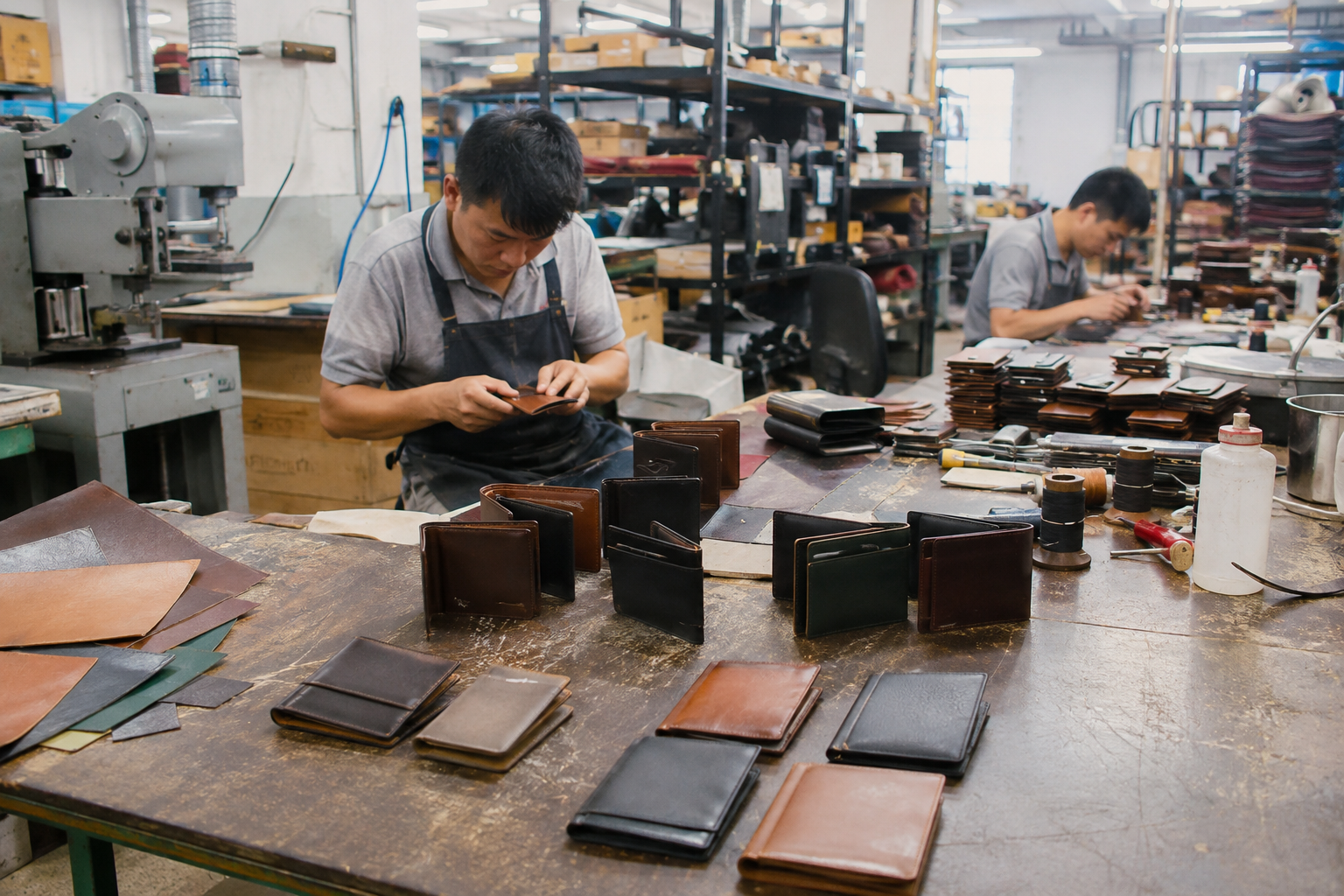
Not every leather goods factory is a wallet factory. Wallets and cardholders require different tooling, cutting, and finishing skills than bags or belts, so look for evidence of wallet-specific experience rather than a generic “years in business” claim.
Ask to see:
- A wallet and cardholder portfolio
- Similar projects to yours (similar construction, leather, or branding)
- Pattern development capability
- Sampling workflow and timelines
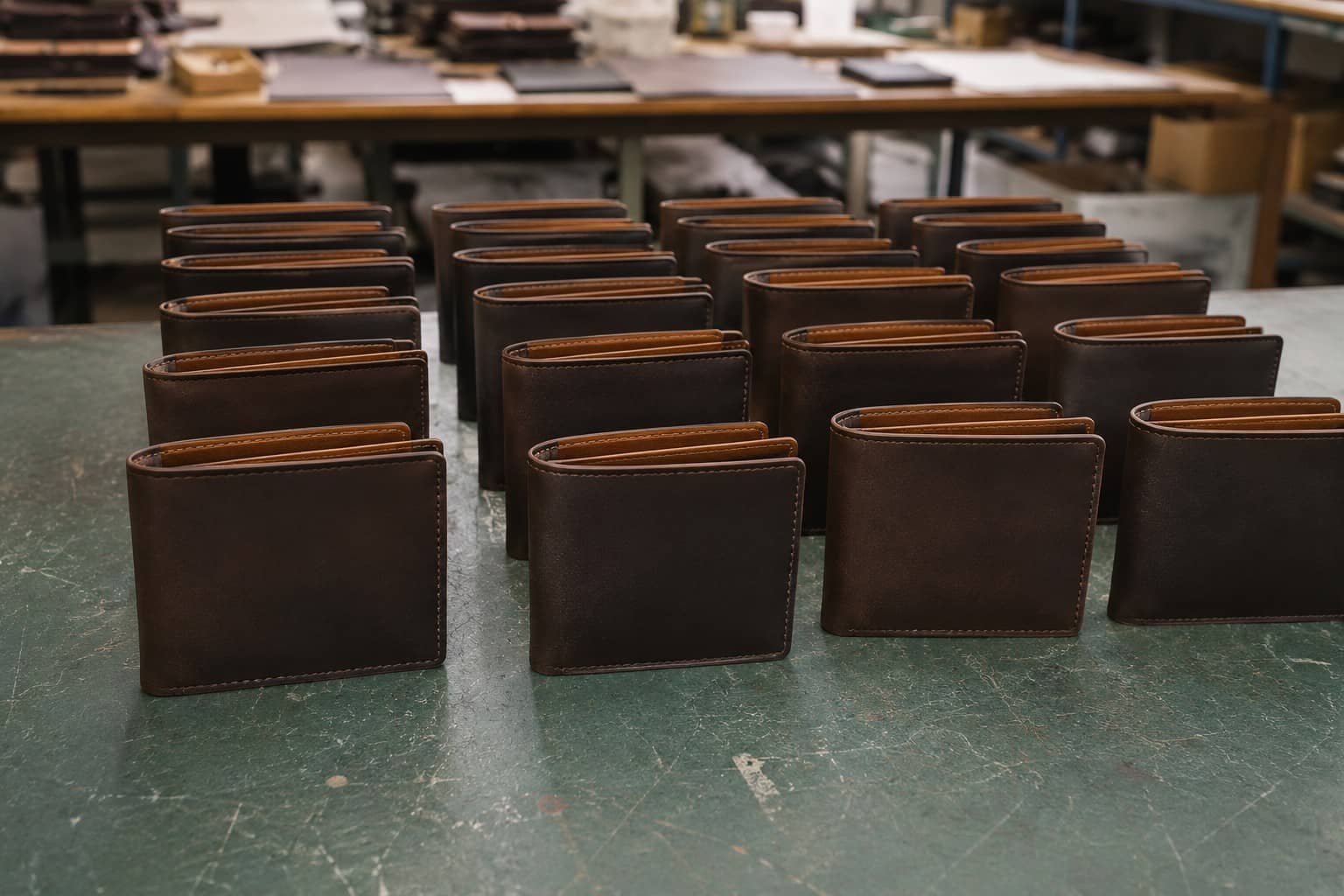
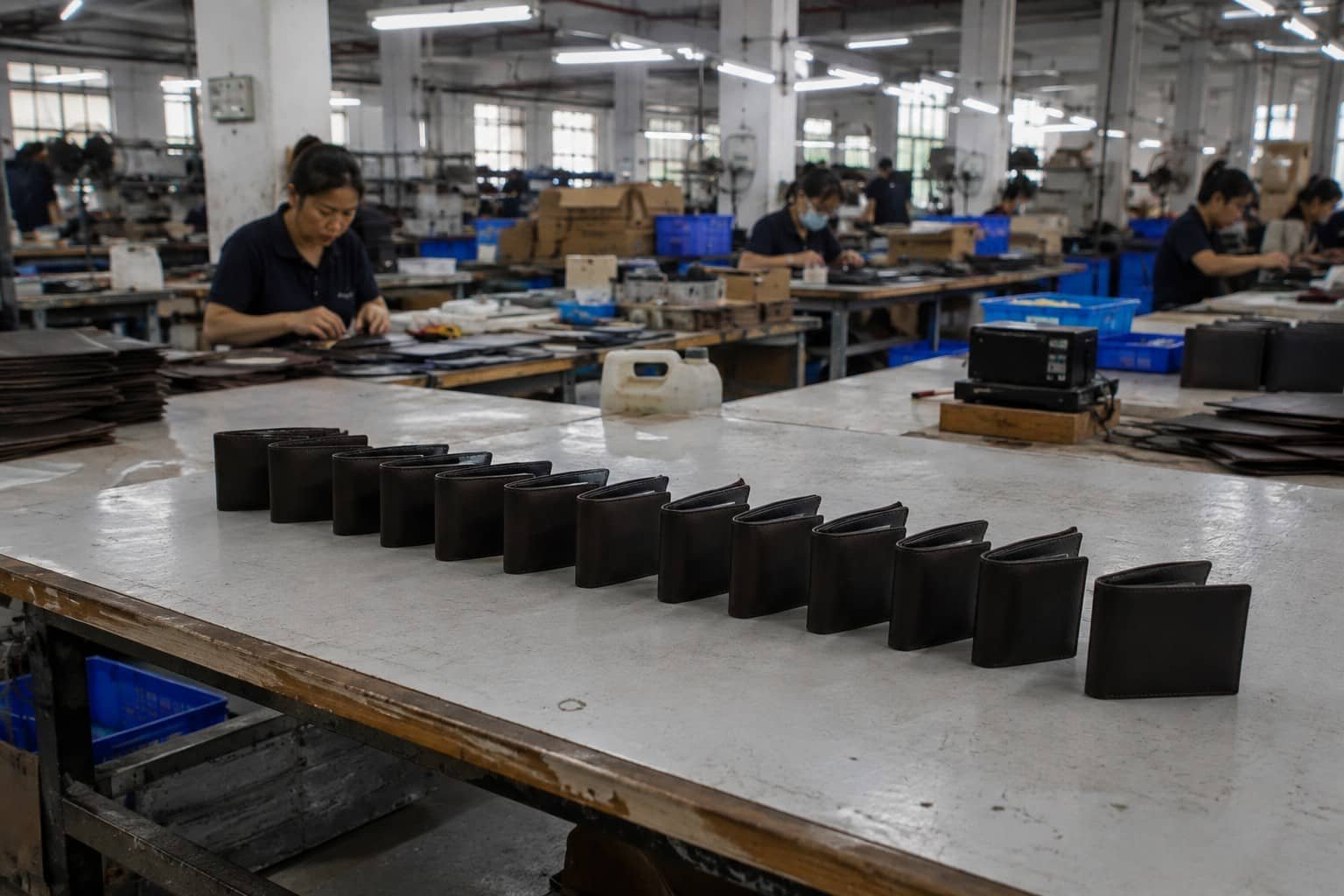
- Evidence of actual production (factory floor, not just catalog images)
- Branding capability (debossing, foil stamping, custom hardware)
Point to remember: Years in business alone do not prove wallet manufacturing expertise. A factory that has made bags for 15 years may never have produced a clean cardholder. Ask for wallet-specific proof.
3. Evaluate Leather and Material Knowledge
A manufacturer who can’t explain leather grades, thickness, or why a hide’s yield matters will not be able to quote your project accurately. When you discuss leather, the factory should be able to explain the difference between full-grain, top-grain, and split leather, how thickness affects structure and feel, and how defects and grain variation affect cutting yield.
Check their knowledge of:
- Leather grades— full-grain, top-grain, split, and their trade-offs
- Thickness— in ounces or millimetres, and what suits a wallet
- Finishes— aniline, semi-aniline, pigmented
- Consistency— how they control shade and grain variation between batches
For a full reference on grades and finishes, see our leather materials guide.
4. Evaluate Wallet Construction and Craftsmanship
Construction is where a cheap wallet shows itself. Ask the manufacturer to walk you through — or better, show you — the following construction details:
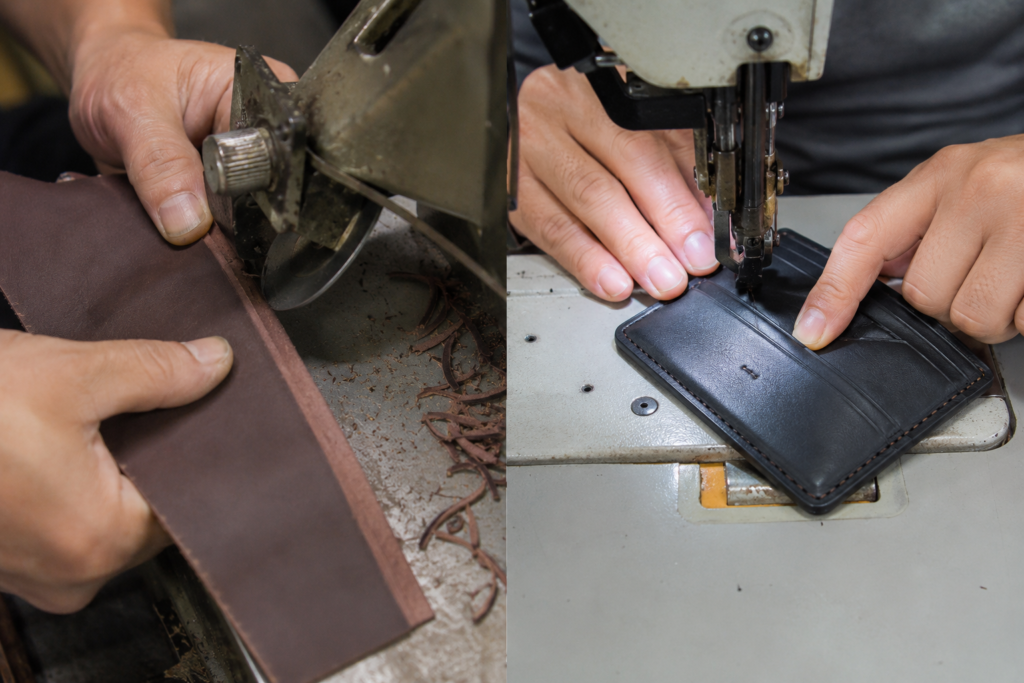
Skiving
Thinning the leather edges where panels meet, so the wallet folds without bulging. Poor skiving produces thick, uneven edges.
Folding
The wallet should fold cleanly and lie flat, without cracking or excessive bulk at the spine.
Card Slot Construction
Slots should be evenly spaced, cut to consistent depth, and reinforced so cards fit securely without tearing over time.
Stitching
Check stitch tension, spacing, and alignment. Uneven or loose stitching is a durability problem, not just a cosmetic one.
Edge Finishing
Edges should be smooth and consistent — raw-cut, heat-sealed, or painted. Edge finishing is the single strongest visual signal of quality.
Logo Application
Debossing, foil stamping, or metal logo placement should be clean, aligned, and consistent across every unit.
Wallet Construction Inspection Points — use this as a checklist when reviewing a sample: leather grade and thickness, card slot fit and spacing, stitch alignment and tension, edge smoothness, logo position and depth, and folding without cracking or bulk.
For a step-by-step look at how a wallet is actually made, see our wallet production process.
5. Approve the Sample Before Bulk Production
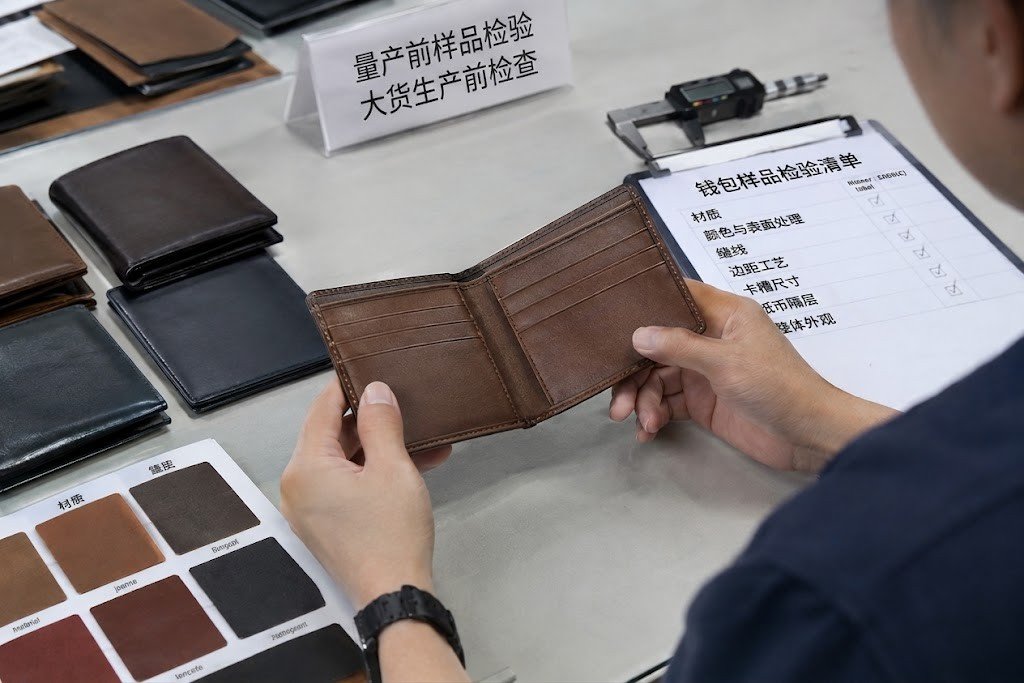
Never evaluate a leather wallet manufacturer based only on catalog photos or a digital rendering. A physical sample is the only way to verify leather, construction, and finish against your specification. The sample process should follow a clear sequence:
Design Brief → Prototype → Sample Revision → Final Sample → Approved Sample → Bulk Production → Final QC
When you receive the sample, verify these points:
| Sample Check | What Buyers Should Verify |
|---|---|
| Leather | Grade, thickness, texture |
| Color | Matches approved reference |
| Dimensions | Matches specifications |
| Card Slots | Fit and spacing |
| Stitching | Alignment and tension |
| Edges | Smooth and consistent |
| Logo | Position, depth and finish |
| Folding | No cracking or excessive bulk |
| Function | Cards and cash fit correctly |
6. Verify Sample-to-Bulk Consistency
A good sample does not automatically mean good mass production. A single hand-finished sample is one thing; reproducing it across hundreds or thousands of units is another. This is the core question every buyer should ask, and the one most suppliers don’t answer clearly.
Between sample and bulk, variation can appear in:
- Leather shade variation
- Thickness variation
- Card slot spacing variation
- Stitching inconsistency
- Edge finishing differences
- Logo misalignment
- Shape and dimension variation
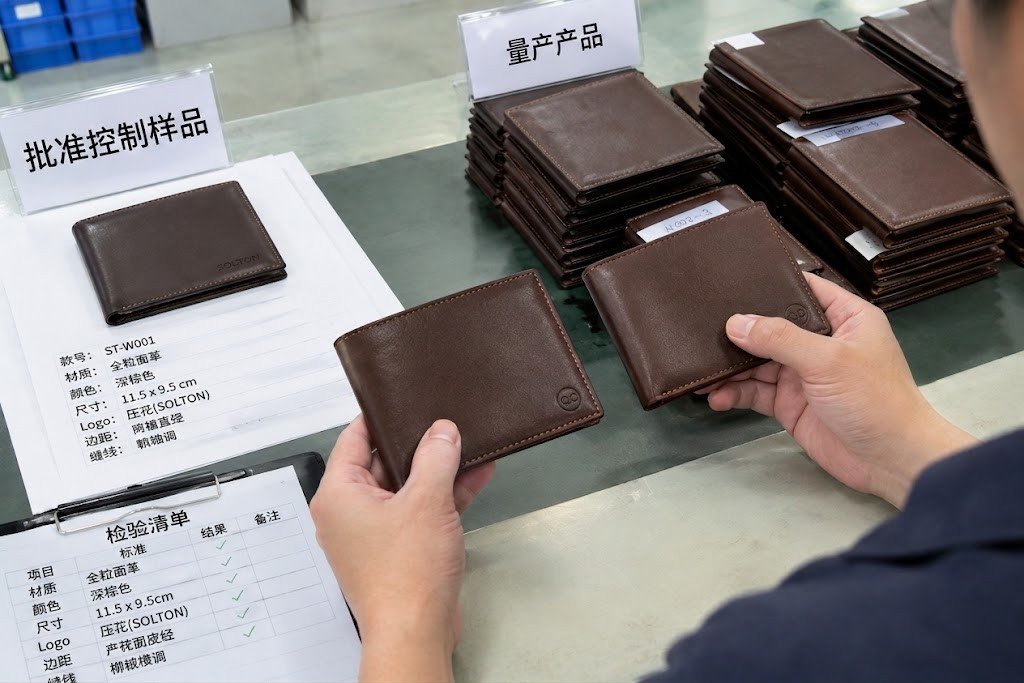
Practical ways to verify sample-to-bulk consistency:
| Verification Method | What It Confirms |
|---|---|
| Sealed control sample | The approved sample stays at the factory as the production reference |
| Batch shade swatches | Leather shade is matched and confirmed before cutting |
| Mid-production photos / video | Construction is checked while the line is running |
| In-process measurement checks | Card slot spacing and dimensions stay within tolerance |
| Pre-shipment sample from bulk | A unit pulled from the actual bulk run matches the approved sample |
| AQL inspection report | Defect rate measured against an agreed standard |
| Third-party inspection | Independent verification before shipment |
Ask the manufacturer directly: “How do you control bulk production against the approved sample?” A strong answer will reference a sealed control sample, describe wallet-specific in-process checks (card slot, fold, stitching, edge), and offer a pre-shipment sample or AQL report. A vague answer is a red flag.
7. Understand How the Manufacturer Calculates MOQ
Confirm whether the MOQ is quoted per style, per color, per SKU, or per total order — this single detail can multiply your total unexpectedly. Ask for a tiered quote so you can see how the price moves at 100, 300, 500, and 1,000 units. For a full explanation of how MOQ is calculated, see our leather wallet MOQ guide.
8. Compare Wallet Manufacturer Quotes Correctly
Never compare wallet quotations by unit price alone. Two manufacturers may quote different prices because they are not quoting the same product:
| Specification | Supplier A | Supplier B |
|---|---|---|
| Leather | Full-grain | Top-grain |
| Thickness | 1.2 mm | 0.9 mm |
| Lining | Leather | Fabric |
| Logo | Debossed | Printed |
| Packaging | Custom box | Poly bag |
| MOQ | 100 | 500 |
| Sample | Included | Extra |
Normalize every quote to the same specification before comparing — leather grade, thickness, lining, logo method, packaging, MOQ, and whether tooling and sampling are included. For a full line-by-line breakdown of what goes into the price, see our leather wallet manufacturing cost guide.
9. Worked Example: Choosing Between Two Factories
Here’s how the evaluation plays out in practice. A buyer developing a 500-piece leather bifold sent the same brief to two factories:
Factory A quoted the lower unit price. But its sample used a thinner top-grain leather than specified, the card slots were slightly uneven, and when asked how it would control bulk against the sample, the sales contact couldn’t explain the QC process. It offered no sealed control sample and no AQL inspection report.
Factory B quoted slightly higher. Its sample matched the specification — correct leather grade and thickness, even stitching, clean edges. It provided a sealed control sample, explained its wallet-specific QC checkpoints (card slot, fold, stitching, edge), and offered a pre-shipment sample pulled from the actual bulk run.
The buyer chose Factory B. Factory A’s lower price would likely have been wiped out by rework, a rejected shipment, or inconsistent stock that retailers returned. The lesson: a cheaper quote is only cheaper if the product matches — score both factories on the same criteria (see the scorecard in Section 13) before deciding.
10. Check OEM, ODM, Private Label, Branding & Packaging
Understand which manufacturing model fits your project, and check the factory’s branding and packaging capability at the same time:
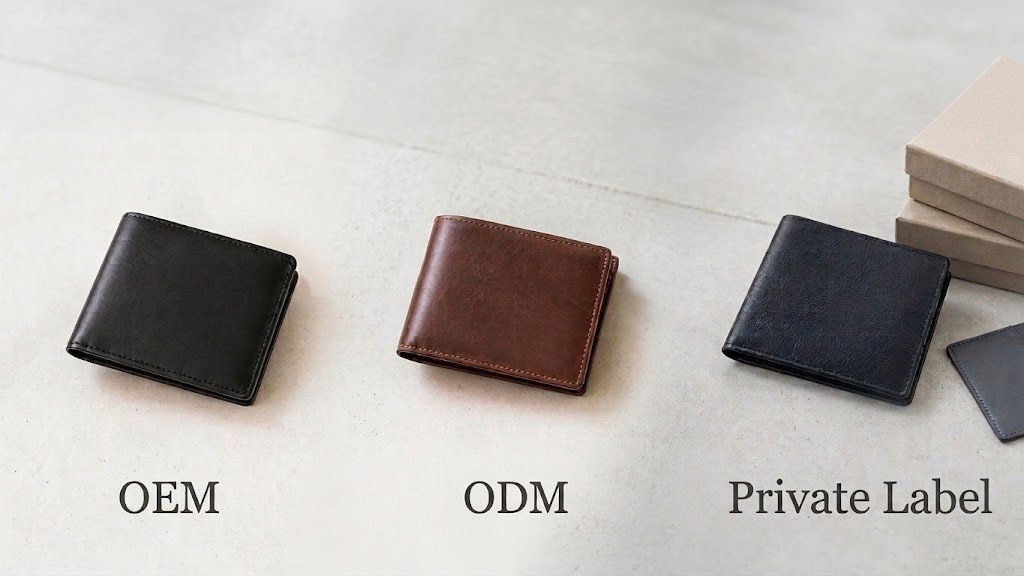
| Model | Best For |
|---|---|
| OEM | Buyers with their own design or specification |
| ODM | Buyers needing product development support |
| Private Label | Brands using existing or developed styles with their own branding |
On branding, confirm the factory can deliver the methods you need — debossing, embossing, foil stamping, metal logo, printed logo — and whether custom packaging (gift boxes, dust bags, retail packaging) carries its own minimum. For OEM/ODM development, see our custom wallet manufacturer page; for rebranding, see our private label wallet manufacturer page. Not sure which fits? See our OEM vs ODM guide.
11. Evaluate Quality Control, Capacity & Lead Time
A factory that “has QC” is not enough — ask what that QC actually looks like, and whether it is specific to wallets. A complete wallet QC system should cover at least five stages:
Stage 1 — Incoming Material Inspection → Stage 2 — Cutting Inspection → Stage 3 — In-Process Inspection → Stage 4 — Assembly Inspection → Stage 5 — Final Inspection
At the in-process and final stages, the inspection should check wallet-specific points, not generic leather goods points:
| Wallet QC Checkpoint | What Inspection Verifies |
|---|---|
| Card slot | Spacing, depth, and card fit |
| Fold | Clean crease, no cracking, lies flat |
| Thickness | Skiving consistency at edges and seams |
| Stitching | Stitch count, tension, and alignment |
| Logo | Position, depth, and finish alignment |
| Edge | Paint and edge consistency, no peeling |
| Lining fit, no puckering |
Also confirm production capacity and lead time. Actual lead time depends on order quantity, material availability, customization requirements, and production scheduling — a manufacturer that gives you one fixed number without asking about your order is guessing.
12. 8 Red Flags When Choosing a Leather Wallet Manufacturer
- Only shows catalog photos.A factory that can’t show real production evidence or send a physical sample is unproven.
- Quotes without understanding your specifications.An instant price with no clarifying questions means they didn’t read your brief.
- Cannot explain leather grade or thickness.If they can’t discuss the material, they can’t control it.
- No physical sample before bulk production.Pushing straight to bulk is a shortcut that usually ends in rework.
- MOQ calculation is unclear.If “per style / per color / per SKU” isn’t explained, the quote is not reliable.
- No documented wallet-specific QC process.“We check quality” without checkpoints for card slot, fold, stitching, or edge is not a QC system.
- Cannot explain how bulk production follows the approved sample.This is the most important answer to hear — and the most telling when it’s missing.
- Price is significantly lower without a clear reason.A price too good to explain usually hides a cheaper material or a skipped process.
13. 15 Questions, Checklist & Manufacturer Scorecard
Ask these before choosing a manufacturer:
- How long have you manufactured leather wallets?
- Do you specialize in wallets and small leather goods?
- What leather grades can you provide?
- What leather thicknesses are available?
- Can you develop products from drawings or reference samples?
- What is your MOQ per style?
- What is your MOQ per color?
- What is the sample lead time?
- How many sample revisions are possible?
- How is the approved sample used during production?
- What wallet-specific QC inspections do you perform?
- Can you provide custom logo finishing?
- Can you provide custom packaging?
- What is your bulk production lead time?
- How do you maintain consistency for repeat orders?
Final selection checklist:
- ☐ Relevant wallet manufacturing experience
- ☐ Similar product portfolio
- ☐ Leather sourcing capability
- ☐ Leather thickness specification
- ☐ Pattern development capability
- ☐ Physical sampling
- ☐ Sample revision process
- ☐ Approved sample control
- ☐ MOQ per style
- ☐ MOQ per color
- ☐ Transparent quotation
- ☐ OEM / ODM capability
- ☐ Private label capability
- ☐ Logo customization
- ☐ Packaging customization
- ☐ Incoming material QC
- ☐ Wallet-specific in-process QC
- ☐ Final QC
- ☐ Production capacity
- ☐ Realistic lead time
- ☐ Export experience
- ☐ Repeat-order consistency
Manufacturer Scorecard — score each factory 1–5 on the criteria below, then compare totals. Weight the criteria to match your own priorities.
| Criterion | Factory A | Factory B |
|---|---|---|
| Wallet experience | /5 | /5 |
| Leather & material knowledge | /5 | /5 |
| Sample quality | /5 | /5 |
| Construction & craftsmanship | /5 | /5 |
| Sample-to-bulk control | /5 | /5 |
| MOQ fit | /5 | /5 |
| Quote transparency | /5 | /5 |
| QC system | /5 | /5 |
| Capacity & lead time | /5 | /5 |
| Communication | /5 | /5 |
| Total | /50 | /50 |
Prioritize the criteria that matter most to your project — for a first-time brand, sample-to-bulk control and communication often matter more than a small price difference.
Why Work With Solton Leather?
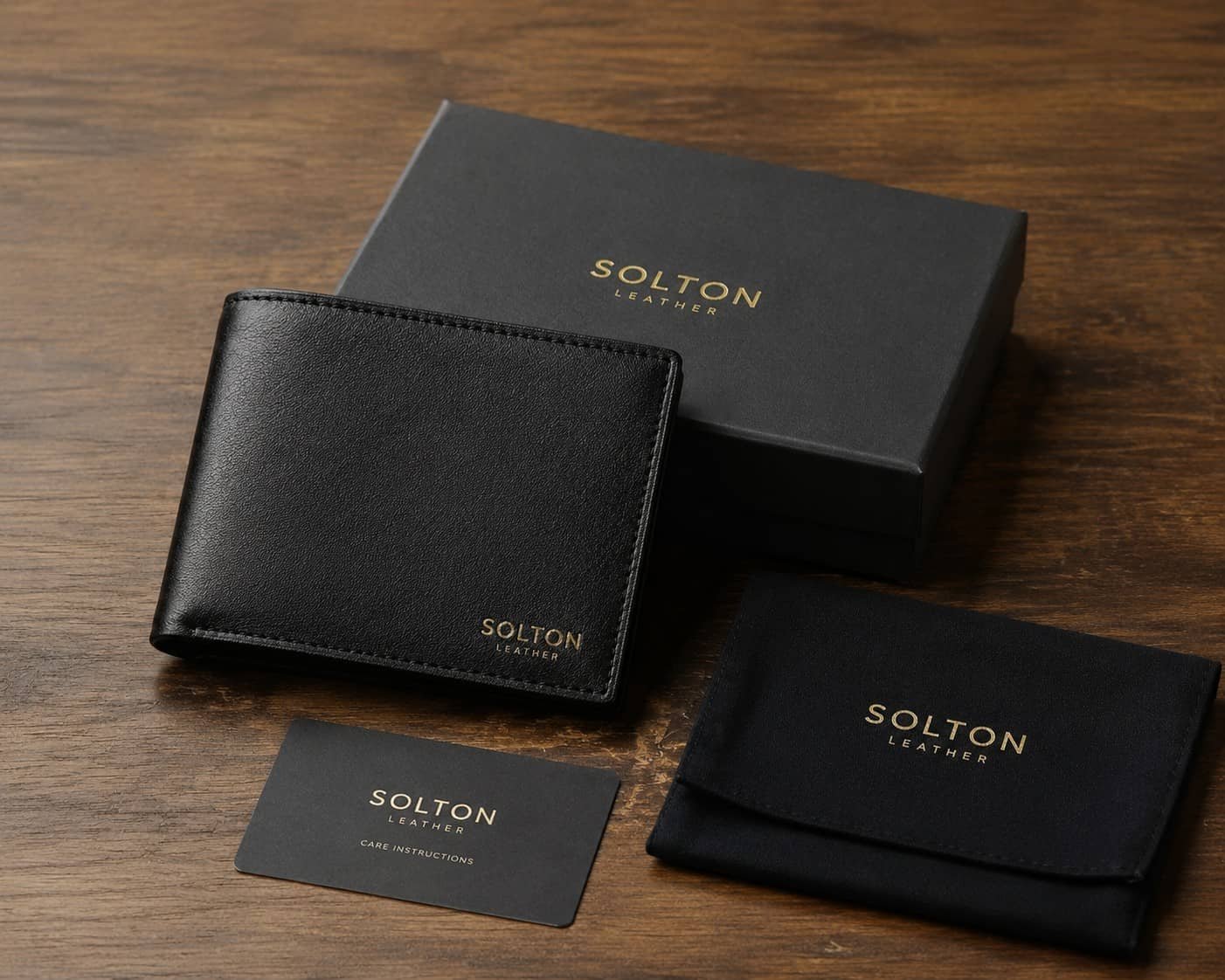
Solton Leather is a Guangzhou-based manufacturer with 12+ years of OEM/ODM experience and a 2,000+ m² in-house factory. Our standard MOQ is 100 pcs per style per color, we produce samples in-house, and we run cutting, skiving, stitching, and finishing under one roof with a wallet-specific QC process. Browse our wallet & card holder collection, or tell us your requirements for a line-item quote.
Frequently Asked Questions
Q1. How do I find a reliable leather wallet manufacturer?
Start with wallet-specific experience, not a generic factory directory. Request a wallet and cardholder portfolio, ask for a physical sample, and verify how they control bulk production against the approved sample. Relevant experience and a documented wallet-specific QC process matter more than a low quote.
Q2. What should I ask a leather wallet manufacturer before placing an order?
Ask about wallet experience, leather grades and thicknesses, MOQ per style and per color, sample lead time and revision policy, how the approved sample is used in production, wallet-specific QC checkpoints, logo and packaging capability, bulk lead time, and how they maintain consistency on repeat orders.
Q3. How do I compare leather wallet manufacturers?
Compare by specification, not by unit price. Normalize leather grade, thickness, lining, logo method, packaging, MOQ, and whether tooling and sampling are included, then score each factory on the same criteria. Two factories quoting different prices are often quoting different products.
Q4. What is the difference between OEM and private label wallet manufacturing?
OEM means the buyer provides the design or specification and the factory manufactures to it. Private label means the factory produces an existing or lightly adjusted style and adds the buyer’s logo, packaging, and branding. ODM sits in between, with the factory providing product development support.
Q5. How important is a physical sample before bulk production?
Essential. A physical sample is the only way to verify leather, construction, and finish against your specification. Never approve a bulk order based on catalog photos or a digital rendering alone — always approve a physical sample in writing before production begins.
Q6. How can I make sure bulk wallets match the approved sample?
Ask the manufacturer how they control bulk production against the approved sample. They should keep a sealed control sample as the production reference, run wallet-specific in-process checks for shade, card slots, stitching, and edges, and offer a pre-shipment sample or AQL report. Consistency over repeat orders is the real test of a manufacturer.
Conclusion
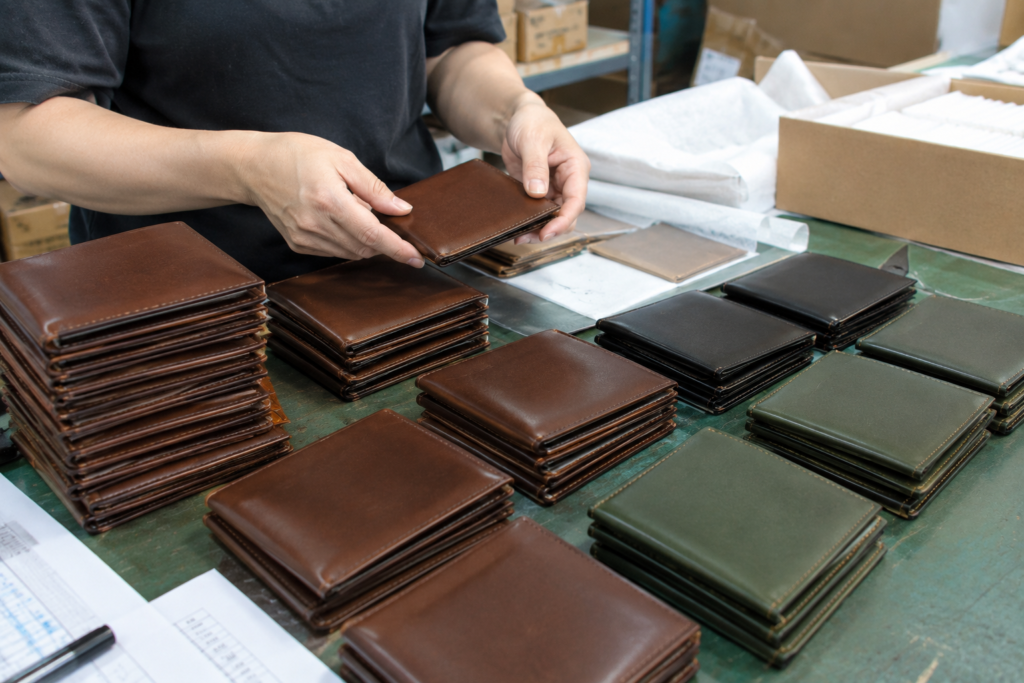
Choosing a leather wallet manufacturer is less about finding the lowest price and more about verifying that a factory can deliver your exact specification — consistently, at scale. The decision path is simple: define your requirements, check wallet-specific experience and leather knowledge, approve a physical sample, verify sample-to-bulk consistency, and confirm MOQ, QC, and lead time. Treat the approved sample as your quality contract, and the factory’s ability to reproduce it as the deciding factor.
Looking for a leather wallet manufacturer? If you are developing a custom leather wallet, cardholder, or private-label collection, send us your design, reference sample, or product requirements. Our team can help review material options, construction, sampling requirements, MOQ, branding, and production specifications. → Request a Custom Wallet Quote