A leather watch travel case that looks right in a photo can fail in the hand. A cushion a few millimetres too wide lets a steel bracelet slide against the divider. A lid that closes with faint resistance presses on the crystal every time the case goes into a bag. A snap that held on the bench releases on the first flight.
None of this appears in a product shot or in a quotation. Two suppliers can quote the same unit price for cases that behave nothing alike a year later.
The three things that decide whether a case protects a watch — cushion profile, compartment clearance and lid clearance — all sit inside, where photography never reaches. This checklist covers seven things to verify before ordering from any leather watch travel case supplier, each with a pass condition rather than a vague description, plus a scorecard for comparing suppliers.
Table of Contents
Does the Manufacturer Specialise in Leather Watch Travel Cases?
A watch travel case is not a small bag with a cushion inside. A wallet only has to fold; a case has to stop a 150-gram steel watch from moving at all, through airport handling and a car boot, without the watch touching anything harder than suede.
Related formats are not interchangeable. A pouch is soft-sided and protects by padding. A travel case has a rigid shell, a fitted cushion and calculated clearances. A supplier who builds pouches well is not automatically equipped to build a multi-watch case, even when both are quoted from the same price list.
Ask three questions. How many capacities does the factory actually produce — single, two, three, six? Does each capacity have its own pattern set, or is the six-watch case a three-watch case with more dividers dropped in? And can it issue an interior drawing before a sample is cut?
The second question separates factories from assemblers. Scaling a three-watch pattern up produces compartments that are proportionally too narrow at the ends and a lid that sits too high in the middle, because the shell spans a longer distance and the reinforcement has not changed.
Our single, two, three and six-watch travel cases are developed as separate formats for exactly this reason, alongside a wider leather goods collection.
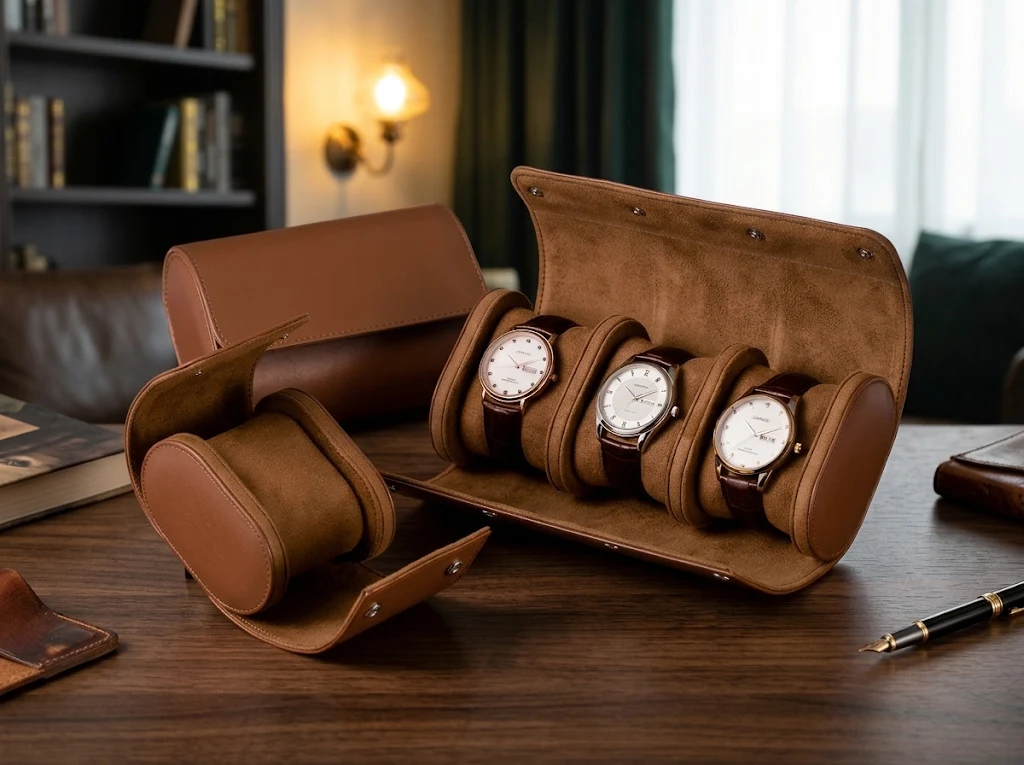
Four formats, four pattern sets. Capacity is a structural decision, not a divider count.
Red flag: “we can make anything” without asking for your watch dimensions.
Can It Prove Cushion Fit and Interior Construction?
Cushion shape is not a diameter
Most buyers specify a cushion by diameter. Diameter alone tells you almost nothing: two oval cushions of the same width hold a 38 mm dress watch and a 44 mm diver completely differently, because what decides fit is the perimeter and how the foam compresses under a clasp.
The number worth asking for is the uncompressed outer perimeter of the oval. We work from two reference sizes, 19 cm and 21 cm, then adjust length, width and thickness in proportion to the watches inside. Both describe the cushion itself — neither is the closed circumference of a bracelet. Confusing the two is the most common reason a case fits nothing properly, because the cushion compresses and the bracelet does not.
Then ask whether the factory can issue an interior drawing from your references before any leather is cut. Our own cushion and interior construction page documents the ranges we build to.
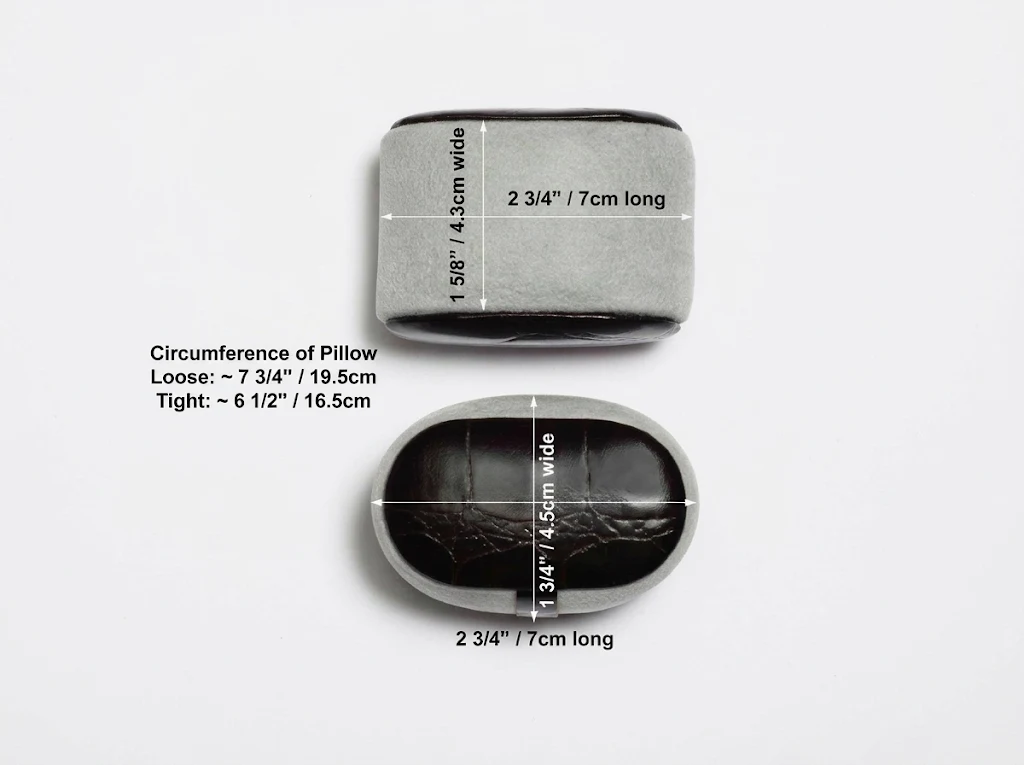
Measuring the cushion, not the bracelet. Perimeter is the dimension that governs fit.
Five numbers the factory must ask for
- Case diameter
- Lug-to-lug length
- Strap or bracelet width at the lugs
- Closed bracelet circumference
- Clasp type and thickness
Lug-to-lug is the one buyers leave out most often. A 40 mm watch with a 48 mm span sits very differently from a 40 mm watch with a 44 mm span, though both read “40 mm” on a spec sheet.
If the factory does not ask for all five, it is guessing. A guess survives sampling, because one watch and one operator can compensate. It fails at bulk.
Two clearances
Compartment clearance is the space between the watch and the compartment wall. It has to account for the crown side, where a watch is widest and where most buyers forget to measure.
Lid clearance is the vertical gap above the watch. A case can look right from outside and still press on a crystal or clasp when closed — on a domed crystal the highest point is the middle, and a flat lid lining reaches it first. A deployant clasp adds height under the bracelet, and that height has to come out of the same clearance.
Both are confirmed on a fitting sample, not agreed in correspondence. A factory that offers to finalise them before a sample exists is either overconfident or planning to change the pattern later.
Red flag: the watch shifts when the closed case is shaken gently, or the lid needs a push to shut.
| Case diameter | Cushion perimeter |
|---|---|
| 36–42 mm | 19 cm |
| 42–45 mm | 21 cm |
Starting point only. Sizes near the boundary are settled on a fitting sample with your own watches.
Does It Know Which Leather and Lining to Specify?
Material names are not specifications. “Full-grain” covers hides from 0.8 mm to 2.0 mm with very different temper, and only one of them holds a travel case’s shape after a year. A hide that is too soft lets the lid bow; one that is too stiff cracks at the hinge fold.
A factory that knows materials recommends from your positioning instead of reading options back:
| Positioning | Leather | Lining | Cushion |
|---|---|---|---|
| Premium / boutique | Full-grain, 1.2–1.4 mm, firm temper | Suede | PU foam, firmer grade |
| Mid-market retail | Top-grain or corrected grain, 1.0–1.2 mm | Microfiber | PU foam, medium |
| Promotional / gift-with-purchase | PU or split leather | Soft fabric | PU foam, softer |
Four things to compare on swatches: thickness, temper, abrasion, and colour consistency across the lot. Leather takes dye with more variation than PU, so an approved lab dip matters more on a genuine leather order. PU is more consistent lot to lot but yellows at fold lines after a couple of years in a window display — worth knowing before it goes in a premium slot.
Both sides of the specification are documented on our leather and lining options page.
A hide and a PU sample with the same name can differ by a factor of two on thickness and temper.
Red flag: a quotation with no physical swatches attached.
Is the Workmanship at Retail Standard?
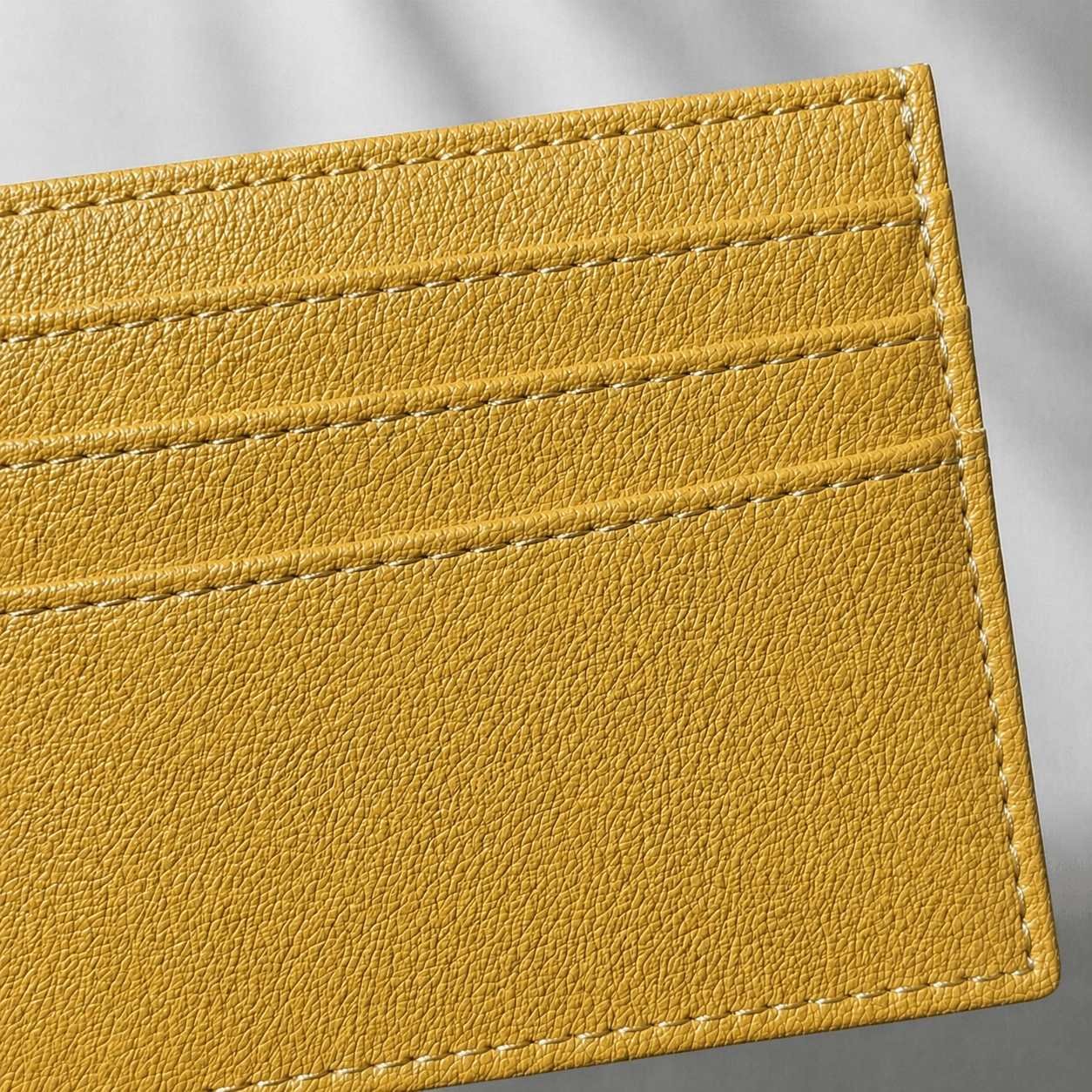
Workmanship is judged in three places a product photo never reaches: the stitch line at a corner, the edge paint on a curve, and the lining where it meets the base.
| Element | What to look for |
|---|---|
| Stitching | Even stitch length against the approved sample, no skipped stitches or puckering at corners |
| Edge finishing | Continuous paint around the curve, no bubbles, no bleed onto the face |
| Closure | Snap aligns without force, opens one-handed, stays closed in a bag |
| Lining assembly | No wrinkles or lift, corners flat against the shell |
| Shape retention | Stands square when empty, edges do not collapse or curl |
A corner is where four things happen at once: leather skived thin, lining turned, stitch direction changed, edge painted on a radius. Each can be done well on a straight run and badly at 90 degrees. Ask for one corner close-up — there is no faster way to separate a workshop from a trading desk.
If the style uses a zipper, add two checks: whether the pull runs smoothly around both corners, and whether both ends are anchored so the tape cannot pull away.
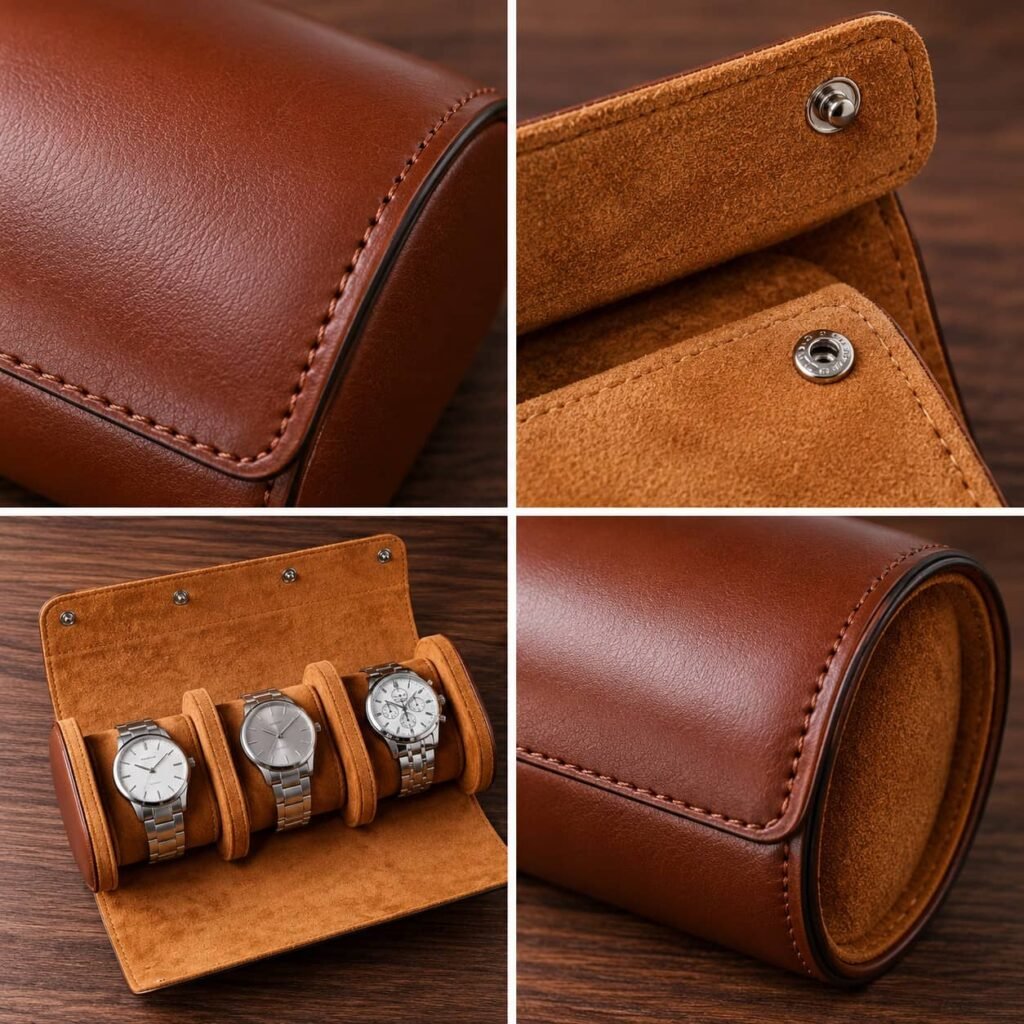
One corner shows stitch length, edge paint continuity, and whether the lining sits flat at the turn.
Red flag: only white-background product shots, with corners described as “hard to photograph”.
Can It Turn a Tech Pack Into a Production Sample?
Sampling capability is not whether a factory can make one good sample. It is whether the third sample in a row matches the first.
Factories take three kinds of input. A tech pack has to be translated into a pattern set, with anything unbuildable flagged before cutting. A reference case has to be reverse-engineered from the inside, not copied from the outside. A photo requires the factory to say what is not visible in the image.
A workable sequence has four steps: a white sample for pattern and clearance, a colour sample for leather and lining, a fitting sample with your watches inside, and a signed confirmation sample kept on file as the bulk standard. The white sample is the step buyers ask to skip and the one that saves the most time — pattern errors found in fabric cost a week, the same errors found in finished leather cost a full re-cut.
Before approving a sample, check:
- Cushion fit and firmness with the actual watch
- Compartment clearance on the crown side
- Lid closes without resistance
- Stitching and edge finish at both corners
- Lining alignment where it meets the base
- Overall shape when the case is empty
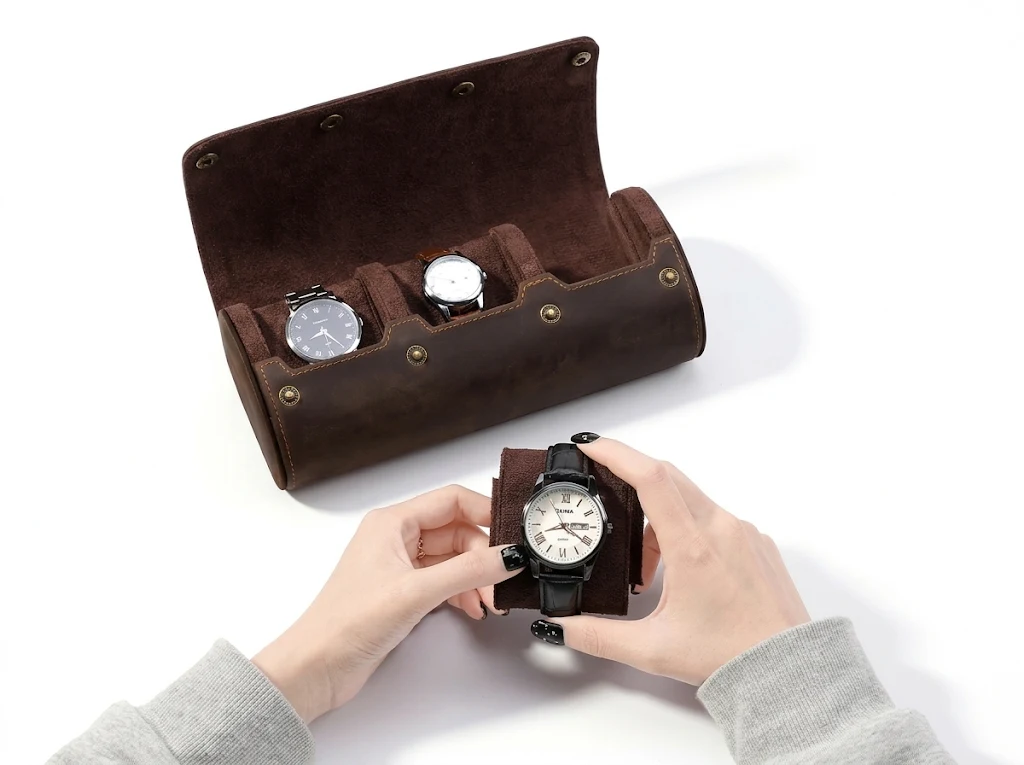
A fitting sample means the real watch, not a plastic mock-up. This is where clearance problems surface.
Red flag: the timeline cannot be given in days, or the white sample is skipped.
Does It Run Real Quality Control?
A watch case has to be inspected as a fitted product, not as a leather good. A case with flawless stitching still fails if the cushion sits off centre and the watch rocks inside. Most failures here are fit failures wearing a cosmetic disguise.
- Leather surface — grain and colour matched panel to panel under consistent light
- Stitching and edge — measured against the approved sample, paint continuous around every curve
- Closure — every snap opened and closed repeatedly for pull force and alignment
- Cushion fit — tested with a watch fitted, not measured on a bench
- Packing — dust bag, box and print checked against the approved artwork
Buyers commonly specify AQL 2.5 on major defects with 100% snap and fit checks. Agree the plan in writing rather than accepting a default — inspection levels are where expectations quietly diverge. Third-party inspection can be arranged when an independent report is needed.
Compared against a sample, not against a memory. Fit is checked with a watch in place.
Red flag: no written checklist, and “we check every piece” with no records.
Is the MOQ, Lead Time and Communication Workable?
MOQ is not one number. It moves with the leather, the colour, and whether a new die has to be cut.
Three tiers explain most of it. Stock leather in a stock colour carries the lowest minimum. A custom colour adds a minimum dye lot, which sets a floor regardless of order size. A new structure or die adds pattern development and tooling, spread across a run of a certain size. Ask which tier you are in and what would move you down one.
Lead time should always be quoted as a range with a starting condition. Sample development typically runs 10–14 days from approved artwork, excluding courier transit. Bulk production typically runs 30–40 days from material arrival and approved sample. August to November fills quickly, so book early if your launch date is fixed.
Four things to check on communication: can specifications be confirmed before cutting; are approved samples kept on file; can a repeat order skip development; and does a design change trigger re-issued drawings instead of a floor adjustment.
Brands that need their own mark on product, packaging and paperwork usually start from private label watch case development.
Red flag: a quote that omits sampling and tooling fees, or a lead time of “about a month”.
Manufacturer Evaluation Scorecard
Seven criteria, each scored 1 to 5 and multiplied by its weight. Once two suppliers differ by 0.5 or more, the lower one rarely wins the gap back on price.
| Criteria | Weight | What a 5 looks like |
|---|---|---|
| Product specialisation | 15% | Separate pattern set per capacity; interior drawings on request |
| Cushion and interior fit | 20% | Asks for case diameter, lug-to-lug and clasp type before quoting |
| Material knowledge | 10% | Sends physical swatches and states thickness and temper unprompted |
| Workmanship | 15% | Shares corner and edge close-ups without being asked |
| Sampling capability | 15% | Runs white sample — colour sample — fitting sample as standard |
| Quality control | 15% | Written checklist, agreed AQL plan, offers third-party inspection |
| MOQ and lead time | 10% | Explains what changes the MOQ instead of quoting one number |
One worked example. Supplier A scores 4.2, Supplier B 3.1; the gap sits almost entirely in cushion fit and sampling — B never asked for watch dimensions and treats sampling as a single step.
Now price. A quotes 18% more. On 500 pieces that is real money, and it is where most buyers stop. But if B’s cushion is a guess, one interior re-cut — new pattern, cushions, dividers, second freight — consumes the difference, and the delivery date has already moved.
Weights are a starting point. If your range is built around multi-watch formats, raise cushion fit to 25% and take five points from material knowledge.
Conclusion
The cheapest quote is rarely the lowest total cost. One re-made batch or one retailer complaint about a case that presses on a crystal pays for the difference several times over.
The seven checks reduce to a short list: a factory that specialises, a cushion confirmed on a real watch, materials recommended rather than listed, finishing that survives a corner close-up, sampling that repeats, and inspection that produces records.
For a custom leather watch travel case manufacturer programme, send the watch references you need to fit, the capacity you are planning, and your target retail price. We will reply with a cushion recommendation, an interior drawing and a sample plan.
Frequently Asked Questions
How long does a watch case sample take?
Typically 10–14 days from approved artwork, excluding courier transit. Complex multi-watch structures with new tooling can take longer, and the estimate is confirmed before the sample starts rather than after.
What information do I need to send for a quotation?
Five things: the watch references you need to fit (case diameter, lug-to-lug length, strap width, clasp type), the capacity and format, your target quantity, any logo or artwork files, and your target retail price and packaging requirements. With those, a factory can quote a cushion recommendation rather than a single unqualified number.
Can you match a Pantone colour on leather?
Yes, with lab dips approved before bulk. Leather takes dye differently from paper or plastic, so a Pantone reference is matched as closely as the hide allows, and the approved dip — not the Pantone number — becomes the production standard.
Can you meet REACH or Prop 65 requirements?
Testing is arranged according to the requirements of your target market, with reports issued by a third-party laboratory — REACH restricted substances for the EU, Prop 65 for California. Material declarations and the testing scope are agreed at sampling stage, so the report covers the materials actually used in your order.