Introduction: The Silent Killer of Leather Goods Brands
Table of Contents
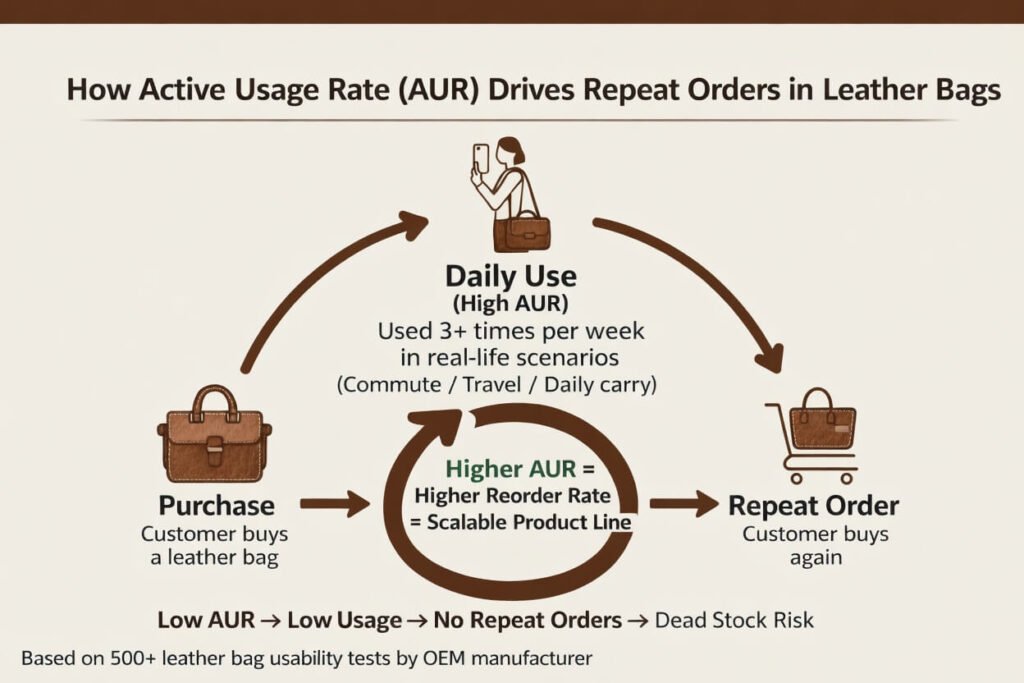
In the competitive world of leather goods, brands and wholesalers often focus on a single metric: initial sales volume. However, the real factor determining long-term success is the Active Usage Rate (AUR).
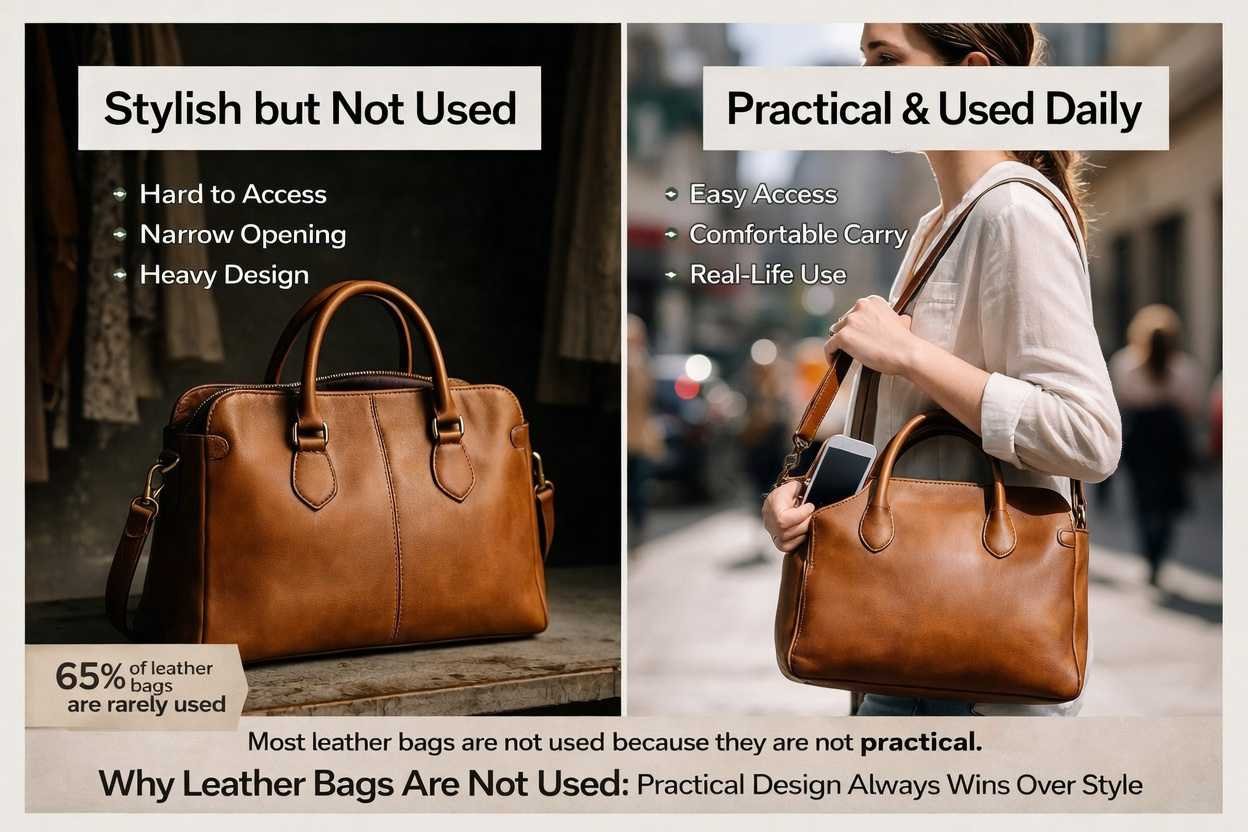
A large number of premium products are purchased but end up forgotten in closets. For B2B buyers, understanding why leather bags are not used in real daily scenarios is critical. When a product fails to integrate into a customer’s lifestyle, it creates a chain reaction of business risks: slow-moving inventory, low customer satisfaction, and a total collapse of repeat orders.
From a manufacturing perspective, this is not just a consumer habit—it is a product usability issue in design and production decisions. In this guide, we will analyze the technical reasons why leather bags are not used ,and how you can use the methods that have been verified in the factory to ensure your next collection becomes a “daily used” for your customers.
1. Defining the Metric: What is Active Usage Rate (AUR)?
Most customers won’t return a bag just because it’s “slightly heavy” or “hard to open”—they simply stop using it.
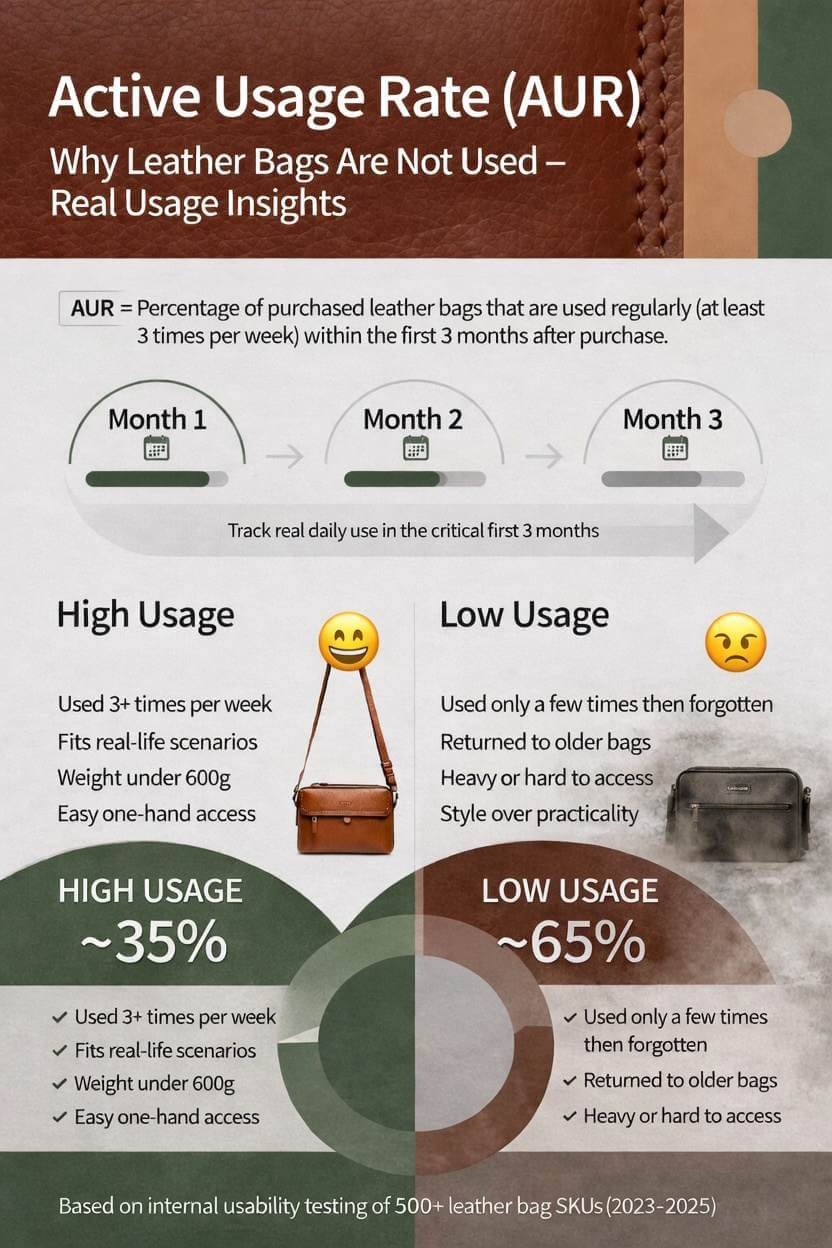
AUR Definition: The percentage of customers who use a bag at least 3 times per week within the first 90 days of purchase.
The B2B Impact: Low AUR is the leading cause of slow-moving inventory and weak customer lifetime value (LTV).
Comparison: High Usage vs. Low Usage Designs
| Feature | High-Usage (The “Daily Driver”) | Low-Usage (The “Closet Resident”) |
| Weight | Under 600g (unfilled) | Over 800g (fatiguing for daily carry) |
| Accessibility | One-handed magnetic/quick-zip | Complex buckles or stiff flaps |
| Strap Ergonomics | 1.5cm+ width with padding | Thin, “cutting” straps or rigid chains |
| Versatility | Seamless transition: Office to Casual | Too formal or overly avant-garde |
2. Top 4 Reasons Why Leather Bags Fail Usability Tests
Based on our factory’s usability testing of over 500 SKUs, we’ve identified the primary “friction points” that lead to consumer abandonment.
A. The Weight-to-Utility Ratio
Our internal test data from 2023 to 2025 shows that the daily usage frequency of packages exceeding 600g will drop by 68%.Overweight reinforcement materials may make the package look “strong” on the shelf, but it has become a burden in real life.
Expert Solution: Source lightweight full-grain leathers and optimizing internal support materials. For certain functional collections, we should consider the choice of Genuine leather vs Lightweight micro-fiber for B2B bags. Although genuine leather is more classy, advanced micro-fiber can greatly reduce the weight of high-usage travel collections while maintaining the premium aesthetic.
B. “Access Friction” in Design
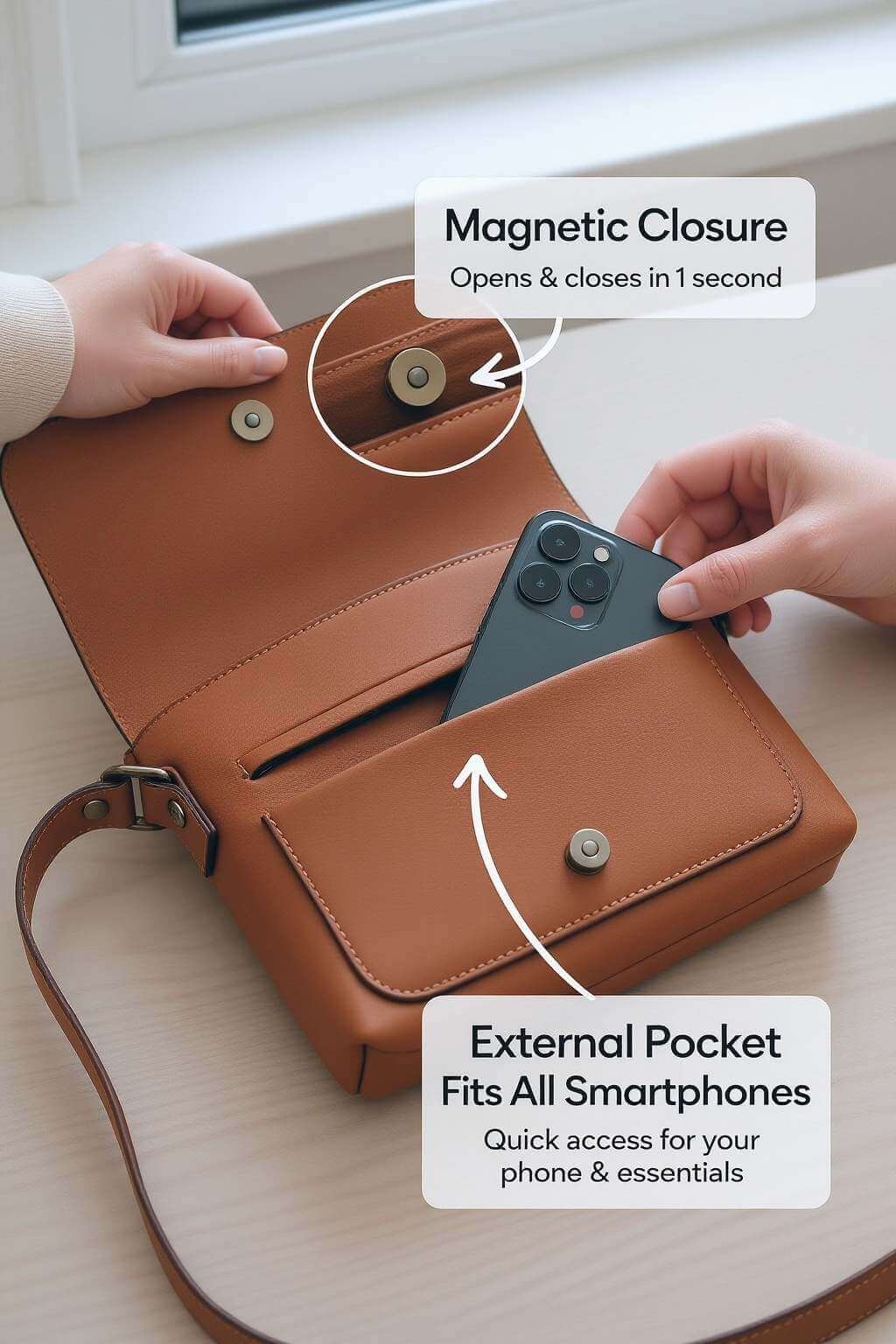
If a user takes more than 3 seconds to reach their phone or keys, the bag is functionally flawed.
Common Failures: Overly narrow gussets, stiff zippers, or no external pockets.
Expert Solution: Incorporate hidden magnetic closures and dedicated quick-access back pockets.
C. Poor Strap Ergonomics
The strap is the primary touch point between the product and the user.
The Issue: Thin straps (under 1cm) look elegant but cause shoulder pain during a 30-minute commute.
Expert Solution: Maintain a minimum width of 1.5cm to 2cm for crossbody styles and ensure hardware allows for smooth length adjustment.
D. Over-Engineering the Interior
B2B buyers often think that the more pockets, the more valuable they are. In fact, too many small pockets will make the bag unable to hold big things, such as camera or large water bottle.
3. The "B2B Risk Checklist": Professional B2B Sourcing Criteria
For professional inventory managers and brand owners, usability metrics should not be an afterthought—they should be integrated into your formal B2B sourcing criteria. By evaluating every SKU against these functional benchmarks before mass production, you can significantly mitigate the risk of slow-moving stock and dead inventory.
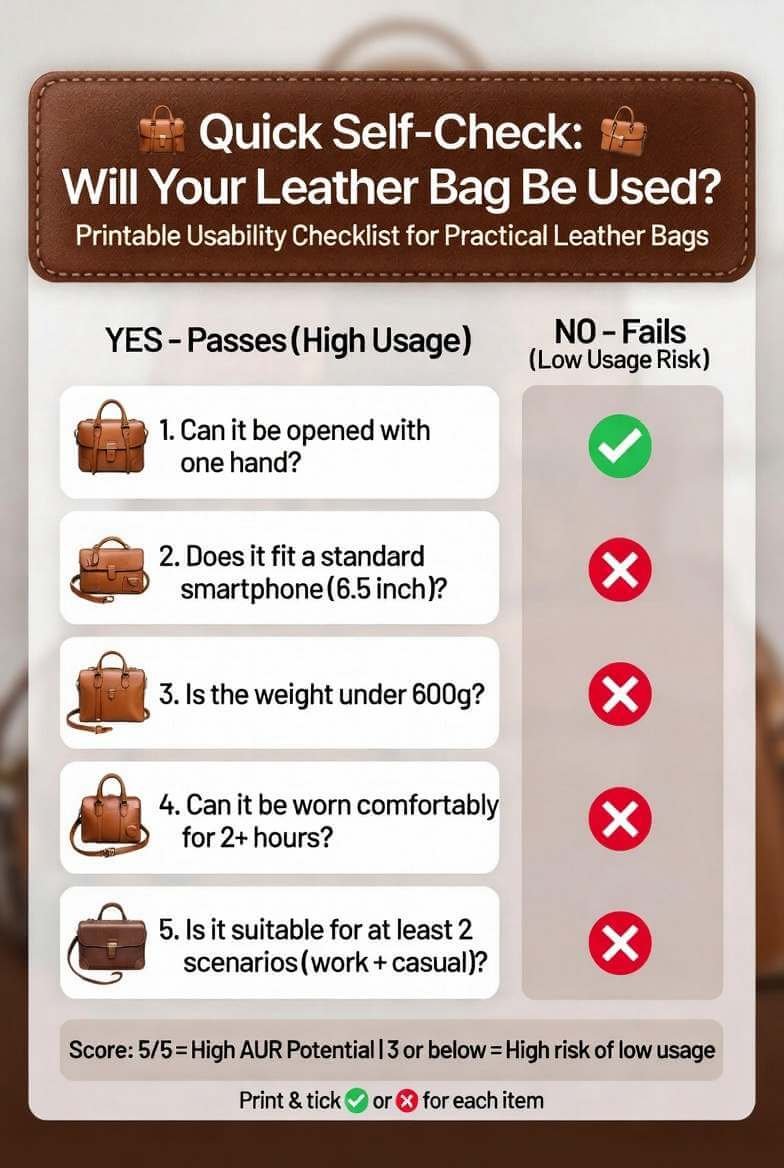
Will Your Next Collection Sell? Use this 5-point usability check:
One-Hand Operation: Can the main compartment be opened while holding a coffee or a phone?
Tech Compatibility: Does the internal pocket fit a 6.7-inch smartphone (e.g., iPhone Pro Max) with a protective case?
Scenario Versatility: Can this bag be used in at least two scenarios (e.g., Work + Casual)?
Static Weight: Is the empty weight under 600g to ensure long-term comfort?
Strap Ergonomics: Is the strap width at least 1.5cm to prevent shoulder fatigue?
Pro Tip: If your prototype fails 2 or more of these points, it is a high-risk product. Updating your B2B sourcing criteria to include these rules is the most effective way to protect your ROI in 2026.
4. The Core of High-Usage: Functional Leather Bag Design
In 2026, focusing on aesthetics alone won’t be enough to sustain a brand. In today’s B2B market , success depends on functional leather bag design—a strategy that balances high-end fashion with the practical needs of modern commuters. This approach goes beyond surface-level beauty to solve the “hidden usage problem” with throughful, intuitive engineering.
To turn low-usage products into high-usage winners, we focus on three pillars of functionality:
Scenario-Based Engineering: We design for multi-scenario transitions (e.g., a bag that fits a 13-inch laptop for work but remains stylish for an evening dinner).
Access Optimization: Implementing “no-look” features like magnetic closures and exterior phone slots to reduce daily friction.
Ergonomic Integration: Ensuring every strap and handle is tested for weight distribution to prevent shoulder fatigue.
5. Case Study: Turning a "Style Failure" into a Best-Seller
A European client launched a structured minimalist small crossbody bag. Initial sales were high, but reorders plummeted by 35% in the third quarter.
The Diagnosis: The opening was too rigid, making it difficult to insert a 6.9 inch phone despite the bag being large enough and the zipper will be damaged.
The Factory Fix: We adjust the top flp with a softer “V-fold” and used a magnetic button.The way of the zipper head was also adjusted, making the zipper more durable when in use.
The Result: Reorder volume recovered by 100% within one season as word-of-mouth improved.
6. Why Your Manufacturer Choice Dictates Your Inventory Risk
A professional manufacturer is your first line of defense against low-usage products. In 2026, a “good” supplier should provide more than just stitching; they should offer:
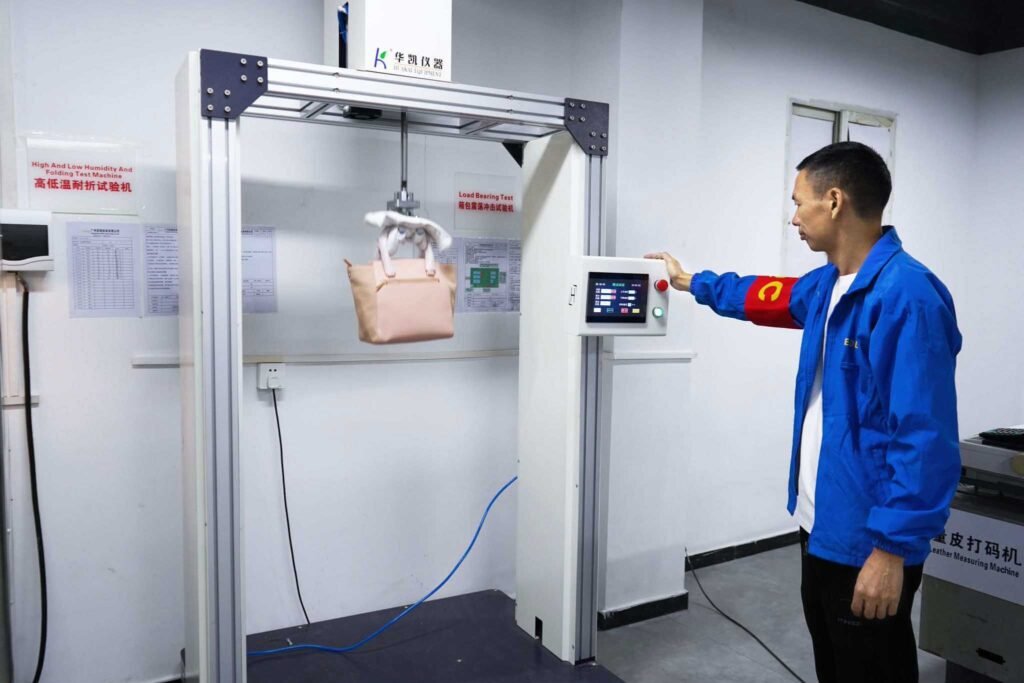
Simulated Usage Testing: Real-world stress tests on straps and hardware.
Material Science: Knowledge of leather densities to reduce weight without sacrificing luxury feel.
Market Insight: Feedback on which silhouettes are currently seeing high repeat purchase rates in your target region.
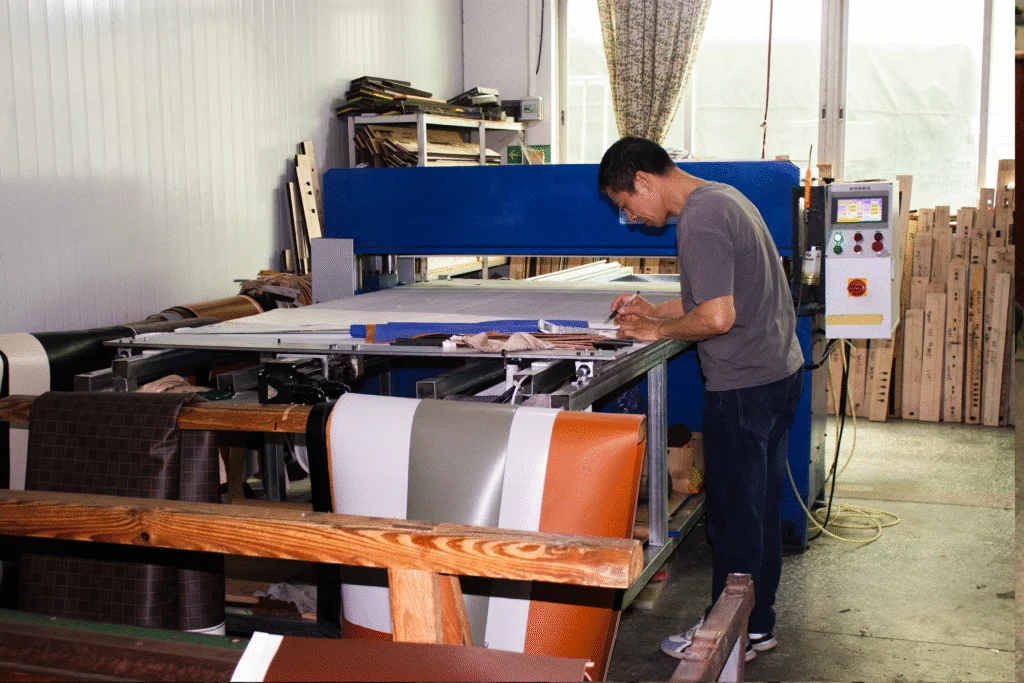
- Real-world prototyping: Our factory conducts rigorous Top-grain leather bag durability tests, including strap tension trials and hardware salt-spray tests, ensuring that practical designs don’t just look good but last for years of daily use.
Conclusion: Focus on Function to Win in 2026
High sales volume is a vanity metric; Active Usage is a sanity metric. When customers love using your bags every day, they become walking advertisements for your brand, leading to the organic growth every B2B buyer dreams of.
Ready to develop a high-usage collection? Partner with a manufacturer that prioritizes ergonomics as much as aesthetics.
Professional Leather Bag Sourcing
They are not practical for daily use—usually due to weight, access friction, strap comfort, or poor design.
Use professional B2B sourcing criteria: Check if it fits a 6.7-inch smartphone, weighs under 600g, and features one-handed access. We recommend requesting a “usability prototype” to test the strap comfort and weight distribution before committing to a large PO.
It depends on your target scenario. Genuine leather vs Lightweight micro-fiber for B2B bags is a common debate. Top-grain leather offers the luxury feel essential for premium brands, while micro-fiber can be an excellent choice for lightweight, high-utility travel gear. We can provide hybrid solutions to balance prestige and weight.
We perform a rigorous Top-grain leather bag durability test on every new design. This includes 5,000+ cycle zipper tests, 10kg load-bearing strap trials, and hardware salt-spray testing to ensure that reducing weight doesn’t compromise the bag’s lifespan.